
What impact does $4-per-gallon gas have on your wallet and the broader economy

Rising Gas Prices Amid Global Conflict
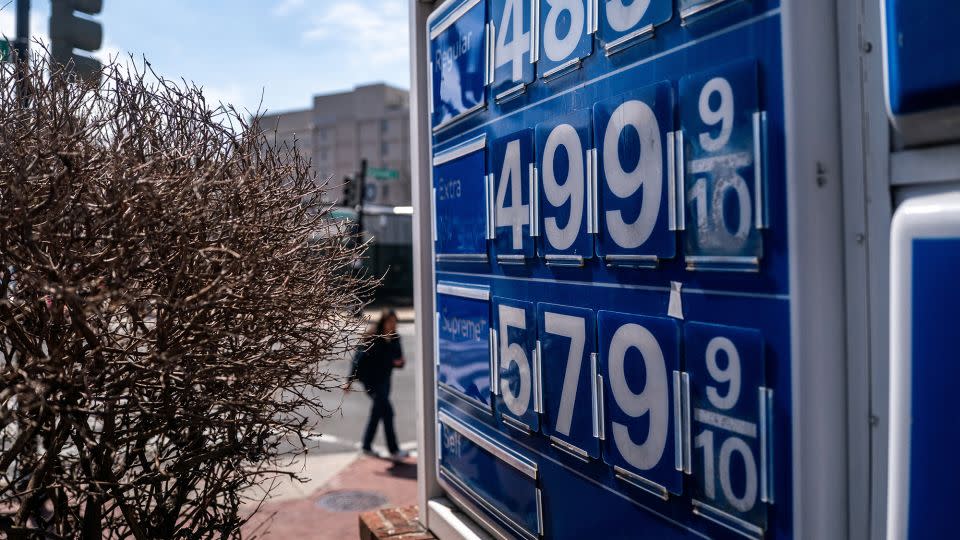
Gas prices displayed at a station on Capitol Hill reflect the ongoing U.S.-Israeli conflict with Iran, as seen in Washington, DC, on March 19, 2026. (Nathan Howard/Reuters)
National Gas Price Trends
The average cost for a gallon of regular gasoline across the United States is approaching $4, marking the highest level since 2022.
Regional differences are significant: In states like California, Washington, and Hawaii, prices exceed $5 per gallon, while areas with lower living costs see prices below $3.50.
No matter where you live, surging gas prices are rarely welcomed by consumers.
Reaching the $4 mark is more than just a number—it has psychological, economic, and practical effects on the nation’s economy.
Diane Swonk, chief economist at KPMG, commented, “This is especially troubling for those least able to absorb the impact.”
Understanding the Numbers
Before examining the broader economic consequences of $4-per-gallon gas, it’s important to break down the calculations.
Joe Brusuelas, chief economist at RSM US, outlined several key factors:
- A $10 rise in oil prices reduces real GDP growth by 0.1 percentage points.
- Inflation increases by 0.2 percentage points for every $10 jump.
- Gas prices at the pump climb by 24 cents.
- Household incomes take a $450 hit annually.
Since the conflict began, oil prices have surged by over $30 per barrel.
Prior to the war, the average price for regular gasoline was $2.98 per gallon.
Impact on Economic Activity
A $30 increase in oil prices translates to a 0.3 percentage point reduction in real GDP growth (which stood at 0.7% at the end of last year). While this may seem minor, Brusuelas notes that the effects accumulate over time.
The U.S. economy, valued at $30 trillion, is robust and adaptable, but even it has vulnerabilities, Brusuelas added.
He warned that trouble could arise if oil prices exceed $125 per barrel, gas rises above $4.25 per gallon, and inflation surpasses 4%. At that point, “demand destruction” becomes a concern—meaning prices get so high that consumers cut back on spending.
Swonk observed that some Americans are already adjusting their habits, reducing travel and limiting purchases.
While decreased demand can lower prices, supply remains restricted due to ongoing disruptions, Brusuelas explained.
Inflationary Pressures
By the end of last week, oil prices were up $30 from pre-war levels, which should have resulted in a 75-cent increase at the pump. However, average gas prices rose by 93 cents, according to Brusuelas.
He noted, “This suggests inflation risks are somewhat elevated.”
According to recent Consumer Price Index data, U.S. prices were rising at an annual rate of 2.4% in February before the conflict began.
Brusuelas predicts that inflation could reach 3.5% in March and potentially exceed 4% in April.
A truck is filled with diesel at a Sacramento gas station on March 19, 2026. (David Paul Morris/Bloomberg/Getty Images)
The estimated 1.1 percentage point jump from February surpasses the typical $10 oil increase = 0.2 percentage point inflation rise, reflecting broader energy price hikes—including diesel and jet fuel—as well as other war-related costs like fertilizer.
These secondary and tertiary effects will continue to impact American households in the coming months, even if the conflict ends soon, Brusuelas said.
He emphasized, “Americans will have to adjust, and the consequences of today’s events will linger through December.”
Economic Landscape and the Federal Reserve
Looking to history can provide context, but today’s economic environment is markedly different from just four years ago.
Swonk recalled, “In 2022, unemployment was dropping rapidly, hundreds of thousands of jobs were being created monthly, yet many Americans believed we were in a recession.”
A recruiter meets with a job seeker at a Jersey City job fair on March 17, 2026. (Michael Nagle/Bloomberg/Getty Images)
Now, job creation has slowed considerably, and the unemployment rate is higher than it was then. Wage growth and labor market opportunities have diminished, and five years of elevated inflation have compounded financial strain for many households. Rising debt levels are becoming increasingly difficult for lower-income Americans to manage.
Swonk remarked, “Prices are already too high for many families.”
There are concerns that the Federal Reserve may face a scenario reminiscent of stagflation—economic slowdown paired with high inflation. However, Swonk noted that interest rate adjustments have limited effectiveness.
She added, “Uncertainty has been extraordinarily high for a long time, acting as a hidden tax on the economy. Unless the conflict in the Middle East ends abruptly, uncertainty will persist. Interest rates alone can’t boost demand for workers.”
Disclaimer: The content of this article solely reflects the author's opinion and does not represent the platform in any capacity. This article is not intended to serve as a reference for making investment decisions.
You may also like
BC-Soybean Futures
BC-Sugar Futures
BC-Merc Table
Trending news
MoreCrypto prices
More





