
Gas prices have increased by 98 cents this March—find out the current rates drivers in your state are facing

Main Highlights
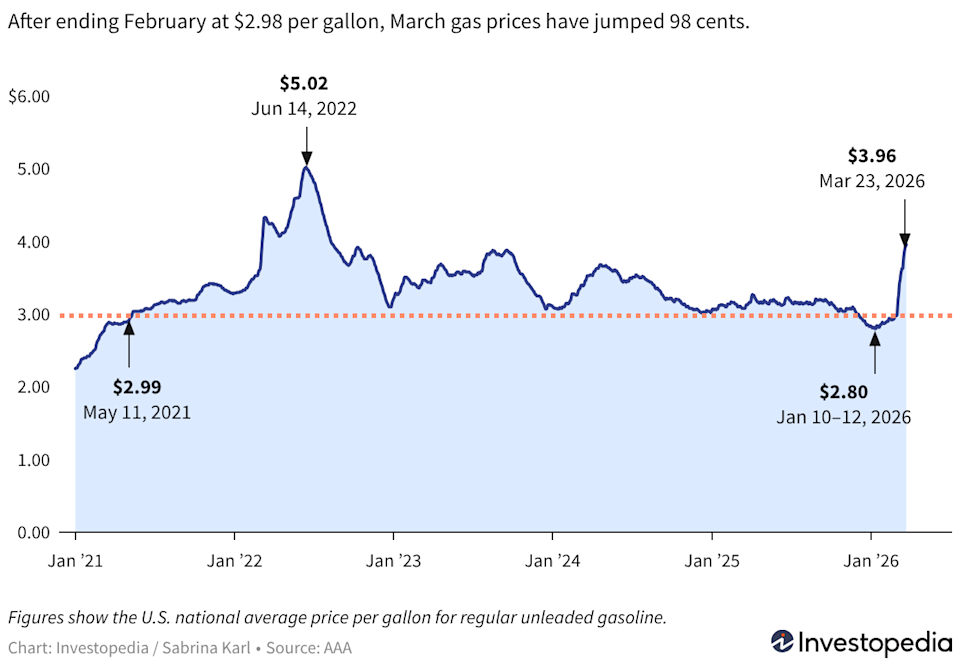
- Escalating oil prices linked to the Iran conflict have driven up gas prices by 96 cents since February 28.
- National gas prices climbed by an additional 2 cents overnight, reaching an average of $3.96 per gallon.
- Hopes for peace negotiations led to a dip in oil prices on Monday, and if talks progress, gas prices may also decline.
Gas Prices Jump Nearly a Dollar in March
The ongoing conflict involving Iran has continued to push oil prices higher, fueling a surge that began in early March. As a result, drivers nationwide are facing higher costs at the pump.
According to AAA, the average price for regular gasoline rose by 2 cents overnight to $3.96 per gallon, marking a 93-cent increase over the past 20 days. Before this spike, the national average had remained under $3 for 13 consecutive weeks—the first such stretch since 2021. Analysts at Pantheon Macroeconomics, referencing last week’s oil prices, predicted that the average could soon reach $4.20 per gallon. However, if the peace discussions promoted by Trump on Monday proceed and yield results, prices may begin to ease.
Why It’s Important
Gasoline is a frequent purchase for most households, so rising prices can quickly put pressure on family budgets. As economist Joe Lavorgna noted on CNBC, “Nothing erodes household liquidity faster than higher gas prices.”
Iran Conflict Drives U.S. Gas Prices Higher
Every State Sees Gas Above $3.25, Three States Top $5
Although gas prices have risen across the country, there are significant differences from state to state.
Oklahoma currently offers the lowest average price at $3.25 per gallon, followed by Kansas, Iowa, and Nebraska. Since March 11, all 50 states have reported average prices above $3 per gallon.
Average Gas Prices by State—March 23, 2026
On the higher end, three states now average over $5 per gallon: California leads at $5.79, with Washington and Hawaii following. Six additional states—Nevada, Oregon, Arizona, Alaska, Illinois, and Idaho—have averages above $4 per gallon.
This results in a $2.54 per gallon difference between the least and most expensive states.
When Gas Last Reached $5
The national average briefly exceeded $5 per gallon in June 2022. In the current surge, three states have crossed that threshold, though most remain in the $3 range.
What Causes State-to-State Differences in Gas Prices?
The variation in gas prices across states is not random, and the recent spike has made these differences even more apparent. Factors such as taxation, production, and distribution all play a role in shaping fuel costs nationwide.
Key Factors Behind Price Differences
- Fuel Taxes: Taxes are a major contributor to price variation. The U.S. Energy Information Administration reports that federal and state taxes made up over 14% of the average per-gallon price in 2023. States with higher gasoline taxes and fees see these costs reflected at the pump.
- Geography and Infrastructure: Proximity to major refineries or pipeline networks can lower transportation costs, while remote areas may face supply challenges that drive prices up.
- Environmental Regulations: Some states, like California, require special cleaner-burning fuel blends that only a few refineries produce, contributing to consistently higher prices.
When oil prices spike, these underlying cost differences can magnify the impact in already expensive states. Even when crude prices fall, these structural factors persist, keeping the gap between states wide.
Disclaimer: The content of this article solely reflects the author's opinion and does not represent the platform in any capacity. This article is not intended to serve as a reference for making investment decisions.
You may also like
SiTime Stuck in Technical Limbo as Conflicting Indicators Leave Investors Uncertain
Japan 10-Year Bond Yield Hits 25-Year High
Gray Media A Stuck in a Technical Limbo Amid Diverging Analyst Opinions
Complii’s $0.025 Convertible Notes Indicate a Bold Move Toward an AI-Led Recovery

Trending news
MoreCrypto prices
More





