
Strategic Storage Trust VI’s $10 Net Asset Value Verified—Is the Market Anticipating a Revision in Guidance?

Strategic Storage Trust VI Maintains $10.00 NAV: Market Implications
Strategic Storage Trust VI has once again set its estimated net asset value (NAV) per share at $10.00, based on figures as of September 30, 2025, with board approval on March 20, 2026. The market’s response centers on whether this figure aligns with or diverges from expectations—a classic scenario for expectation-driven trading.
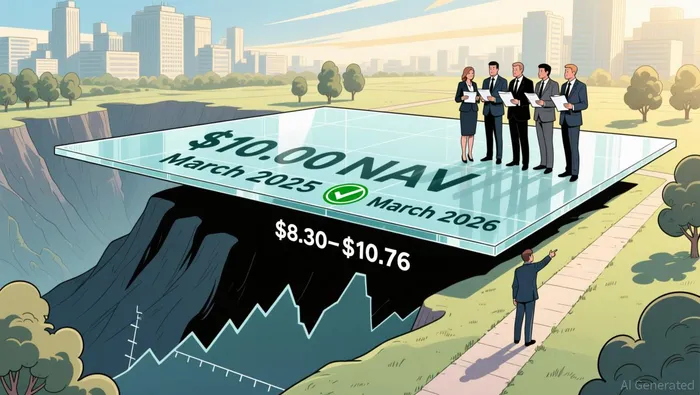
What stands out is the consistency: this $10 NAV matches the board’s decision from the previous year, which relied on data from March 31, 2024. For over twelve months, the valuation has remained unchanged. In the context of a non-listed REIT, where NAV is pivotal for both redemptions and investor confidence, this lack of movement prompts a key question: did investors anticipate a change, or has $10 become the new normal?
The valuation was independently conducted by Robert A. Stanger & Co., Inc., which previously suggested a range between $8.30 and $10.76, with a midpoint at $9.74. The board’s reaffirmed $10 sits slightly above this midpoint. While this could be interpreted as a minor positive surprise compared to the lower end of expectations, in reality, for a security with little price movement, such reaffirmation typically signals a reset in guidance rather than a meaningful beat.
Gap Reversion Long-Only Strategy: Backtest Overview
- Entry Criteria: Buy when the opening price is more than 2% below the previous close and the price recovers at least half of the gap within five trading days.
- Exit Criteria: Sell if the price falls below the 20-day simple moving average, after 10 trading days, or if a 5% gain or 3% loss is reached.
- Asset: SGST
- Risk Controls: 5% take-profit, 3% stop-loss, maximum holding period of 10 days.
Backtest Results
- Total Return: -25.95%
- Annualized Return: -27.45%
- Maximum Drawdown: 34.42%
- Profit-Loss Ratio: 0.67
Trade Statistics
| Total Trades | 24 |
| Winning Trades | 2 |
| Losing Trades | 5 |
| Win Rate | 8.33% |
| Average Hold Days | 0.58 |
| Max Consecutive Losses | 2 |
| Profit-Loss Ratio | 0.67 |
| Average Win Return | 5.55% |
| Average Loss Return | 7.76% |
| Max Single Return | 5.89% |
| Max Single Loss Return | 15.06% |
Ultimately, the market’s reaction will depend on whether this NAV is seen as a positive surprise or simply confirmation of a stagnant trend. With the NAV unchanged for a year, it appears more likely to be a routine update than a catalyst for change. The real question is whether the company’s portfolio growth—reflected in the increase from $226.6 million to $273.2 million in estimated NAV as of September 30, 2025—will eventually drive a higher NAV in future cycles. For now, the $10 benchmark remains intact.
Portfolio Strategy vs. Market Performance
The company attributes its steady NAV to a deliberate move into Canadian markets, which it argues offer stronger fundamentals and more attractive pricing. This strategic shift—moving away from the post-pandemic U.S. surge—is credited for the portfolio’s estimated value climbing from $226.6 million to $273.2 million over the last year. In theory, this should be a positive sign, indicating value creation in a more stable environment.
However, the financials paint a less optimistic picture. Over the past twelve months, the company generated $28.2 million in revenue but reported a net loss of -$35.6 million, resulting in a net margin of -126%. This disconnect is significant: while asset values may be rising, ongoing losses suggest the portfolio is not yet producing strong operating income. Investors must consider whether the Canadian strategy is truly delivering improved cash flow, or if NAV growth is being driven more by market valuations than by underlying business performance.
This issue is further complicated by the company’s share redemption policy, which sets the redemption price at 93% of the most recent estimated NAV. For all share classes, this means a redemption price of $9.30 per share—a 7% discount to the stated $10 NAV. This built-in discount demonstrates that even the company does not treat the NAV as a guaranteed redemption value, reinforcing a persistent gap between stated value and market reality.
In summary, while the company’s strategic narrative supports NAV stability, the financial results highlight ongoing challenges in generating earnings. The market is likely weighing the potential benefits of the Canadian focus against the immediate impact of continued losses. Until cash flow improves, the $10 NAV may remain a reference point, but one that the market already discounts.
Valuation Outlook and Potential Catalysts
The reaffirmed $10 NAV serves as a clear, though static, reference for the stock. For investors, the central question is whether this figure represents a solid value floor or simply signals a lack of progress. With the redemption program effectively pricing shares at $9.30, the $10 NAV stands as a theoretical ceiling rather than a market reality, with the expectation gap defined by company policy.
For the stock to re-rate higher, NAV growth—not just stability—will be essential. The company’s focus on expanding in Canada is the main avenue for potential NAV increases in the next cycle. Investors should look for concrete updates on new acquisitions in Canada, as these would be the first signs that the strategy is resulting in real asset growth beyond the current $273.2 million valuation.
At the same time, the company must address its operating losses. The ongoing net loss of -$35.6 million on $28.2 million in revenue is unsustainable. The market will need to see a clear path toward profitability before it can fully value the expanding portfolio. Until then, the $10 NAV remains more of an accounting reference than a reflection of cash-generating power.
Finally, any adjustments to the company’s capital return policies could signal a shift in outlook. While the board has declared daily distributions, the scale of losses raises doubts about their sustainability. Changes to dividends or redemption terms could indicate a significant change in financial health and the relationship to NAV. For now, the stock’s trajectory will depend on whether the next NAV update shows real progress or simply extends the status quo.
Disclaimer: The content of this article solely reflects the author's opinion and does not represent the platform in any capacity. This article is not intended to serve as a reference for making investment decisions.
You may also like
Constellation Brands Stock Climbs 1.9% as Trading Volume Slumps to 434th in Market Activity
Big Money Buys NRG as Analysts Doubt It

H&R Block Falls 1.46% as Technical Signals Turn Bearish
Trending news
MoreCrypto prices
More





