
CLB Emerges as a Barometer for Middle East Tensions Easing, Reflecting Changes in Search Trends and Oil Market Prices

Market Movements: Contrasting Fortunes for CLB and OTLK
Tuesday’s trading session highlighted a stark contrast between two stocks. CLB shares jumped 4.07%, closing at $16.87, while OTLK declined 2.39% to $0.93, hovering near its lowest point in the past year. This split raises the question: are these isolated events, or do they reflect a broader market trend shaped by the day’s most significant financial developments?
CLB’s rally fits the classic pattern of “buy the rumor, sell the news.” Despite lowering its Q1 2026 outlook due to disruptions linked to Middle East tensions, the stock surged, suggesting investors are anticipating a resolution to the conflict. As headlines shift from escalation to potential peace, CLB has become the focal point for traders betting that the worst may be behind us.
In contrast, OTLK’s continued slide reflects ongoing internal challenges. The biotech firm’s shares have been under pressure, trading below their 200-day moving average and close to their yearly low. This decline is rooted in persistent issues with its clinical pipeline and financial health, rather than any immediate geopolitical developments. OTLK’s struggles are fundamentally driven, not a reaction to news from the Middle East.
Looking at the bigger picture, volatility remains high across the market. While CLB and OTLK moved in opposite directions, major indices are also feeling the strain. The Nasdaq has dropped 3% in March, the S&P 500 is down 4.3%, and the Dow has fallen 5.7%. This environment has investors zeroing in on specific catalysts, with the Middle East conflict now commanding the spotlight. For the moment, CLB is benefiting from hopes of de-escalation, while OTLK’s unique hurdles continue to weigh on its performance.
Spotlight on the Middle East: Conflict and Oil Price Volatility
Investor focus has narrowed to one high-impact narrative: the potential resolution of the U.S.-Iran conflict. This theme is dominating financial news, fueled by a dramatic shift in oil futures. On Monday, West Texas Intermediate crude futures plunged nearly 11% after President Donald Trump expressed optimism about an end to hostilities with Iran. This sharp decline marked a significant change in risk perception for energy markets.
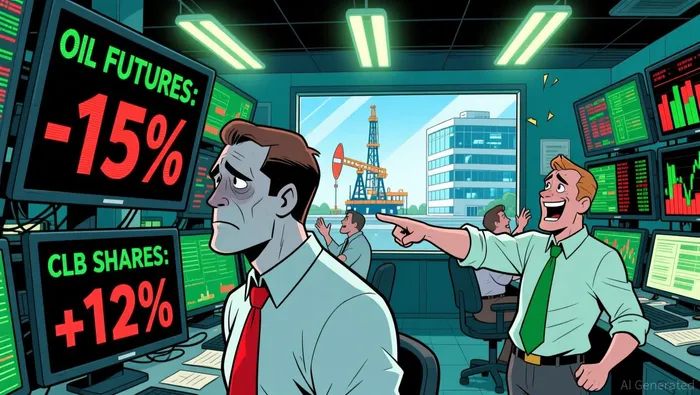
The narrative of easing conflict has become the dominant force in financial markets. As fears of supply disruptions subside, commodities are adjusting accordingly. This context makes CLB’s recent gains particularly notable. Despite a challenging sector backdrop—with the Nasdaq down 3% this month and broader markets under pressure—CLB managed a 4.07% increase.
This divergence signals that investors are treating CLB as a unique story. Its rally is not part of a general market rebound, but rather a targeted response to de-escalation hopes. While oil prices fall, CLB’s guidance cut was directly tied to the conflict. The market’s reaction suggests that the most severe disruptions are now seen as less likely, providing a more stable outlook for the company. In this turbulent news cycle, CLB stands out as a beneficiary of peace rumors, even as other energy stocks remain unsettled.
Search Trends: What’s Capturing Market Attention?
Surging search interest reveals where market attention is truly focused. As the Middle East conflict dominates headlines, online searches for terms like “Middle East conflict oil prices” have soared, reflecting widespread curiosity and concern about the situation’s impact on markets. This surge in attention is fueling a viral narrative that’s shaping trading behavior.
Within this environment, CLB has taken center stage. The company’s updated guidance directly referenced delays and supply-chain issues stemming from the conflict. The stock’s upward move is a clear response to the perceived reduction in headline risk. Investors are signaling that the worst disruptions may be behind, making CLB’s future appear more secure. This is a textbook example of a stock benefiting from a shift in sentiment, with both search volume and share price rising in tandem.
Meanwhile, OTLK’s decline illustrates that not every stock is reacting to the same headlines. Its continued weakness is tied to company-specific challenges, not the broader geopolitical narrative. This distinction highlights how some stocks are swept up in trending news, while others remain anchored to their own fundamentals. In a market hyper-focused on the latest catalyst, CLB is in the spotlight, while OTLK is left on the sidelines.
Key Insights: Navigating Headline-Driven Markets
The current setup is straightforward: market attention is locked on the prospect of Middle East peace, a theme that has already moved oil prices and triggered a sharp reaction in CLB shares. For traders, the next steps depend on upcoming catalysts and the risk that this rally may prove short-lived.
The most significant event for CLB is its Q1 earnings webcast on April 30, 2026. During this call, management will address the conflict’s impact and outline the company’s strategy moving forward. The recent stock surge suggests that investors are betting on positive news. However, if the webcast reveals that operational challenges will persist, the optimism could quickly fade, turning today’s rally into tomorrow’s disappointment.

It’s important to recognize that even if geopolitical risks subside, CLB’s recovery may not be immediate. The company’s revised outlook pointed to ongoing project delays and supply chain hurdles. Restoring normal operations could take time, and if the upcoming call suggests a slower recovery, the recent gains might reverse.
For those trading these headlines, monitoring search trends and oil price movements remains crucial. Should optimism around a resolution wane, CLB’s rally could quickly unwind. The stock’s performance is closely tied to the ebb and flow of headline risk. As long as the market perceives that risk as low, CLB enjoys a favorable tailwind. But in a rapidly shifting news environment, attention can pivot quickly, and fundamentals may once again take center stage. Ultimately, in this market, the narrative itself is the driving force.
Disclaimer: The content of this article solely reflects the author's opinion and does not represent the platform in any capacity. This article is not intended to serve as a reference for making investment decisions.
You may also like
Willi-Food's NIS 90M Logistics Bet Could Fuel Margin Expansion — or Drain Growth Potential

HOOK (HOOK) 24-hour price swing of 40.7%: Short-term rebound followed by a correction driven by high trading volume
AITX conducts Alaska ROSA Deployment Trials, Marking a Breakthrough in Autonomous Security S-Curve Expansion

Inotiv's Emergency Liquidity Move Triggers Institutional Exodus and Insider Offloading as Savvy Investors Exit

Trending news
MoreCrypto prices
More





