
Capella's Tümad Partnership: A Macro-Hedged Play on Gold-Copper Cyclical Upswings

The maiden drill program at Killero E is now complete. Last week, Capella Minerals successfully finished 1,946 meters of diamond drilling across nine holes in northern Finland. This initial pass was a necessary tactical step, but its strategic value and the company's ability to fund a larger 2026 campaign are deeply tied to the prevailing macroeconomic cycle.
Geologically, the target sits within a region of renewed exploration interest. Killero E hosts a historic gold-copper Base of Till ("BoT") geochemical anomaly defined by Anglo American, located in the highly prospective Central Lapland Greenstone Belt. This belt has seen significant discoveries, like Rupert Resources' Ikkari deposit, fueling a broader gold-copper cycle in the area. Yet, the timing of this first drill program is noteworthy. It was executed under a mandatory 12,000m drill commitment as part of a staged earn-in agreement with Turkish miner Tümad, which secures capital during a period of high real interest rates. This funding mechanism is a direct response to a challenging capital environment where the cost of financing exploration is elevated.
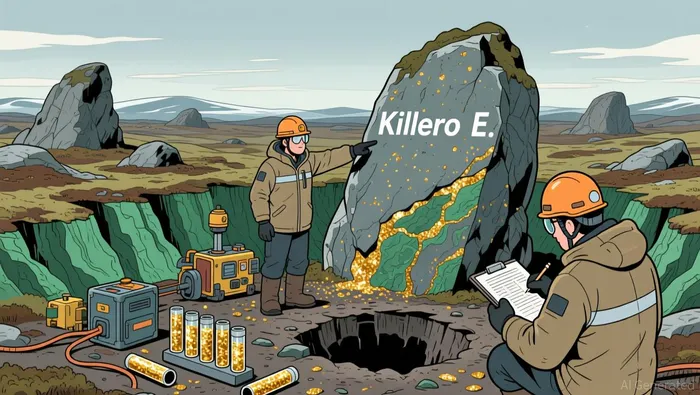
Viewed through a macro lens, the program's completion is a small but critical data point. It provides a first look at the geology underpinning a historic anomaly, but the real test for Capella-and for its ability to advance to a second, more extensive phase-comes from the larger cycle of real interest rates, U.S. dollar strength, and investor appetite for mining equities.
These forces will ultimately determine whether the company can attract the capital needed to follow up on any promising results. For now, the drill program is a funded step forward, but its path depends on the macro backdrop.The Macro-Driven Valuation: How Rates and Capital Flows Shape Exploration Plays
The valuation of early-stage exploration assets like Capella's projects is not determined by geology alone. It is a function of the prevailing macro cycle, where high real interest rates and a strong U.S. dollar compress the risk-adjusted return profile for investors. This dynamic makes partnerships like the one with Tümad not just strategic, but essential for survival.
High real interest rates directly increase the discount rate applied to the distant, uncertain cash flows that exploration projects promise. When the cost of capital is elevated, the present value of future profits shrinks dramatically. This mechanism effectively devalues non-producing assets, making it harder for juniors to raise equity at reasonable valuations. The company's maiden drill program at Killero E was executed under a mandatory 12,000m drill commitment as part of the earn-in agreement, a clear adaptation to this capital-constrained environment. The partnership secured committed capital that was more accessible than what Capella could likely source on its own at current rates.
This challenge is compounded by the U.S. dollar's role. A strong dollar typically weighs on base metal prices, which are priced in USD. For a project like Killero E, which targets copper alongside gold, this creates a double pressure. Lower copper prices reduce the USD-denominated cash flow potential, while the strong dollar itself makes the project's future revenues less valuable in a global context. This combination diminishes investor appetite for junior miners, whose stock prices are often more volatile and sensitive to commodity price swings and funding costs.
The Tümad partnership acts as a critical de-risking mechanism. By securing a committed partner with annual gold production of approximately 200,000 ounces, Capella has locked in a portion of the exploration budget for its Scandinavian portfolio. This reduces the company's immediate cash burn and dilution risk. More importantly, it positions Capella to benefit from capital flows into mining equities during cyclical upswings. When the macro backdrop improves-real rates stabilize or decline, the dollar moderates-investor appetite for exploration will likely return. With a partner already invested and a funded drill program complete, Capella is in a stronger position to follow up on any promising results, scaling its efforts as the cycle turns. The partnership is a tactical hedge against the current cycle's headwinds.
Strategic Execution: Leveraging the Earn-In to Navigate the Cycle
The Tümad earn-in agreement is not just a funding deal; it is the structural backbone that allows Capella to advance its portfolio in a capital-constrained world. The mandatory work commitments provide a clear, funded path for exploration, directly addressing the high-cost environment that pressures juniors. Under the agreement, Tümad is required to invest USD 1,250,000 in exploration expenditures for the Finnish projects during the first year, including the completion of up to 4,000m of core drilling. This commitment, already fulfilled by the maiden program at Killero E, ensures that Capella's primary project in Finland is funded for a critical phase of evaluation without the company bearing the full upfront cost.
The structure also creates a tangible incentive for Capella to deliver. By meeting its Year 1 obligations, the company secures a 30% interest in the Finnish project. The agreement then outlines a clear, optional path to majority control: Tümad can elect to continue with a second phase, investing a further USD 5,000,000 to earn a 51% stake. This staged approach de-risks the partnership for both parties. For Capella, it means it can advance its portfolio with committed capital, but it also introduces a key caveat. As the agreement notes, after Year 1, Tümad retains the option to either continue investing or reverting to a Net Smelter Royalty (NSR) on projects in each country that it decides not to continue with. This means that any exploration beyond the initial 12,000m commitment is at Tümad's discretion, not a guaranteed next step.
The strategic benefit of this arrangement is profound. It allows Capella to focus its own resources and management attention on advancing multiple projects across its portfolio. The company has already announced a separate earn-in agreement for its Solana Iron Oxide Copper-Gold (IOCG) project in southern Spain, where it will conduct initial drill target definition in early 2026. Without the Tümad partnership, funding this parallel exploration effort would likely require significant equity raises or debt, diluting existing shareholders and increasing financial risk. Instead, the earn-in provides a capital-efficient model: Capella secures funding for its Finnish work while preserving its balance sheet to pursue other opportunities. In a macro cycle where the cost of capital is high and investor appetite is selective, this ability to leverage partnerships to de-risk and fund exploration is a necessity for survival and growth.
Catalysts and Risks: The Path to 2026's Busy Campaign
The immediate path forward is defined by a clear, time-bound catalyst: the completion of the full 12,000m drill commitment for 2026. The maiden program at Killero E, which completed 1,946 meters across nine holes last week, was just the first phase. The remaining work-approximately 2,000 meters at Killero E and the balance at other Finnish targets-is the primary test of the strategy. Success here means delivering assay results that confirm the geological model and demonstrate resource potential. For the Tümad partnership, hitting this commitment is non-negotiable; it is the minimum requirement for the earn-in to proceed to the next stage. The company expects to report all assays from this initial program in April, providing the first hard data on the project's promise.
The key operational risk, however, is that this initial success may not be enough to trigger the next phase. The earn-in agreement grants Tümad a clear option after Year 1: it can elect to continue investing in exploration to increase its stake, or it can revert to a Net Smelter Royalty (NSR) on projects it decides not to pursue. This means that any follow-up drilling beyond the mandatory 12,000m is at Tümad's discretion, not a guaranteed next step. The company's ability to advance the project hinges on Tümad's continued capital commitment, which is not assured. This creates a dependency that caps Capella's control and introduces a binary outcome for the project's future.
On a broader scale, the entire venture remains vulnerable to the cyclical nature of the gold-copper market. The project's value is contingent on sustained favorable commodity prices and investor appetite for exploration, both of which are sensitive to the real interest rate and U.S. dollar cycle. If the macro backdrop turns more hostile-real rates remain elevated or the dollar strengthens-commodity prices could soften, and capital flows into juniors could dry up. This would pressure the economics of any potential resource and make it harder for Capella to fund further work or attract new partners, even if the drill results are positive. The partnership with Tümad provides a near-term hedge against this risk, but it does not eliminate the underlying commodity cycle that ultimately determines the project's long-term payoff.
Disclaimer: The content of this article solely reflects the author's opinion and does not represent the platform in any capacity. This article is not intended to serve as a reference for making investment decisions.
You may also like
LIGHT (Bitlight) fluctuated 66.7% in 24 hours: Trading volume surged 169% triggering intense volatility
NAORIS (NAORIS) fluctuated 84.0% in 24 hours: Surging futures trading volume drives price rebound
CSPR fluctuates 57.8% in 24 hours: Mainnet V2.2.0 upgrade triggers sharp price rebound
Can Pan American Silver Sustain Its Strong Momentum in Silver Output?
Trending news
MoreCrypto prices
More





