
Nvidia’s OpenClaw Sparks an AI Agent Revolution—Could This Be the Next ChatGPT?

A New Era for AI User Interfaces
Artificial intelligence is experiencing its most significant transformation in user interaction since the advent of graphical desktops. Nvidia's OpenClaw marks this pivotal moment—not as a chatbot, but as an open-source framework for autonomous AI agents. These agents can perform tasks, integrate with various tools, and operate independently over time. In effect, OpenClaw serves as a personal operating system for individual AI.
This evolution is crucial. While ChatGPT ushered in the age of AI-powered answers, OpenClaw signals the next leap: AI that acts. Running locally on users’ devices, it retains context, adapts to ongoing conversations, and acquires new abilities through modular "skills." Applications range from a virtual assistant handling schedules and emails to research agents compiling information. The focus has shifted from passive replies to proactive execution.
Adoption has been rapid and widespread. OpenClaw has quickly become the fastest-growing open-source project ever, reaching popularity milestones in weeks that took Linux decades to achieve. This surge reflects a strong grassroots demand for new ways to engage with technology. Nvidia CEO Jensen Huang has even called it 'definitely the next ChatGPT', highlighting its disruptive potential.
For investors, the opportunity lies not in a single application, but in a foundational infrastructure that will support the next wave of software innovation. The swift embrace of local, persistent agents validates this model. Nvidia’s introduction of NemoClaw—a secure, enterprise-ready version—demonstrates the company’s intent to lead this new paradigm. The transition from conversational AI to autonomous agents is underway, with OpenClaw as the open-source catalyst.
NemoClaw: Powering the Commercial AI Infrastructure
Nvidia’s strategy with NemoClaw follows a classic pattern: spark open-source adoption with OpenClaw, then scale with a robust commercial platform. OpenClaw democratized autonomous agents, fueling experimentation and rapid uptake. NemoClaw is the next step, engineered for reliability and deployment in real-world, production environments.
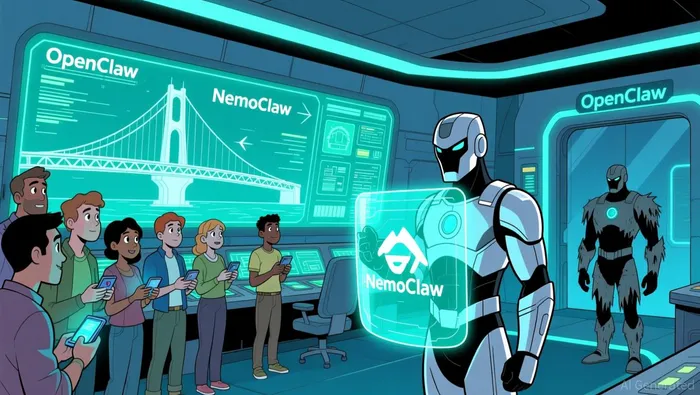
While OpenClaw is ideal for local experimentation, NemoClaw is built for controlled, scalable deployments. Rather than replacing OpenClaw, it complements it, targeting a different stage of adoption. NemoClaw integrates the NVIDIA Agent Toolkit and the OpenShell runtime into a streamlined package, enhancing privacy and security and optimizing local compute resources for high-performance AI models. This forms the essential infrastructure layer beneath autonomous agents.
Central to NemoClaw’s value is its policy-driven management. By leveraging OpenShell, it enforces strict privacy and security boundaries, creating isolated environments for agents. This directly addresses enterprise concerns around trust and data handling, transforming agents from experimental tools into dependable, long-running services.
NemoClaw is purpose-built for Nvidia’s hardware ecosystem, from consumer RTX PCs to enterprise-grade DGX systems. This close integration ensures efficient, local execution, maximizing privacy and cost-effectiveness. The synergy between open-source software and dedicated hardware creates a self-reinforcing cycle: demand for agents drives hardware adoption, and hardware capabilities enable advanced, persistent AI workloads.
Ultimately, NemoClaw answers the question of practical AI deployment. By packaging OpenClaw’s innovation for enterprise use, Nvidia positions itself as the backbone of the AI agent revolution—moving beyond hardware to become the core infrastructure provider for autonomous AI.
ATR Volatility Breakout Strategy: NVDA Backtest Summary
- Strategy: Long-only on NVDA. Enter when the closing price exceeds the 20-day high of ATR(14) normalized range; exit if the closing price falls below the 20-day low, after 20 days, or upon hitting a 10% gain or 5% loss.
- Backtest Period: March 24, 2024 – March 24, 2026
- Key Results:
- Strategy Return: 49.57%
- Annualized Return: 22.03%
- Maximum Drawdown: 18.99%
- Profit-Loss Ratio: 1.58
- Total Trades: 14
- Winning Trades: 8
- Losing Trades: 6
- Win Rate: 57.14%
- Average Hold Days: 8.93
- Max Consecutive Losses: 3
- Average Win: 10.46%
- Average Loss: 6.29%
- Best Single Trade: 14.15%
- Worst Single Trade: 7.81%
Compute Power and the Rise of the AI Factory
The transition from conversational AI to autonomous agents is reshaping the very purpose of data centers. As Jensen Huang describes, traditional server rooms are giving way to massive AI installations. These new "factories" are designed not just to store files, but to generate tokens—the essential output of AI models. The main financial lever is the cost of inference, or the price per token produced. Nvidia’s integrated approach is focused on minimizing this cost, creating a significant competitive advantage.
The rapid proliferation of agents powered by OpenClaw and NemoClaw will dramatically increase token generation, pushing the limits of legacy data center infrastructure. Traditional systems, built for human-driven queries, are not equipped for the continuous, context-rich demands of multi-agent AI. Nvidia’s end-to-end control—from hardware to AI models—enables optimization for these new workloads, aiming to transform data centers into highly efficient, GPU-driven AI factories.
This comprehensive strategy simplifies complexity and boosts efficiency across cooling, networking, and storage. For organizations eager to deploy secure, autonomous agents, this streamlined approach is a major advantage. The stack is anchored by new hardware like the Rubin GPU and Vera CPU, alongside Groq’s inference chip for enhanced memory bandwidth. Software such as Dynamo coordinates these components, while advanced networking and storage solutions ensure seamless data flow for context management.
Financially, Nvidia is not just selling hardware—it’s offering the blueprint for the AI factory. Capturing a significant share of the global build-out of these token-generating centers is crucial. Delays in deployment can cost enterprises billions, making Nvidia’s integrated, optimized path from hardware to secure agent deployment highly valuable. This strategy is central to monetizing the explosive growth of the agent-driven AI era.
Key Drivers, Challenges, and Outlook
Nvidia’s success in the AI agent space will depend on several near-term developments. The most important factor is how quickly the NemoClaw stack becomes integrated with the broader AI infrastructure. Progress will be measured by enterprise adoption rates and major partnership announcements, which will indicate the commercial strength of Nvidia’s security and control platform. This integration is essential for scaling the "AI factories" that Huang envisions, turning open-source momentum into sustainable revenue.
One significant risk is fragmentation within the agent ecosystem. Competing frameworks like NanoClaw, which emphasize minimalism and containerization, present an alternative to the more integrated OpenClaw approach. Diverging standards could weaken Nvidia’s influence over the foundational architecture. The company’s push for a unified, vendor-neutral platform is designed to address this, but widespread adoption will require winning over both developers and enterprises.
The rate at which NemoClaw is adopted by organizations and developers will be the clearest indicator of its success. Its focus on secure, production-ready environments directly addresses the trust issues that have hindered broader agent deployment. Strong uptake would validate Nvidia’s approach, while slow adoption or preference for alternatives would suggest the need for further refinement. Ultimately, Nvidia is staking its infrastructure leadership on the agent paradigm, and the coming quarters will reveal whether OpenClaw’s open-source momentum can be translated into NemoClaw’s secure, scalable reality.
Disclaimer: The content of this article solely reflects the author's opinion and does not represent the platform in any capacity. This article is not intended to serve as a reference for making investment decisions.
You may also like

Australian CPI Drops Slightly, Yet Inflation Remains Above Target
AAOI Tumbles 20.5% as Big Money Holds Back Despite Bullish Hopes
Dogecoin Eyes 300% Upside: Analyst Flags Major Reversal Zone

Trending news
MoreCrypto prices
More





