
TEPCO's overhaul depends on private investment while the government continues to shoulder Fukushima-related liabilities

TEPCO’s Financial Reality: Public Support and Long-Term Challenges
TEPCO’s latest government grant does not represent a sustainable solution, but rather highlights the company’s ongoing structural issues. As a utility, TEPCO continues to operate primarily because of fiscal and political imperatives, not because it is a sound investment. The sheer volume of public funds required to keep TEPCO afloat is a testament to the enduring financial impact of the Fukushima disaster.
To date, TEPCO has secured roughly 11.66 trillion yen in government grants and 188.9 billion yen in indemnity payments from the state-backed Nuclear Damage Compensation and Decommissioning Facilitation Corporation. This support structure exists because TEPCO’s own resources have been depleted. The company’s updated business plan, released in January 2026, openly admits this lack of financial resilience. It sets a target of 3.1 trillion yen in cost reductions over the next ten years, acknowledging that TEPCO cannot meet its obligations without ongoing external assistance.
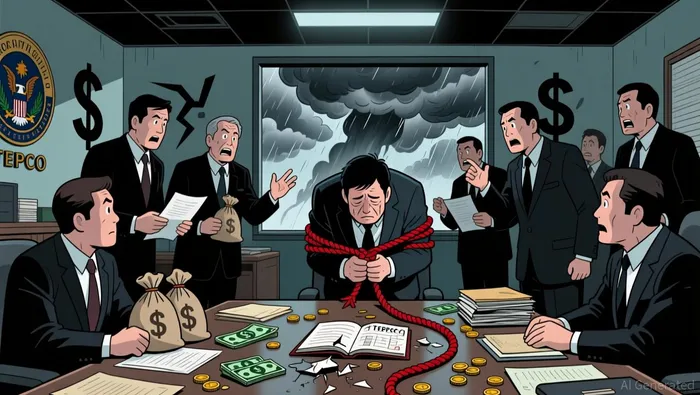
Ultimately, the financial burden of the Fukushima disaster has fallen heavily on Japanese taxpayers, who have contributed nearly $100 billion. Although TEPCO is legally responsible for compensation and decommissioning, the reality is that public funds have covered the vast majority of these costs. This dependency means TEPCO’s survival is entirely reliant on government support. For institutional investors, this situation is clear: TEPCO is a distressed asset, and its share price reflects both its fragile finances and the unpredictable, long-term costs it faces.
Restructuring and the Move Toward Privatization
TEPCO’s current strategy focuses on shedding its most significant liabilities and attracting private investment to drive future growth. The company is actively pursuing partnerships, with interest from major international investors such as KKR & Co. and Bain Capital, as well as domestic funds and infrastructure firms. This process, which began in February, is expected to result in formal proposals by the end of March and a shortlist of candidates by year’s end.
Proposed restructuring options are designed to make TEPCO a more attractive investment. One approach involves a major capital injection that could take the company private through a tender offer. Another plan would establish an “intermediate holdings company” to consolidate TEPCO’s non-nuclear generation, retail, and transmission businesses. The goal is to separate these operations from the enormous and unpredictable costs of decommissioning the Fukushima plant, creating a cleaner investment profile for private capital.
For institutional investors, this restructuring presents both opportunities and risks. The growth potential is real, driven by increasing electricity demand from data centers and semiconductor manufacturing in Japan. However, TEPCO lacks the resources to fund this expansion independently. The new partnership models aim to fill this gap, but the government intends to retain majority voting rights, ensuring continued state control over critical infrastructure even as private capital is introduced.
This arrangement creates a complex risk-reward scenario. Investors gain access to a growing, non-nuclear business with more transparent costs, but the ultimate responsibility for Fukushima-related liabilities remains with the state. The plan’s success depends on overcoming significant obstacles, including strict foreign investment regulations and TEPCO’s track record of limited partnership success. For now, institutional investors are proceeding cautiously, attracted by growth prospects but aware that the deepest financial challenges remain the government’s responsibility.
Sector Lessons: Managing Extreme Risk in Energy Investments
TEPCO’s situation serves as a powerful example of extreme tail risk in the energy sector. The landmark 13.321 trillion yen director liability ruling demonstrates how a single catastrophic event can create liabilities that far exceed a company’s equity and persist for decades, potentially leading to bankruptcy. This is not a temporary setback but a long-term, structural risk that fundamentally changes the investment equation. For portfolio managers, TEPCO illustrates the limitations of public-private partnerships: while new capital structures may isolate growth assets, the core decommissioning and compensation costs remain a state-backed, multi-decade obligation. These financial maneuvers do not resolve the underlying liabilities.
This disconnect between technical market sentiment and fundamental financial reality is striking. TEPCO’s stock may carry a Strong Buy technical signal, likely fueled by short-term momentum and optimism around non-nuclear growth. Yet, the company’s survival depends on continued government support, and its business plan only aims for 3.1 trillion yen in cost cuts over a decade—a partial solution to a problem that has already cost the public $100 billion. The market may be pricing in future growth, but the real risk lies in the unresolved past and open-ended liabilities. This misalignment could present opportunities for contrarian investors, but only for those willing to bet against the government’s willingness to continue supporting TEPCO.
For most institutional investors, the conclusion is straightforward: TEPCO is best avoided or significantly underweighted. Its value is tied to political and fiscal decisions, not operational performance. Capital allocation is dictated by a government-mandated decommissioning schedule, not shareholder interests. While new partnerships may attract private capital for growth, they do not change the fact that TEPCO’s financial independence remains a distant goal. In portfolio terms, investing in TEPCO is essentially a wager on the durability of government guarantees, not on the company’s business fundamentals. With more predictable and capital-efficient opportunities available in the energy transition, the risk premium required for TEPCO is difficult to justify.
Looking Ahead: Key Catalysts and Risks
The next several months will be crucial in determining whether TEPCO’s restructuring plan can succeed. The immediate catalyst is the government’s final decision on capital partnership proposals, expected by year’s end. After a search process that began in February and formal proposals due by the end of March, the selection of partners will shape TEPCO’s future ownership. Success would bring in the private capital needed for non-nuclear growth, with major investors like KKR & Co. and Bain Capital already showing interest. However, failure or excessive foreign involvement could derail the plan and prolong TEPCO’s reliance on public funds.
A significant risk is that decommissioning costs could surpass the government’s current estimate of 21.5 trillion yen. The Board of Audit has already cautioned that expenses may rise, noting that over half of the projected total has been spent in just 11 years. Additional concerns include compensation for reputational damage and evacuee claims that exceed interim guidelines, which could force a costly reassessment. If the government’s cost projections are revised upward, TEPCO’s plan for 3.1 trillion yen in cost reductions may prove inadequate, potentially requiring further public intervention and undermining the partnership strategy.
Regulatory and public perception risks add further uncertainty. The controversial plan to release treated radioactive water into the ocean could spark new liabilities or operational setbacks. The Board of Audit has pointed out that the government’s cost estimates do not account for potential damages related to reputational harm from the water release. Any resulting lawsuits or reputational damage could increase compensation claims, further weakening TEPCO’s financial position and complicating its ability to fund decommissioning. Combined with strict foreign investment rules, these challenges make the path to a streamlined, private TEPCO fraught with political and operational obstacles.
Disclaimer: The content of this article solely reflects the author's opinion and does not represent the platform in any capacity. This article is not intended to serve as a reference for making investment decisions.
You may also like


Praemium’s Board Overhaul: Can the New Leadership Accelerate Spectrum’s Proven Growth Engine?

Rivian’s R2 Debut Set for 2026 May Mark a Turning Point—Will Growth Accelerate or Hit a Plateau?

Trending news
MoreCrypto prices
More





