
Philippines' 45-day fuel reserve triggers squeeze trading amid geopolitical turmoil, prompting urgent Russian oil imports

Philippines Declares National Energy Emergency Amid Middle East Conflict
On March 24, 2026, President Ferdinand Marcos Jr. announced a national energy emergency in response to escalating tensions in the Middle East and the closure of the Strait of Hormuz. This move was prompted by the looming threat to the Philippines’ fuel supply, as the ongoing conflict has caused global oil prices to surge and disrupted international supply chains.
The Philippines faces significant structural risks due to its heavy reliance on oil imports from the Middle East—accounting for 90% of its oil needs. With reserves sufficient for only 45 days of consumption, the country is highly susceptible to supply interruptions, making regional turmoil an immediate threat to both energy security and economic stability.
To mitigate the crisis, the government is urgently seeking alternative sources. Energy Secretary Sharon Garin confirmed efforts to secure fuel from various countries, including unconventional suppliers. Notably, the Philippines is set to receive Russian crude oil for the first time in five years, facilitated by a US sanctions waiver. Emergency measures also include proposed legislation to temporarily suspend or reduce fuel excise taxes during price spikes, aiming to lessen the impact on consumers and businesses.
President Marcos has cautioned that grounding flights due to jet fuel shortages is a real possibility, underscoring how quickly fuel scarcity can disrupt transportation and commerce. The government’s swift actions highlight the fragility of the supply chain and the urgent need to diversify energy sources.
Understanding the Crisis in the Context of Oil Price Cycles
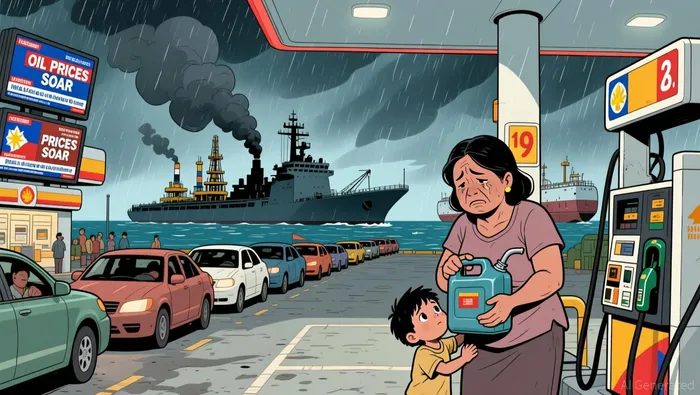
The Philippines’ predicament illustrates how geopolitical turmoil can rapidly destabilize supply chains. However, to grasp its broader market implications, it’s essential to consider the current macroeconomic and commodity landscape. Despite the immediate shock, underlying market fundamentals remain weak, which limits the potential for sustained price increases.
According to J.P. Morgan Global Research, the oil market is expected to average $60 per barrel for Brent crude in 2026. This forecast is based on the expectation that global oil supply will outpace demand, resulting in surpluses. The recent price spike above $100 per barrel is seen as a temporary volatility event rather than a lasting shift. The market is currently balancing robust demand with even stronger supply growth, making prolonged disruptions less likely.
There is a crucial tension at play: while the Philippines and the broader Middle East conflict represent significant geopolitical shocks, these only become major market events if they trigger wider macroeconomic disruptions. Historically, the most severe downturns have been driven by fundamental or macroeconomic factors, such as the stagflation following the 1973 oil embargo. Today, with strategic reserves being tapped and supply routes redirected, the market appears better prepared to absorb shocks without fundamentally altering the supply-demand balance.
The US dollar’s recent strength is another important factor. As investors seek safety, the dollar has appreciated against other currencies, reflecting the US’s position as a net energy exporter. However, a stronger dollar tightens global financial conditions, increases the cost of dollar-denominated debt for emerging markets, and can offset some inflationary effects from higher oil prices.
Ultimately, the Philippines’ emergency highlights a localized vulnerability. For the global oil market, the current price spike is likely a short-term deviation within a cycle characterized by abundant supply and weak fundamentals. The real challenge will be if the conflict escalates enough to disrupt the supply-demand balance or trigger broader stagflation risks—possibilities that remain elevated but are not the central scenario.
Aviation Sector Under Pressure: Operational and Financial Consequences
The geopolitical crisis is now manifesting as financial strain, especially for the aviation industry. Due to the conflict and related sanctions, several countries have refused to refuel Philippine airlines, forcing carriers to carry extra fuel for round trips. This practice reduces payload capacity and increases costs, severely impacting long-haul operations.
Budget airline Cebu Pacific has responded by suspending routes and cutting flight frequencies from April to October 2026. Fuel surcharges have reached record highs, with domestic fares exceeding ₱787 and international fares over ₱6,208.98. These increases represent a fundamental shift in air travel economics, with costs more than doubling compared to 2025 due to the crisis.
President Marcos has emphasized the risk of a worst-case scenario, where operational constraints could escalate into liquidity and safety issues. While Energy Secretary Garin has assured that airlines have sufficient fuel orders, this contrasts with the President’s warnings, highlighting the tension between short-term planning and the threat of an actual shortage.
The breakdown in air connectivity poses a significant risk to the broader economy. As a regional transport hub, disruptions to the Philippines’ airline network affect tourism, business travel, and supply chains. The financial strain on airlines like Cebu Pacific signals a contraction in the sector’s contribution to GDP and increases pressure on government finances, especially as emergency measures to reduce fuel taxes could further erode revenue.
Macro Impacts: Interest Rates, Currency, and Future Outlook
The crisis in the Philippines serves as a case study in how geopolitical shocks can test a country’s macroeconomic resilience. Globally, the key question is whether this event will alter the current commodity cycle, which depends on real interest rates, dollar strength, and oil price trends.
If disruptions persist, the Philippines may be forced to draw down its limited reserves, risking a currency crisis. This would amplify the effects of a stronger dollar, which already acts as a global stabilizer. For economies reliant on imports, a rising dollar increases the cost of essential goods and dollar-denominated debt, creating a cycle of inflation and financial stress that pressures central banks to respond.
This leads to a dilemma for monetary policymakers. Renewed inflation risks from the conflict may prompt central banks in Asia, including Malaysia and Australia, to consider raising rates. In the US, while dollar strength can hurt corporate earnings, the Federal Reserve may need to maintain higher real interest rates if inflation expectations rise. The market’s response will depend on whether supply disruptions are viewed as temporary or as a lasting shift in trade flows, which could break the soft supply-demand balance projected by J.P. Morgan.
Historically, major market downturns have been triggered by geopolitical events that cause macroeconomic shocks, such as the stagflation of 1973. Currently, with strategic stockpiles being released and supply routes adjusted, the market is better equipped to handle temporary spikes. However, a prolonged closure of the Strait of Hormuz could reignite inflation and complicate central bank policy, potentially leading to higher real interest rates. While the dollar’s strength benefits the US as a safe haven, it also adds global financial stress that could counteract some inflationary pressures from rising oil prices. The future of the oil price cycle will depend on the interplay between geopolitics, currency markets, and central bank strategies.
Exxon Mobil Stock Trend

Exxon Mobil (XOM) closed at 165.380 on the NYSE, up 4.250 points or 2.64%. The stock is currently not trading. This performance reflects market volatility amid the ongoing energy crisis.
Key Catalysts, Scenarios, and What to Monitor
The unfolding crisis in Manila is now a test of containment, with several critical factors determining whether the disruption remains limited or escalates into a broader economic and financial shock.
- Duration of Strait of Hormuz Closure: The Philippines’ oil reserves cover only 45 days of consumption. A prolonged blockade could quickly deplete supplies, leading to rationing or grounding of flights.
- Securing Alternative Fuel Sources: The government is actively seeking new suppliers, including Russian crude, to replace Middle Eastern imports. The ability to scale up these alternatives will be crucial.
- Emergency Fiscal Measures: Legislation to suspend or reduce fuel excise taxes when prices exceed $80/barrel for a month aims to protect the economy but may strain the national budget.
- Global Macro Environment: The dollar’s strength increases the cost of imported fuel and debt servicing for the Philippines. Sustained high oil prices could force a reassessment of market fundamentals.
In summary, the Philippines faces a high-stakes challenge involving inventory management, alternative supply deals, fiscal policy, and the dual forces of oil prices and currency movements. The outcome will reveal whether this is a temporary shock absorbed by global markets or the trigger for a more severe macroeconomic cycle.
Disclaimer: The content of this article solely reflects the author's opinion and does not represent the platform in any capacity. This article is not intended to serve as a reference for making investment decisions.
You may also like
Resolv Offers 10% Bounty: 72 Hours to Return $25 Million Stolen Funds
Bitget's Flow Momentum: Boosting Liquidity with MotoGP and Artificial Intelligence



Trending news
MoreCrypto prices
More





