
Jin insiders purchase shares at a premium while major institutional investors remain inactive during the market downturn

Insider Activity: Subtle Optimism or Hesitation?
At first glance, insider buying appears encouraging. However, a closer look reveals a more nuanced picture. While individuals closely linked to Chairman Siu Fai Ng have recently acquired shares—indicating some personal investment—the chairman’s own actions and the stock’s lackluster technical performance suggest a more restrained outlook.
In January 2025, Mr. Chi Lam Michael NG, an associate of the chairman, purchased 46,460 shares at NOK5.9834 and 4,237 shares at NOK6.0600. Later, in April, Ms. Yee Man Gloria WONG acquired 10,000 shares at NOK5.3800 and 2,521 shares at NOK5.1000. These transactions, executed at prices above the prevailing market rate, suggest these insiders see underlying value and are willing to pay a premium.
Yet, Chairman Ng’s recent activity tells a different story. Although he has been a steady buyer over the past year, his latest acquisition—a kr272,000 purchase at kr6.34 per share—only increased his ownership by 0.9%. His average purchase price for the year stands at kr7.66 per share, notably higher than his most recent buy. This pattern points to a cautious approach: he’s still buying, but in small increments and at lower prices, signaling limited conviction rather than aggressive accumulation.
In summary, while there is some alignment between insiders and shareholders, the scale and frequency of purchases suggest caution rather than strong confidence. Associates are willing to pay up, but the chairman’s modest buying hints at a wait-and-see attitude. In a market with weak technicals, this reserved stance from leadership is telling—a quiet endorsement of the company’s fundamentals, but far from a resounding vote of confidence.
Institutional Sentiment and Market Valuation
While insider buying sends a faint signal, institutional investors are making their position clear by staying on the sidelines. The technical indicators for the stock reinforce this lack of enthusiasm, reflecting a market that has already factored in considerable risk.
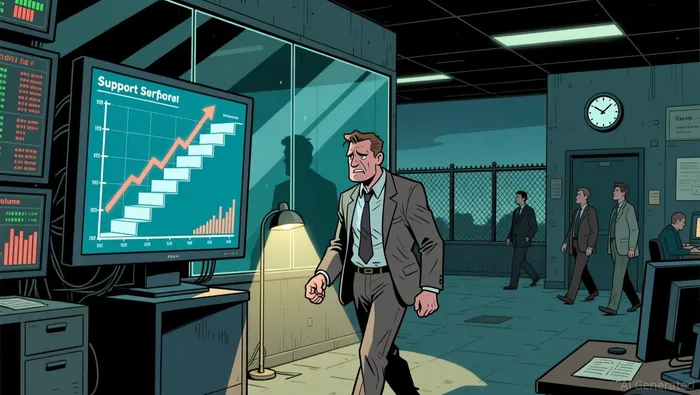
Jinhui Shipping is currently entrenched in a downward trend channel, a classic indicator of growing investor pessimism. The share price has slipped below its 50-day moving average and is now trading between support at NOK5.50 and resistance at NOK5.73. A failed head-and-shoulders pattern further highlights the risk of continued declines. For sophisticated investors, such a trend is a warning sign rather than an invitation to buy on weakness.
Trading volume adds another layer to the story. Recent activity has hovered at or below the average, with a volume of 67,346 shares compared to an average of 73,163. In situations where large investors are accumulating, volume typically surges. Here, the subdued trading suggests that institutional investors are not building positions, despite insiders paying above-market prices. This disconnect is significant: while some insiders are buying, the broader market is not following suit.
Valuation Metrics: Cheap for a Reason?
The stock currently trades at a price-to-earnings ratio of 5.15 and offers a projected dividend yield of 3.04%. On the surface, these numbers might appear attractive. However, in the context of a persistent downtrend, such low multiples often signal deep concerns about future profitability or the company’s business model. Rather than rewarding the dividend, the market is discounting the stock due to perceived risks ahead. The low valuation is less a bargain and more a reflection of ongoing uncertainty.
Key Takeaway
There is a clear divergence: insiders are accumulating shares at a premium, but institutional investors remain absent, and technical signals point to continued weakness. For seasoned investors, the lack of institutional buying in a declining market is the real message. When large players are inactive, it often means they see more risk than opportunity.
Potential Catalysts and Risks: What Could Change the Outlook?
The prevailing narrative is one of caution—insiders are making small moves, while the broader market is retreating. For sentiment to shift, several key developments would need to occur:
- Significant Insider Commitment: A large, above-market purchase by Chairman Ng would demonstrate increased confidence and could serve as a bullish signal. His recent acquisition of 3,667 shares at NOK0.77 in January 2025 was minor. A more substantial investment would indicate a stronger belief in the company’s prospects.
- Technical Breakout: The stock remains trapped in a downward channel, with resistance at NOK5.73. A decisive move above this level would challenge the current bearish trend and could attract new buyers. Until then, low volume and weak momentum suggest institutions will remain on the sidelines.
- Upcoming Earnings Report: The next financial results will be crucial. Operating in a challenging shipping environment and having recently sold a vessel for $24 million, the company must demonstrate its ability to generate profits and maintain a healthy balance sheet. A disappointing report would reinforce negative sentiment, while a strong performance could start to shift perceptions.
In conclusion, the current situation is precarious. While insiders are watching and making small moves, a true reversal would require bold action from leadership, a technical breakout, and a positive earnings surprise. Until these catalysts emerge, the cautious outlook remains intact.
Disclaimer: The content of this article solely reflects the author's opinion and does not represent the platform in any capacity. This article is not intended to serve as a reference for making investment decisions.
You may also like
Middle East conflict: worldwide economic consequences
Ripple's RLUSD Pilot: A $2.5T Trade Finance Play for a $1.4B Stablecoin

WMTX Token Launches On Interport Finance, Advancing DeFi Cross-Chain Liquidity For World Mobile Chain
NFT buyers surge 100% weekly, Ethereum dominates sales volume
Trending news
MoreCrypto prices
More





