
ECB vs Market: The Hike Bet That Could Collapse If War Ends

The European Central Bank's official stance provides a direct counterpoint to the market's rising fears. Last week, the Governing Council decided to keep the three key ECB interest rates unchanged, reaffirming its commitment to ensuring inflation stabilizes at its 2% target in the medium term. This decision was made against a backdrop of heightened uncertainty, with the war in the Middle East creating clear upside risks for inflation and downside risks for growth. Yet the ECB's baseline assumption is one of a shorter conflict. As Vice President Luis de Guindos stated, a short-lived war is the ECB's "baseline".
The central bank's approach is explicitly data-dependent. De Guindos noted that a "steady modification" in the level of inflation could prompt the ECB to change its policy stance. This signals that policymakers are watching for a sustained shift, not reacting to a single spike. The new staff projections, which incorporate data up to early March, reflect this cautious outlook. They see headline inflation averaging 2.6% in 2026 before cooling to 2.0% in 2027, a path that is higher than previous forecasts due to elevated energy prices. The ECB's baseline assumes this is a transitory shock.
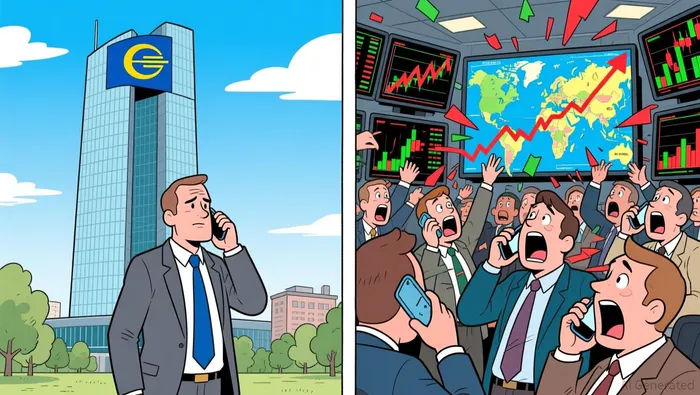
The critical risk, however, is that the conflict proves longer than expected. The scenario analysis published alongside the projections suggests that a prolonged disruption in the supply of oil and gas would result in inflation being above, and growth being below, the baseline projections. More importantly, a sustained energy shock could risk a shift in medium-term inflation expectations-a development that would concern policymakers deeply. In other words, the ECB's current patience hinges on the war ending swiftly, leaving energy prices to fall again. Any deviation from that baseline scenario is what could force a policy shift.
Market Sentiment: Priced for a Worst-Case Scenario
The financial markets are clearly pricing in a much more aggressive policy response than the official consensus. While the ECB's baseline remains one of patience, investors are betting on a significant shift. Currently, markets are pricing in roughly three hikes by year-end, a dramatic reversal from just weeks ago. This expectation gap is stark when compared to the more cautious view of professional economists. A recent Reuters poll shows that nearly two-thirds of economists still expect the deposit rate to hold at 2% this year, a view that has only slightly softened from over 90% just two weeks prior.
The divergence is driven by a hawkish tilt in the analyst community. Major brokerage firms have revised their forecasts sharply. J.P. Morgan, Morgan Stanley and Barclays all revised their forecasts on Thursday to anticipate multiple rate hikes, with Barclays and J.P. Morgan penciling in as many as three increases of 25 basis points each. This institutional shift signals that the market's fear of a prolonged energy shock and its potential to re-anchor inflation expectations is now a priced-in reality.
The setup here is one of extreme sensitivity to the conflict's duration. The market is essentially betting that the ECB's "baseline" of a short-lived war will prove wrong. With oil prices surging about 40% and input costs hitting multi-year highs, the risk of second-round effects is front and center. The market's pricing implies it sees a higher probability of that risk materializing than the broader economic consensus does. For now, the risk/reward favors the market's view, as the potential downside of a delayed response-should inflation expectations truly break-could be severe. Yet, the consensus view reminds us that the ECB's patience is not infinite, and a swift de-escalation would quickly deflate these hike expectations.
The Asymmetry of Risk: What's Priced In vs. What's Prevented
The core of the tension lies in the asymmetry of risk. The market is betting on a policy response, pricing in multiple hikes. The ECB, however, is explicitly waiting for a different trigger. Its key concern is not the initial spike in energy prices, which it acknowledges it cannot prevent. Its focus is on second-round effects, where higher costs for fuel and food feed into broader wage and price-setting behavior, potentially entrenching inflation.
This is the critical buffer. The ECB's position is well-anchored. Inflation has been at its 2% target for the past year, and longer-term inflation expectations are well anchored. This stability provides a crucial buffer against a full-blown shock. The central bank's tools are designed for this scenario: to monitor and act if it sees evidence that the initial shock is becoming permanent. As Vice President de Guindos stated, the ECB will step in if rapid price growth is at risk of getting entrenched.
Viewed another way, the market's bet on hikes may be pricing in a longer conflict and a more entrenched inflation problem than the ECB's baseline assumes. The central bank's "baseline" is a short-lived war, which it expects to be a transitory shock. If that baseline holds, the ECB's patience is justified, and the hike expectations would be a costly mistake. The risk/reward here favors the ECB's view, as the potential downside of a delayed response is severe, but the central bank's well-anchored position and data-dependent approach provide a clear path to avoid it.
The bottom line is one of expectation gaps. The market is pricing in a worst-case scenario of prolonged conflict and broken expectations. The ECB is betting on a shorter war and a resilient economy, where energy prices fall again and the shock remains contained. For now, the asymmetry favors the central bank's baseline. Any shift in the market's pricing would require a clear signal that second-round effects are taking hold-a development that would force the ECB's hand.
Catalysts and Watchpoints
The path forward hinges on a few clear data points and events. The market's bet on multiple ECB hikes is not a given; it will be validated or proven premature based on what unfolds in the coming weeks.
The primary watchpoint is incoming inflation data. The ECB is explicitly monitoring for second-round effects, where higher energy costs begin to feed into broader price and wage-setting behavior. Analysts should look for signs that inflation is broadening beyond energy and food into services and wages. The central bank's baseline assumes a transitory shock, but any evidence that this initial impact is becoming entrenched would be the trigger for a policy shift. The ECB's own projections show inflation excluding energy and food is also being revised higher, underscoring the risk of these spillovers.
Closely tied to this is the monitoring of longer-term inflation expectations. The ECB's position is well-anchored, with longer-term inflation expectations well anchored. However, a sustained energy shock could risk a shift in these expectations-a development that would concern policymakers deeply. The central bank has stated it will follow a data-dependent and meeting-by-meeting approach, meaning it will assess the inflation outlook and risks based on the incoming data.
Ultimately, the length and intensity of the Middle East conflict will be the primary determinant. As Vice President de Guindos noted, the length of the conflict would be key in judging its impact. The ECB's baseline is a short-lived war, and it will assess how energy prices affect the economy over time. If the conflict proves prolonged and energy prices remain elevated, the risk of second-round effects and broken expectations rises sharply. The central bank is committed to a meeting-by-meeting assessment, meaning its next move will be dictated by the evolving data, not pre-announced policy. For now, the market's hike expectations are priced for a longer conflict and a more entrenched inflation problem than the ECB's baseline assumes.
| Total Trade | 0 |
| Winning Trades | 0 |
| Losing Trades | 0 |
| Win Rate | 0% |
| Average Hold Days | 0 |
| Max Consecutive Losses | 0 |
| Profit Loss Ratio | 0 |
| Avg Win Return | 0% |
| Avg Loss Return | 0% |
| Max Single Return | 0% |
| Max Single Loss Return | 0% |
Disclaimer: The content of this article solely reflects the author's opinion and does not represent the platform in any capacity. This article is not intended to serve as a reference for making investment decisions.
You may also like
US Congressman Moves to Ban Staff From Trading on Prediction Markets
Stellantis Supplier Council: The Binary Bet on 2026 Margins

Crypto : Circle Weakened on the Stock Market but Supported by Structural Growth
XRPL-Native Crypto Card Targets Real-World Spending With Direct XRP Payments
Trending news
MoreCrypto prices
More





