
CRH Stock Trade: $300M Repurchase Reflects Confidence as Valuation Tightens Ahead of Major Catalyst

CRH’s U.S. Share Repurchase: A Decade of Strategic Capital Allocation
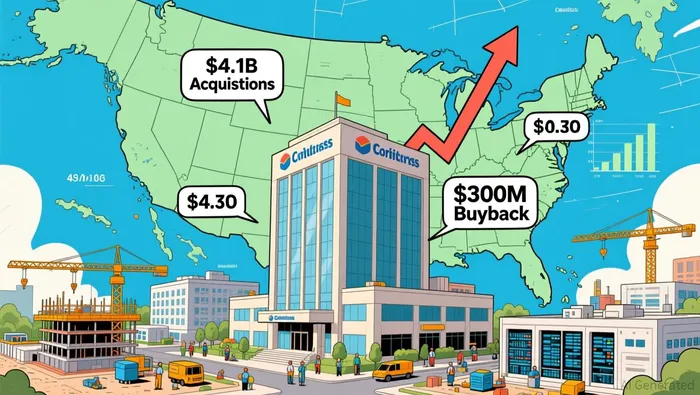
CRH’s most recent share buyback in the United States is part of a broader, long-term approach to capital management. The company has initiated a fresh $300 million share repurchase program set to run until April 2026, following the conclusion of a previous $0.3 billion phase earlier this year. This move is consistent with CRH’s disciplined pattern of returning capital to shareholders; since 2018, the company has distributed $9.7 billion to investors. CRH funds these buybacks opportunistically, utilizing cash from operations and asset sales to repurchase shares when they are trading below what the company considers their intrinsic value.
Alongside these buybacks, CRH has made significant investments. In 2025, the company allocated $4.1 billion to 38 acquisitions and invested $1.7 billion in capital expenditures focused on growth. The buyback program is a central element in managing the company’s capital structure, supporting a dual strategy of investment and capital return. CRH currently holds 35.6 million shares as treasury stock, about 5.1% of its total shares outstanding. This reserve allows for future buybacks and supports earnings per share growth as the number of shares in circulation decreases.
From an institutional standpoint, CRH’s approach demonstrates confidence in its business model’s resilience. The company is channeling excess capital into high-return projects within its core operations, while also enhancing shareholder value through systematic buybacks. This strategy boosts earnings per share and overall returns, all while maintaining financial flexibility. However, the effectiveness of this capital return depends on the broader economic cycle. While the current program is a disciplined response to market valuations, its long-term viability will be shaped by the ongoing strength of the North American construction sector, which remains the main source of CRH’s profits. For now, the company’s capital deployment appears both timely and well-managed.
Valuation Insights and Sector Positioning
CRH’s current valuation presents a complex picture for institutional investors. The stock trades at a price-to-earnings ratio of 19.14, which is 10% higher than its decade-long average of 17.33. However, this premium has narrowed recently, with the ratio falling 9% from its average over the past four quarters. This shift suggests that the market is adopting a more cautious stance on near-term earnings, even though the stock remains above its historical average. The projected price of $106.05 reflects expectations for continued robust EBITDA growth and marks the twelfth consecutive year of margin improvement.
For portfolio managers, CRH’s buyback program is a strong indicator of management’s confidence in the company’s valuation. The company is repurchasing shares at prices that, while not deeply undervalued, are still reasonable given its earnings potential. This is a classic quality investment approach: buying back shares below intrinsic value supports earnings per share growth and benefits remaining shareholders. The scale of the program—a new $300 million authorization and a treasury stock position of 35.6 million shares—underscores CRH’s commitment to returning capital and aligns with a high-conviction investment thesis for a cash-generative business.
Nevertheless, the sustainability of the buyback depends on strong operational cash flow and prudent debt management. With $4.1 billion invested in acquisitions and $1.7 billion in growth capital expenditures, maintaining a healthy balance sheet is essential. Institutional investors should closely monitor the company’s debt-to-EBITDA ratio and free cash flow to ensure that buybacks remain a responsible use of surplus capital rather than a potential strain on financial stability.
From a sector rotation perspective, CRH’s valuation and capital allocation strategy make it an attractive option for portfolios seeking exposure to the North American construction cycle. The stock combines cyclical sensitivity with disciplined operations and a clear capital return mechanism. The recent decline in the P/E ratio may offer a more appealing entry point for investors focused on quality, but the core investment case rests on the company’s ability to sustain earnings growth and margin expansion.
North American Construction Trends and Execution Challenges
The main driver behind CRH’s buyback strategy is the evolving North American construction landscape. Total U.S. construction spending is forecasted to dip by 1% in 2025, before rebounding by 1% in 2026 to reach $2.2 trillion. Growth is uneven across sectors, with data centers and infrastructure projects offsetting weaker performance in more cyclical building segments. This environment requires CRH’s capital allocation strategy to be flexible and responsive to sector-specific volatility.
The ongoing success of the buyback program relies heavily on the effective integration of recent acquisitions and continued stability in international markets. Management has highlighted improvements in the company’s international operations as a key factor in its recent capital decisions. CRH’s ability to invest in high-growth areas and successfully integrate new businesses is crucial for maintaining performance. The $4.1 billion spent on 38 acquisitions in 2025 must deliver operational synergies and cash flow to justify the ongoing buyback program. Without these benefits, the appeal of returning capital to shareholders would diminish.
One significant risk is the potential for changing market conditions to alter CRH’s capital requirements, which could result in a pause or adjustment to the buyback program. The company has stated that future buyback decisions will be based on ongoing assessments of capital needs and market conditions, acknowledging the cyclical nature of the industry. If the expected recovery in construction activity for 2026 does not materialize, or if integration costs from recent acquisitions exceed expectations, CRH may need to revise its capital allocation strategy. While the buyback program reflects confidence in current fundamentals, its continuation is not guaranteed and depends on the company’s ability to deliver on its growth initiatives in a challenging market.
Key Catalysts, Scenarios, and Portfolio Considerations
The main factors shaping CRH’s buyback outlook are becoming clearer. The most significant catalyst is the anticipated wave of federal infrastructure spending, particularly the $40 billion in projected funding through 2030 provided by the IIJA. Management expects 2026 to be a record year for federal highway funding, directly supporting forecasts for continued double-digit EBITDA growth. This funding provides the financial foundation for CRH’s capital allocation plan, ensuring the cash flow needed to support both growth investments and shareholder returns.
Institutional investors should pay close attention to the company’s first-quarter earnings report in April for short-term confirmation of the strategy. Key metrics to watch include aggregate volumes and pricing, which should align with management’s guidance for low-single-digit volume growth and mid-single-digit price increases. Meeting these targets would reinforce the company’s earnings power and support the rationale for ongoing buybacks. Any significant deviation, especially a slowdown in volume growth, would pose a risk to the capital return thesis.
At its current price of $100.50, CRH’s shares are trading 24% below their 52-week high of $131.55, offering a substantial margin of safety for investors. Combined with a consensus "Moderate Buy" rating and an average price target of $135.87, the stock presents clear upside potential. Recent volatility, including a sharp increase following a quarterly earnings miss, highlights the market’s focus on long-term cash flow quality rather than short-term results. For portfolio managers, this environment represents a strong opportunity: CRH’s disciplined buyback program and attractive valuation provide a buffer against cyclical risks. The key is to monitor the execution of IIJA funding, track quarterly volume and pricing trends, and ensure that the company’s growth investments continue to generate the cash flow necessary to sustain both buybacks and dividends.
Disclaimer: The content of this article solely reflects the author's opinion and does not represent the platform in any capacity. This article is not intended to serve as a reference for making investment decisions.
You may also like
The Estee Lauder Companies Expands Its Leadership in the Category: What Lies Ahead?
FuelCell Energy: Can Expansion Counterbalance FCEL's Immediate Challenges?
BEAM Looks to Broaden AATD Research Worldwide Following Promising Initial Results
Here’s Why Parker-Hannifin Shares Might Be a Smart Investment Choice
Trending news
MoreCrypto prices
More





