
BX vs. KKR: Which Offers a Wiser Investment as Private Credit Becomes More Restrictive?

Blackstone vs. KKR: A Deep Dive into Leading Alternative Asset Managers
Within the alternative investment landscape, Blackstone Inc. (BX) and KKR & Co. Inc. (KKR) stand out as industry titans. Both firms manage vast sums of institutional capital and compete head-to-head in private equity, credit, and infrastructure. For those looking to tap into the expanding private credit sector, KKR and Blackstone are often compared due to their similar business models—raising long-term funds, generating fee-based income, and benefiting from performance incentives. As investors increasingly move away from traditional assets, these two powerhouses are shaping the future of global capital allocation.
Despite their similarities, Blackstone and KKR employ distinct strategies. Blackstone has developed a large-scale, capital-efficient platform, excelling in real estate and credit, and acting as a major allocator of third-party funds. KKR, meanwhile, combines its asset management expertise with a growing insurance division, relying more on its own balance sheet and long-term capital sources.
So, which firm is better equipped to weather current challenges in private credit and deliver sustainable growth? Let’s examine the fundamentals of each to determine which may be the more attractive option for investors today.
Why Blackstone Stands Out
Blackstone distinguishes itself through its immense scale, diversified operations, and reliable fee-based revenue, which help buffer against market volatility. Its leadership in high-demand sectors attracts substantial investor inflows, and its capital-light approach ensures steady management fees and performance-based gains.
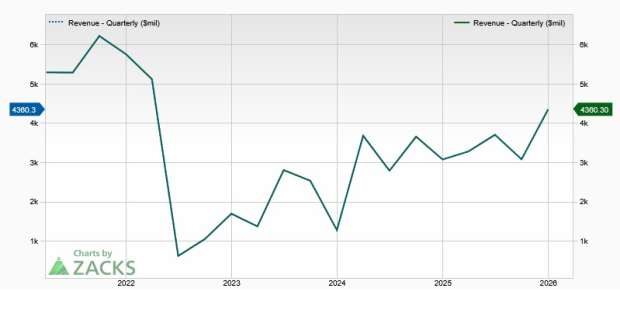
Over the five years from 2020 to 2025, Blackstone’s segment revenues have grown at a compound annual rate of 15%, fueled by rising management and advisory fees as well as investment income.
Revenue Growth at Blackstone
Source: Zacks Investment Research
During the same period, Blackstone’s total assets under management (AUM) and fee-earning AUM expanded at CAGRs of 15.6% and 14.4%, respectively. By the end of 2025, total AUM reached a record $1.27 trillion. This robust asset base underpins Blackstone’s long-term earnings, enabling the launch of new funds, attracting institutional clients, and supporting diverse investment strategies—further fueling fundraising momentum.
Even amid a tough fundraising climate, Blackstone has continued to attract capital. As of December 31, 2025, the firm’s available capital, or “dry powder,” stood at $198.3 billion. Blackstone deployed $133.9 billion in 2024 and $138.2 billion in 2025, positioning itself to capitalize on market disruptions.
The company maintains a positive outlook on sectors such as digital infrastructure, energy, life sciences, alternative assets, and the recovery of commercial real estate. Rapid growth in markets like India and Japan also presents compelling opportunities for capital deployment and future expansion.
However, Blackstone’s dividend payments are closely tied to its earnings, which can be volatile. This means its dividend may not always be reliable, and while there is a share repurchase program in place, sustaining current capital return levels could be challenging.
What Sets KKR Apart
KKR leverages a broad investment platform and an innovative insurance-focused model, providing access to stable, long-term capital. This integration enables more consistent capital deployment across market cycles, supporting growth in private equity, credit, and infrastructure.
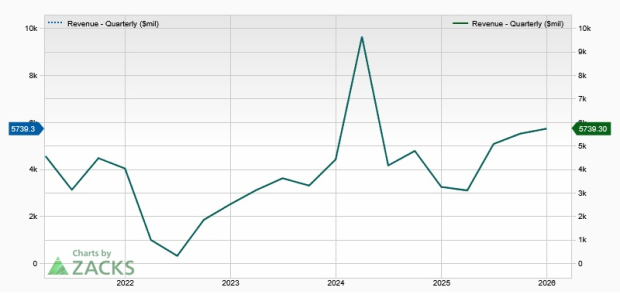
From 2020 to 2025, KKR’s total AUM grew at a CAGR of 24.2%, while segment revenues increased at a 13.8% CAGR. The firm has expanded its capabilities in infrastructure, real estate, and growth investing, resulting in more deals and a larger revenue base.
KKR’s Revenue Trajectory
Source: Zacks Investment Research
In February 2026, KKR agreed to acquire Arctos Partners for $1.4 billion, broadening its reach in private equity, credit, real assets, insurance, and capital markets. The July 2025 acquisition of a majority stake in HealthCare Royalty Partners added nearly $3 billion to KKR’s AUM.
At its 2024 investor day, KKR outlined plans to scale its core businesses and target at least $1 trillion in AUM by 2030, building on its asset management, insurance, and strategic holdings.
KKR’s capital return strategy remains robust. In April 2024, the board updated its buyback program to automatically add $500 million when the remaining authorization drops to $50 million or less, and another $500 million was added in April 2025. As of December 31, 2025, $439 million remained available for buybacks. The company also pays regular dividends and plans to increase its annual dividend from 74 cents to 78 cents per share with the results for the quarter ending March 31, 2026.
Comparing Analyst Estimates: BX vs. KKR
For Blackstone, the Zacks Consensus Estimate projects revenue growth of 21.5% in 2026 and 24.1% in 2027. Earnings are expected to rise 14% in 2026 and 26.8% in 2027, though estimates for both years have been revised downward in the past month.
Blackstone Earnings Estimate Trends

Source: Zacks Investment Research
Analysts are slightly less optimistic about KKR’s revenue outlook. Consensus estimates suggest revenue growth of 17.6% in 2026 and 15.8% in 2027. Earnings are forecast to increase by 33.9% in 2026 and 21.8% in 2027, with both years’ estimates also revised lower recently.
KKR Earnings Estimate Trends

Source: Zacks Investment Research
Stock Performance and Valuation
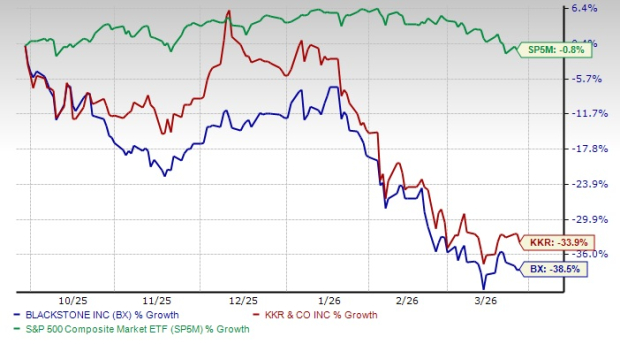
Over the past six months, Blackstone shares have dropped 38.5%, while KKR has fallen 33.9%, both lagging behind the S&P 500 Index’s 0.8% decline.
Six-Month Price Movement
Source: Zacks Investment Research
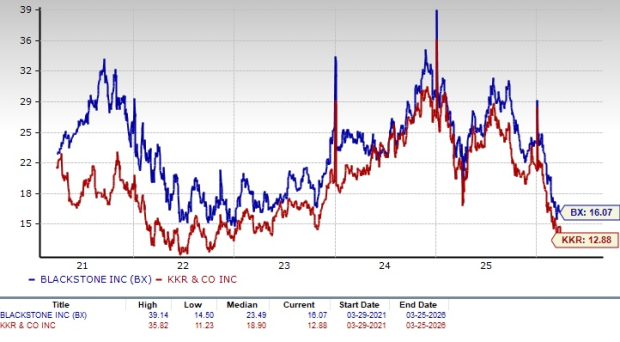
In terms of valuation, Blackstone is trading at a 12-month forward price-to-earnings (P/E) ratio of 16.07, below its five-year median of 23.49. KKR’s forward P/E stands at 12.88, also under its five-year median of 18.90.
Forward P/E Ratio Comparison
Source: Zacks Investment Research
Which Firm Offers Greater Growth Potential?
Although current headwinds in private credit may temporarily slow AUM growth for alternative asset managers, the long-term outlook remains positive as institutional investors continue to favor alternative assets. Both Blackstone and KKR, with over a trillion dollars in AUM and leading positions in private credit, real estate, and infrastructure, are well-placed for future growth.
Blackstone’s strength lies in its scale and stable fee-based earnings, making it resilient across market cycles and attractive for those seeking consistency. KKR, with its insurance-driven model, offers permanent capital and greater flexibility, potentially delivering higher returns but with increased balance sheet exposure.
Ultimately, Blackstone offers stability and scalability, while KKR provides the potential for stronger growth in certain market conditions. The choice between the two depends on whether investors value steady performance or are willing to pursue greater upside.
Currently, both Blackstone and KKR hold a Zacks Rank #3 (Hold).
Spotlight: A Top Semiconductor Opportunity
There’s a lesser-known company in the semiconductor industry that produces products not offered by giants like NVIDIA. Positioned to benefit from the next wave of market growth, this firm is just starting to gain attention—an ideal time for investors to take notice.
With robust earnings and a growing customer base, the company is set to meet surging demand in Artificial Intelligence, Machine Learning, and the Internet of Things. The global semiconductor market is projected to soar from $452 billion in 2021 to $971 billion by 2028.
More Resources from Zacks
Disclaimer: The content of this article solely reflects the author's opinion and does not represent the platform in any capacity. This article is not intended to serve as a reference for making investment decisions.
You may also like
Sharplink Shattered: SBET Plunges Over 10% Into Uncharted Depths as Volatility Ignites

GOOGL's $280 Put Barrier: How the Decline to $283 Could Be a Bear Trap and an Opportunity for Bulls

PLSE Speeds Up Cardiac Catheter Initiative Following Landmark AFib Findings
Carrier Global Drops 6%: Unexpected Industry Jolt or Underlying Trigger?

Trending news
MoreCrypto prices
More





