
Berkshire's $373 Billion Cash Hoard: A Strategic Power Play or a Waiting Game?

The numbers tell a clear story. Over the past eight trading sessions, Berkshire Hathaway's stock has fallen for eight consecutive days, marking its longest losing streak in over seven years. This recent slide has pulled the share price down 6.18% month-to-date and 5.76% year-to-date, a significant retreat from its 2025 peak. The stock is now trading around $473, a level not seen since late January, and sits roughly 12% below its all-time closing high.
This pressure follows a quarter where the underlying business results were mixed. Berkshire's operating earnings slumped 30% year-on-year to $10.2 billion, weighed down by weak insurance performance. Yet, the company's cash position tells a different part of the story. In that same quarter, Berkshire's cash pile grew to a record $373 billion, as the company sold stocks and refrained from share buybacks for the sixth straight quarter.
So, what's the investment question? The selling is a reaction to a known, strategic pause in buying, not a sudden business failure. The market is pricing in the disappointment of a sharp profit drop, but it's also grappling with the sheer scale of the cash hoard. The core tension is this: a legendary investor is holding tight, refusing to deploy nearly $400 billion into a market he sees as expensive, while the stock price reflects the earnings shortfall. The question for investors is whether this is a defensive pause, a sign of a deeper problem, or simply the market's way of waiting for the next move.
The Business Logic: Why the Cash Pile is a Strategic Asset
The recent stock price drop is a reaction to a known profit shortfall, but the real story is the deliberate strategy behind it. The 30% year-on-year drop in operating earnings to $10.2 billion was driven by a sharp decline in insurance profits, which more than offset gains in other parts of the business like rail and manufacturing. This weakness is a clear business headwind, but it's not the whole picture.


| Total Trade | 5 |
| Winning Trades | 3 |
| Losing Trades | 1 |
| Win Rate | 60% |
| Average Hold Days | 7.6 |
| Max Consecutive Losses | 1 |
| Profit Loss Ratio | 3.15 |
| Avg Win Return | 4.62% |
| Avg Loss Return | 1.51% |
| Max Single Return | 5.17% |
| Max Single Loss Return | 1.51% |
Viewed another way, this hoard is Berkshire's primary tool for future growth and its ultimate safety net. Buffett has said he would be happy to deploy $100 billion if the right opportunity arose, but he refuses to force a deal. This cash is the company's rainy day fund, built to capitalize on market downturns or major mispricings. It's the financial equivalent of having a huge, ready supply of capital when others are scrambling. For now, the business logic is clear: a strategic pause in buying, driven by valuation concerns, is creating a powerful reserve for the future.
The Valuation and Forward View: Patience vs. Panic
The investment case now hinges on a simple math problem. At a trailing P/E ratio of 15.08, the stock trades at a discount to the broader market, a clear reflection of the near-term earnings pressure. The market is pricing in the 30% slump in operating profits, valuing the company based on its current, weaker results. This creates a gap between the stock's price and the underlying business value, which is supported by that massive $373 billion cash reserve.
The key catalyst for closing that gap is Greg Abel's first full year of leadership. Buffett stepped down at the start of the year, handing the reins to his hand-picked successor. The coming 12 months will be a critical test. Can the business units-rail, utilities, manufacturing-continue to generate steady cash flow and growth without the direct, hands-on guidance of the legendary CEO? This period will show whether the company's operational engine is robust enough to run on its own, or if it still leans heavily on Buffett's strategic vision.
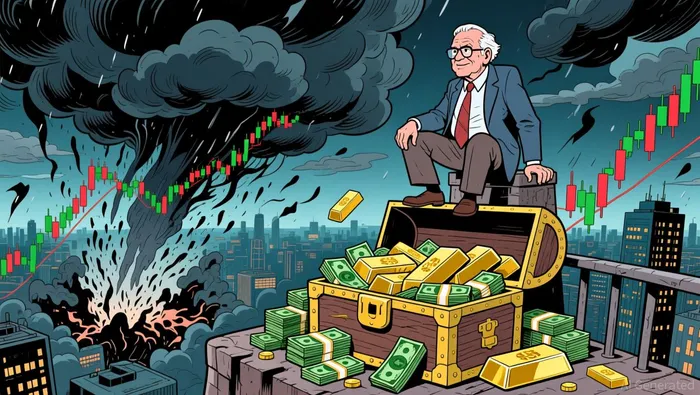
The main risk is that the cash pile remains idle for too long. A war chest of nearly $400 billion is a strategic asset, but it's also a liability if it sits unused while the company's intrinsic value grows slowly. Yet, the alternative-forcing a buy at today's elevated valuations-is exactly what Buffett has spent decades avoiding. He has spent his final years as CEO selling stocks and growing the cash reserves, a defensive playbook designed to preserve capital for a downturn. In that light, the current pause is a feature, not a bug.
The bottom line is one of patience versus panic. The stock's discount to the market is a rational response to a profit drop, but it may be overlooking the long-term value of a patient capital manager. The forward view is set by Abel's leadership test and the eventual deployment of that cash. For now, the market is waiting to see if the new captain can steer the ship as well as the old one.
Catalysts and What to Watch
The investment thesis now turns to a handful of near-term events and metrics that will test whether this is a defensive pause or a sign of deeper trouble. The first major catalyst is the next earnings report, with the estimated earnings date of May 2, 2026. This Q1 2026 release will be the first full quarter under Greg Abel's leadership and will show how the business units perform without Buffett's direct oversight. Investors will be watching for any signs of operational resilience or further weakness, especially in insurance, to gauge the stability of the underlying cash-generating engine.
More critically, watch for any shift in the cash balance or new large purchases. The entire defensive strategy is built on that $373 billion hoard. A significant reduction in cash, or the announcement of a major acquisition, would signal a change in the posture that has defined the past three years. As Buffett has said, he would be happy to deploy $100 billion if the right opportunity arose, but he refuses to force a deal. The market is waiting for that signal. Any move to deploy capital would validate the thesis that the current market is no longer a "casino" in his eyes, while continued inactivity would reinforce the caution that is currently pressuring the stock.
Finally, the broader market valuation remains a key backdrop. The Buffett Indicator, which measures the total market capitalization of U.S. stocks against the nation's GDP, stands at 221%. This elevated level is a direct reflection of the market's "feverish activity" that Buffett has warned about. It highlights the very reason for his defensive playbook-selling stocks and building a war chest. For individual investors, this indicator serves as a reminder that the caution behind Berkshire's strategy is rooted in a simple, long-term rule: avoid paying high prices in a market that is already expensive. The coming months will show if that rule continues to pay off.
Disclaimer: The content of this article solely reflects the author's opinion and does not represent the platform in any capacity. This article is not intended to serve as a reference for making investment decisions.
You may also like
Chinese Trader Who Was Previously Bullish on Bitcoin and Altcoins Has Revealed His Future Plans

Euro Stablecoin Movement Compared to Presale Excitement: Examining the Liquidity Hypothesis

StableX Network: An Institutional Adoption Analysis Based on Flow Dynamics

Trending news
MoreCrypto prices
More





