
Hedge funds sell tech stocks at fastest pace in two years as cracks appear within US equities

Behind the record highs in the indices, hedge funds are exiting tech stocks at the fastest pace in two years.
Last week (ending April 25), the S&P 500 and Nasdaq both rose, with the Nasdaq 100 (NDX) up 2% for the week. However, according to Goldman Sachs trading desk data, this rally was far from a broad-based bull market.
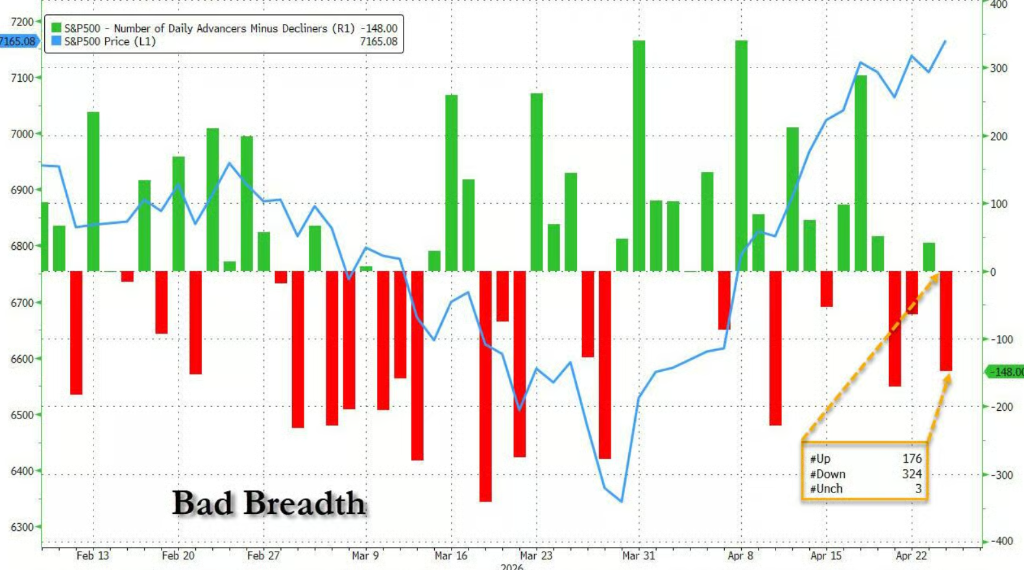
On Friday, the S&P 500 hit an all-time high, yet 324 constituent stocks closed lower that day, with a net breadth reading of -148—a record for the second worst market breadth on a high day, only behind October 2025, when 80% of S&P constituents fell on a record day.
Beneath the surface prosperity, clear divisions have emerged within the market.
Hedge Funds Undergo Major Deleveraging, Tech Stock Sell-off Hits Nearly Two-Year High
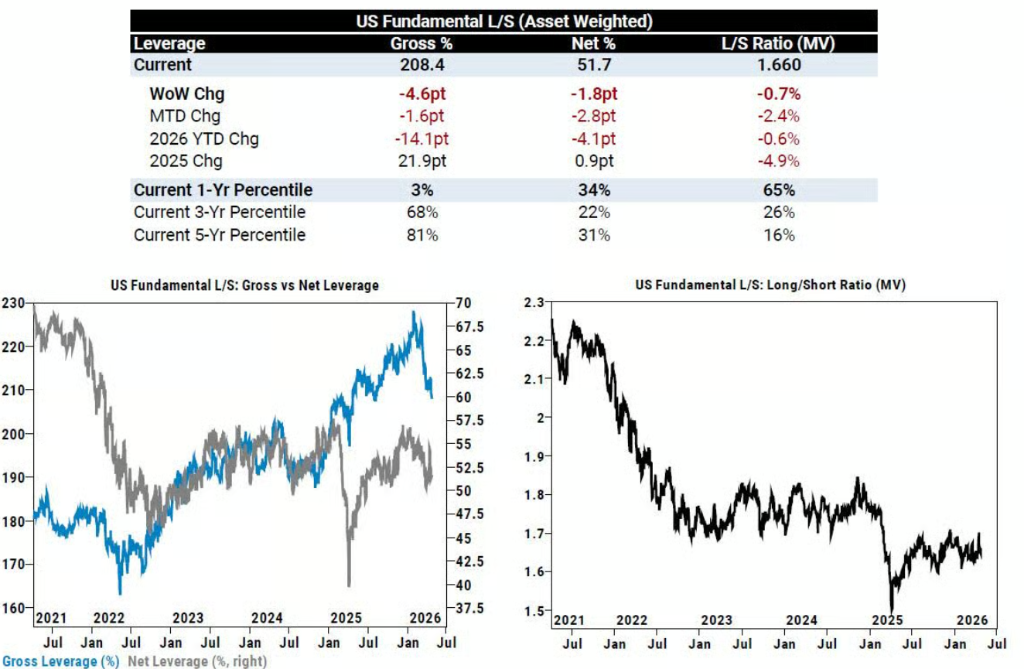
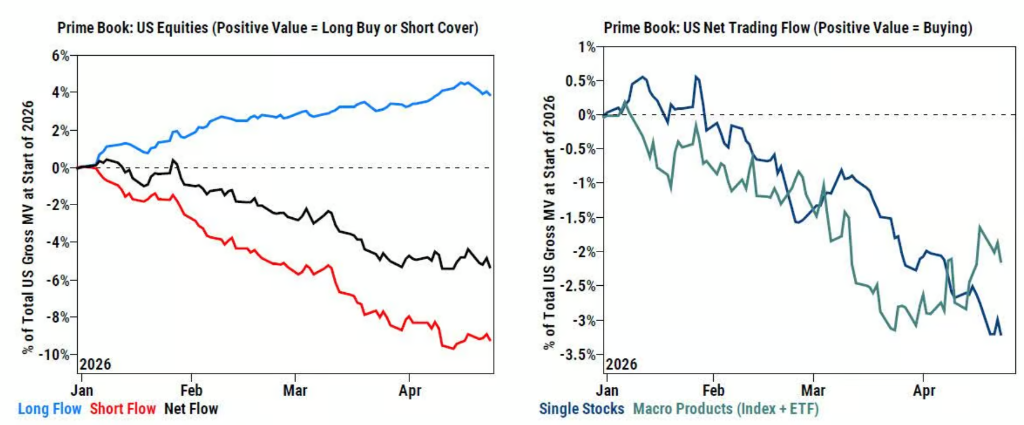
Goldman Sachs prime brokerage’s weekly report shows total leverage among US long/short hedge funds fell 4.6% last week, with US equities seeing the largest nominal deleveraging in seven months (since September 2025), primarily driven by risk unwinding on individual stocks.
US equities have now seen net selling from hedge funds for the second consecutive week—nine out of the last ten weeks have been net selling, almost entirely from long unwinding. Net selling was observed in nine out of eleven sectors.
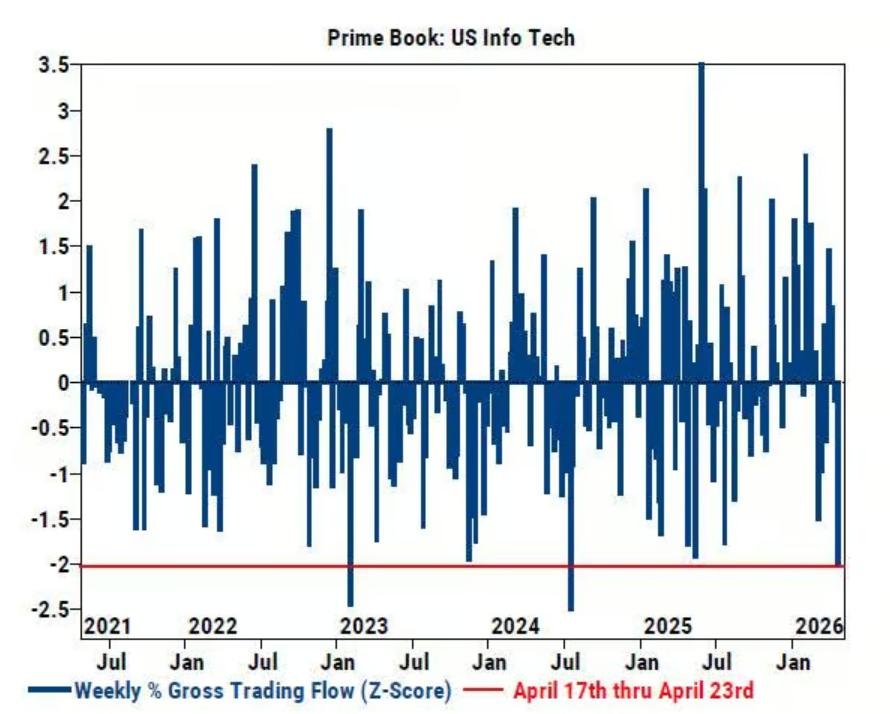
The most notable is the Information Technology sector: Last week, single-week deleveraging in this sector was the largest since July 2024 and the third largest in the past five years. Specifically, the ratio of long sales to short covering was 1.9:1, with almost all sub-sectors undergoing deleveraging. Ranked by nominal value: software (long sales > short covering), semiconductors and semiconductor equipment (long sales), tech hardware (short covering > long sales), and communication equipment (long sales > short covering).
What’s concerning is that despite this week’s significant deleveraging, total exposure of the Information Technology sector still makes up 20.6% of US equities market cap—at the 92nd percentile for the past year and the 98th percentile for the past five years. Goldman Sachs noted this means "if tech stocks start falling, there is still a long way down."
Consumer Discretionary Stocks Face Seven Consecutive Weeks of Selling, Retail Under Pressure
The Consumer Discretionary sector is also in a tough position. Hedge funds have posted net sales in this sector for seven consecutive weeks, with last week’s sell speed the fastest in ten weeks (-2.1 standard deviations, based on the past year), again almost solely from long unwinding.
Leading declines among sub-sectors were retail, hotels/restaurants/leisure, textiles/apparel, and luxury goods.
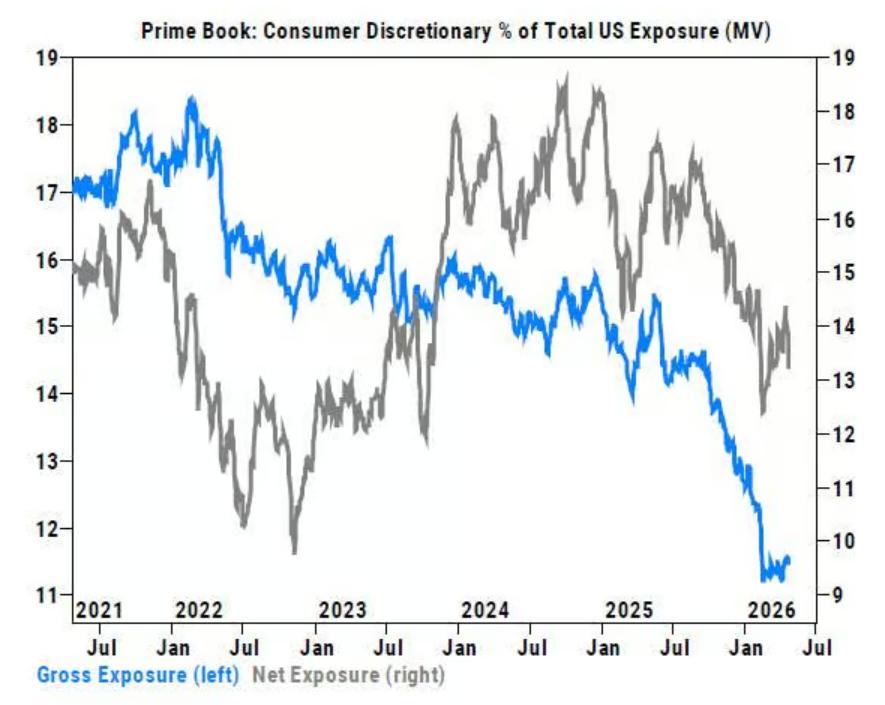
From a position perspective, Consumer Discretionary currently accounts for 11.5%/13.2% of hedge fund total/net exposure to US equities, ranking at the 14th/7th percentile for the past year, and the 3rd/29th percentile for the past five years—meaning holdings have been cut to historically low ranges.
Goldman Sachs’s trading desk also pointed out that the retail sector underperformed the market for four straight days last week, with a total relative gap of -350 basis points. "There’s no obvious single cause; it’s more the market’s growing concerns over oil prices, input costs, and waning fiscal stimulus effects, with focus shifting to the second half of the year."
Divergence Between Asset Managers and Hedge Funds, ETF Short Covering Continues
In contrast to hedge funds’ caution, data from Goldman Sachs equity sales desk shows asset managers are increasing positions in some tech segments, showing signs of "re-risking."
On macro products (indexes and ETFs combined), last week saw a slight net buy (+0.1 standard deviations, annual baseline), driven by moderate long buying and short covering at a ratio of 2.7:1. US-listed ETF short interest fell another 1.4% last week and is down 21.5% month-to-date, with covering concentrated in credit, information technology, and small cap ETFs.
AI Narrative Supports the Nasdaq, But This Week’s Earnings Are the Real Test
Though hedge funds are reducing exposure, the market is still digesting positive AI data points. Goldman Sachs’s trading desk notes that densely packed Google partnership announcements, as well as strong earnings from Intel (INTC), Texas Instruments (TXN), Lam Research (LRCX), and Hynix, have revived confidence in semiconductor and AI trades. The Philadelphia Semiconductor Index (SOX) jumped 9% last week, pushing its RSI to 85. Intel’s better-than-expected results and guidance boosted AMD, ARM, Qualcomm (QCOM), among others, all surging over 10% in a single day.
But the real test comes this week—Meta, Microsoft (MSFT), Google (GOOGL), and Amazon (AMZN) will all report earnings after the bell on Wednesday. With hedge funds having already cut their positions significantly, the results will directly determine whether tech stocks can hold their current gains.
Disclaimer: The content of this article solely reflects the author's opinion and does not represent the platform in any capacity. This article is not intended to serve as a reference for making investment decisions.
You may also like
Wall Street giants’ trading operations show a tale of two extremes: JPMorgan (JPM.US) expects a surge in Q3 performance, while Bank of America (BAC.US) warns of a slowdown
JPMorgan predicts that trading and investment banking income will see double-digit growth in Q3, triggering a rebound in its stock price. Previously, Bank of America warned of flat revenue due to a pullback in financing, leading to a sell-off in the sector.

Trillion-dollar defense budget in sight, Guggenheim strongly recommends defense stocks, L3Harris Technologies (LHX.US) is the top large-cap pick
Guggenheim Securities recently initiated coverage of 22 aerospace and defense companies, with an overall positive outlook on defense contractors and aircraft manufacturers, but a cautious attitude toward commercial aviation aftermarket suppliers.

Tokenized funds expand across chains, yet liquidity remains fragmented – Why?

Japan Reportedly Plans to Double Defense Spending to 3.5% of GDP, Ministry of Defense Denies, Yet Japanese Bond Yields Hit 30-Year High
According to reports, Japanese defense officials have expressed their willingness to significantly increase defense spending during meetings with the United States. One proposal is to raise defense spending to 3.5% of GDP within ten years, while another, lower target is 3%. Japanese officials previously stated that this fiscal year's defense and related expenditures are approximately $68.8 billion, equivalent to about 1.9% of Japan's nominal GDP in 2022.
Crypto prices
More


