
Earnings Reports of Tech Giants: Insights and Implications

Three tech giants reported their earnings on the same night, and the explosive growth of the cloud business is prompting Wall Street to reassess the commercial returns of AI.
According to Winds Trading Desk, on April 30, a Morgan Stanley analyst team led by Brian Nowak released research interpreting the latest financial reports from Google parent company Alphabet, Amazon, and Meta. The accelerated revenue growth of hyperscale cloud providers is becoming the most important validation signal for generative AI's return on invested capital (ROIC) this year.
Google Cloud: Order Backlog Doubles, TPU Chip Sales Become a New Story
Google Cloud was the biggest surprise of this earnings season.
Quarterly revenue grew 63% year-on-year, exceeding the buy-side expectation of 60%. The growth came from two drivers: first, Gemini Enterprise's paid MAUs surged quarter-on-quarter, with over 16 billion tokens processed per minute via direct API; second, sustained strong demand for AI infrastructure, with Google continuing to sell TPUs and GPUs to external customers.
Perhaps even more striking is the order backlog figure. Google Cloud’s quarter-end order backlog jumped from $243 billion to $462 billion, a net increase of $219 billion in a single quarter, nearly doubling. Morgan Stanley points out that this reflects large private lab contracts, as well as Google’s contribution from selling TPU chips to third parties.
TPUs sold to external clients is a new variable. Morgan Stanley estimates, based on chip sales volume and unit price, TPUs may have contributed $20 billion to $100 billion (base case about $55 billion) to this quarter’s order backlog. This means Google is not just a cloud service provider but is also selling computing hardware externally—a logic previously seen as a “bull case” but now becoming the base case scenario.
The financial impact is directly reflected in forecasts: Morgan Stanley raised 2026/2027 Google Cloud revenue forecasts by approximately 11%/40%, expecting growth rates of 78%/86%. Looking farther ahead, under the current model, Google Cloud’s EBIT contribution as a proportion of overall company EBIT is expected to exceed 50% by 2029 and reach 64% by 2030.
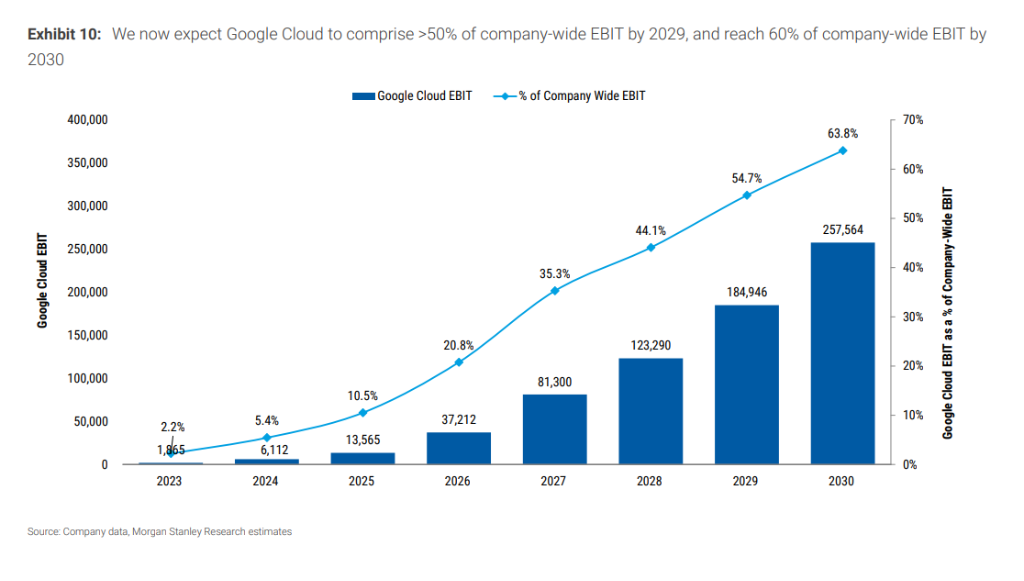
As a result, Morgan Stanley raised Google’s target price from $330 to $375, corresponding to 24x 2027 projected EPS of about $15.74, maintaining an “Overweight” rating. The 2027 EPS estimate was also raised 14% to around $16.
AWS: Growth Misses Expectations, But Backlog Shows Stronger Future
AWS grew 28% year-on-year this quarter, below the approximately 30% expected by the buy side, making it a relatively “lackluster” result in this set of reports.
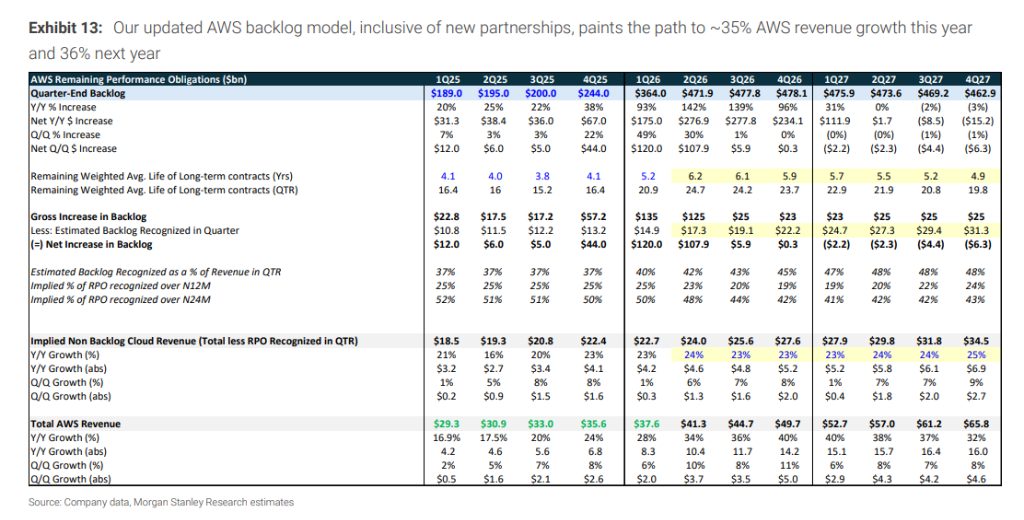
However, Morgan Stanley reminds investors not to focus only on this quarter’s numbers. AWS accelerated about 480 basis points from last quarter, and the change in backlog is even more telling: quarter-end backlog increased from $244 billion to $364 billion, a net addition of $120 billion in a single quarter, beating Morgan Stanley's previous forecast of about $350 billion, mainly from large-scale private lab contracts and new business.
Morgan Stanley forecasts that as capacity comes online, AWS’s growth will further accelerate to 35%/36% in 2026/2027, respectively.
Amazon’s retail business also exceeded expectations: North American Q1 EBIT was about $1 billion above expectations, with unit growth of about 15% year-on-year, beating expectations by about 400 basis points, and fulfillment and delivery costs were 2% lower than expected.
Combining cloud and retail businesses, Morgan Stanley raised Amazon’s 2027 EPS forecast by about 9% to approximately $11.3, increased the target price from $300 to $330, corresponding to about 29x P/E, and maintained an “Overweight” rating.
META: Ads Remain Robust, But Lacks the Cloud Play
META’s situation differs from Google and Amazon.
Q1 revenue was $5.631 billion, slightly below the expected $5.676 billion, but core ad metrics continued to improve: Facebook video viewing hours grew over 8% quarter-on-quarter, the largest increase in four years; Instagram Reels hours rose by 10%; global average ad price increased 12% year-on-year; ad impressions up 19% year-on-year.
Adjusted EBITDA margin reached 62%, much higher than the expected 56.3%.
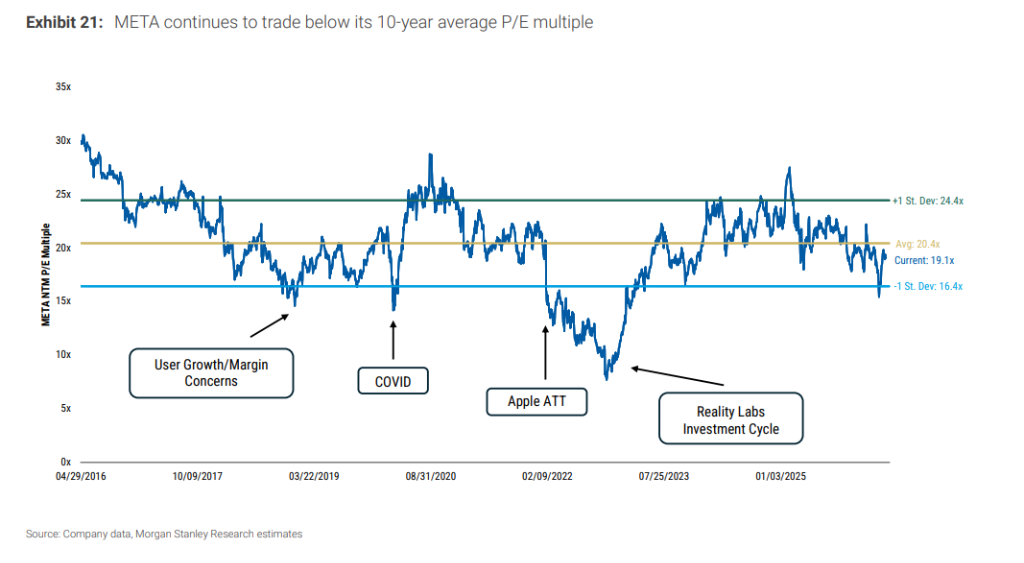
However, Morgan Stanley points out that unlike Google Cloud or AWS, META does not have a high-growth business that can directly showcase AI investment returns, nor does it have forward-looking revenue visibility. Therefore, whether META’s share price can be re-rated further hinges on the commercialization of new Muse-driven products (such as personal AI shopping assistants) and changes in user adoption and payment behavior.
Morgan Stanley also mentions that an internal META memo shows management plans to lay off about 10% of staff (approximately 8,000 people) and close about 6,000 open positions (a further 8% reduction in headcount). Every 10% staff reduction is expected to add about $0.50 to $1.50 to 2027 EPS. Morgan Stanley currently forecasts META’s 2027 baseline EPS at about $34, with a target price of $775 representing about 23x P/E, maintaining an “Overweight” rating.
Capital Expenditure: Projected to Surpass $1 Trillion by 2027
Behind the rapid growth of cloud businesses lies relentless increase in capital spending.
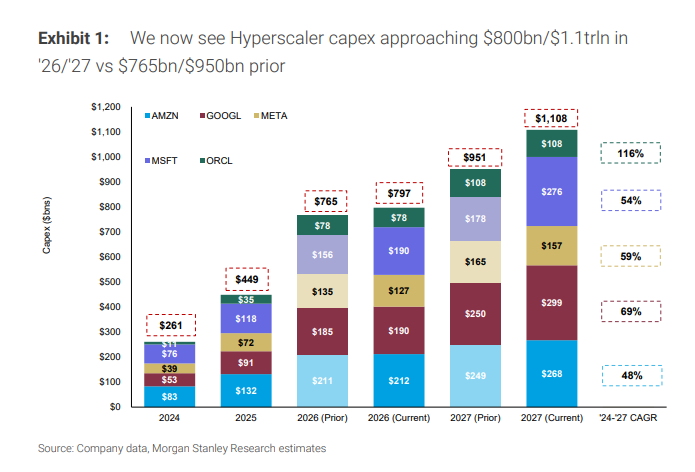
Morgan Stanley’s latest forecast is that the five hyperscale cloud providers (Amazon, Google, Meta, Microsoft, Oracle) will total about $800 billion in capital expenditures in 2026, surpassing $1.1 trillion in 2027—an upward revision from the previously estimated $950 billion.
For individual companies: Google raised its 2026 capex ceiling by $5 billion; Morgan Stanley expects Google/Amazon data center capex in 2027 to reach $300 billion/$225 billion, respectively.
The logic behind this spending: invest heavily and build capacity first, then recover these investments through scaled revenue and ROIC. The surge in order backlog is the most direct evidence that this logic works.
Cloud Market Structure: Google’s Quarterly New Revenue Surpasses AWS and Azure for the First Time
In terms of quarterly new revenue—the “market share barometer”—Google Cloud added $2.3 billion in Q1, AWS added $2.0 billion, and Azure added $1.9 billion.
This is a noteworthy signal: Google Cloud’s quarterly new revenue surpassed AWS and Azure for the first time.
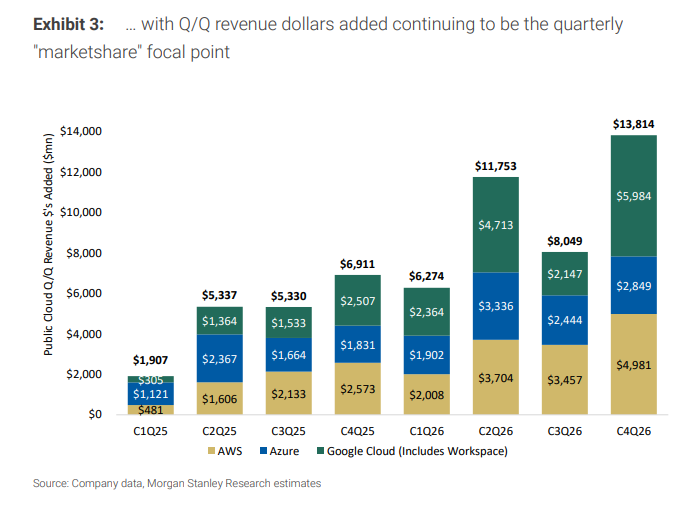
The three cloud providers’ combined quarter-end backlog now exceeds $1.5 trillion, clearly signaling continued growing demand.
Disclaimer: The content of this article solely reflects the author's opinion and does not represent the platform in any capacity. This article is not intended to serve as a reference for making investment decisions.
You may also like
SpaceX (SPCX.US) has 80% upside potential hidden in Starship? Morgan Stanley: The 15th test flight will be a major catalyst
Morgan Stanley stated that SpaceX's upcoming 15th Starship flight mission could mark an important step toward making its next-generation rocket fully reusable, potentially expanding the company's opportunities in satellite communications and artificial intelligence (AI) sectors.
Up 20% in October, funds bet on another 30% surge! "Self-destructing" Snap (SNAP.US) call options soar as specs push for $5 billion valuation
As of Monday during the U.S. stock market hours, Snap has risen by more than 20% this month, and its options trading volume has surged to over four times the monthly average. Of the approximately $5.5 million in total options premiums traded, about $5 million came from call options.
Ahead of Earnings Report, Bank of America Raises Target Price for TSMC: 2nm Capacity Ramp-Up Boosts Sales Expectations and Profit Margins
Ahead of TSMC’s Q3 earnings report, Bank of America Merrill Lynch raised its US stock target price to $620 and maintained a Buy rating. Q3 revenue is expected to exceed the upper end of guidance, with the proportion of 2nm process rising from 3% to 11% in a single quarter, becoming the biggest highlight. Q4 sales are expected to increase by another 11% quarter-on-quarter, targeting a full-year growth rate of 40%. The current stock price corresponds to a forward P/E ratio of 16, which is still at the historical median. Bank of America believes the valuation is “not demanding,” implying approximately 37% upside to the target price.
Crypto prices
More


