
Infographic: 30 Hyperliquid Web3 business partners building an operating system for on-chain liquidity

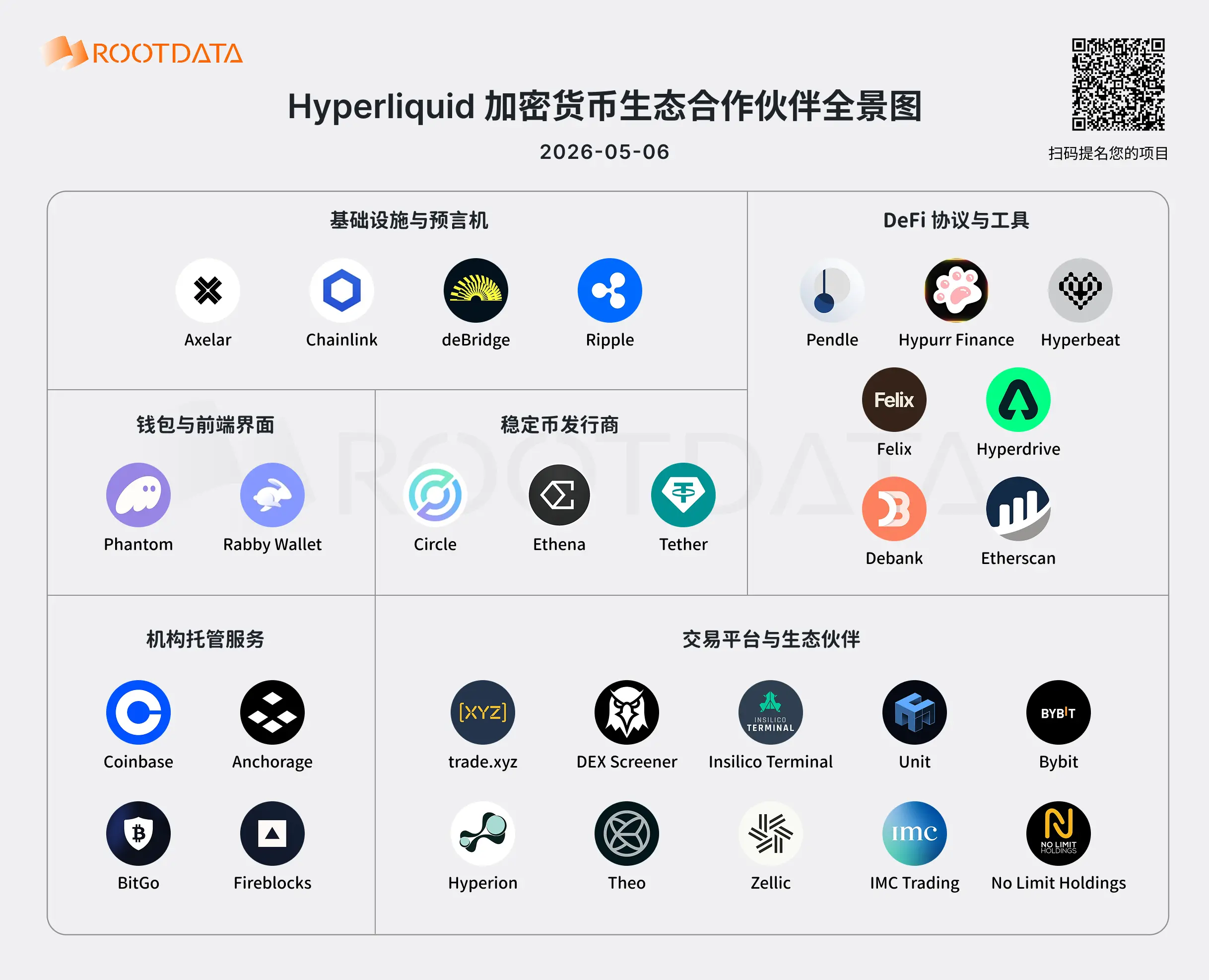
The Web3 asset data platform RootData has compiled Hyperliquid’s 30 Web3 business partners, covering a range of key areas including stablecoins, cross-chain infrastructure, wallet gateways, DeFi protocols, institutional custody, and trading ecosystems, gradually forming a comprehensive on-chain financial system.
At the capital layer, Hyperliquid has integrated with stablecoin issuers such as Circle, Tether, and Ethena. In terms of fundamental infrastructure, it connects with cross-chain and oracle service providers such as Chainlink, Axelar, deBridge, and Ripple. At the user access layer, it is compatible with wallets and frontend tools like Phantom, Rabby Wallet, and DeBank, lowering the entry barrier for users.
Meanwhile, more native DeFi protocols are emerging within its ecosystem, such as Pendle, Felix, HypurrFi, and HyperBeat. According to RootData, the Hyperliquid ecosystem has included 145 quality projects, indicating that Hyperliquid is attracting more financial applications to build their businesses around its liquidity.
In addition, the participation of custodial service providers such as Anchorage Digital, BitGo, and Fireblocks has allowed it to begin connecting with larger-scale institutional capital. Trading platforms and market makers including a certain exchange, trade.xyz, and IMC Trading are further enhancing market liquidity.
Overall, Hyperliquid is continuously expanding outward around “on-chain liquidity,” aiming to replicate the ecological model of centralized exchanges on-chain, but with the focus no longer on the account system. Related compilation 【Hyperliquid Web3 Partner Network Collection (Continuously Updated)】
It has become a key method for crypto projects to proactively showcase their partner networks to enhance transparency and market trust. Reportedly, RootData welcomes Web3 project representatives to claim their information records and continuously tracks and opens up more project business relationship disclosure channels. The platform has published multiple crypto project ecosystem overviews in succession, nominating Web3 ecosystem partners serving upstream clients such as Visa, Mastercard, and a certain exchange.
If you wish to nominate your project in future ecosystem overviews, you are welcome to fill in the 【RootData 2026 Industry Ecosystem Mapping 】form to add your important clients and partners.
Disclaimer: The content of this article solely reflects the author's opinion and does not represent the platform in any capacity. This article is not intended to serve as a reference for making investment decisions.
You may also like
Under continuous pressure from inflation and interest rate hike concerns, US Treasury sell-off intensifies; 30-year yield once surpassed 5.6%, hitting a more than 24-year high
U.S. long-term Treasury yields continued to rise on Tuesday, extending the recent sharp upward trend.
The US releases the final batch of strategic oil reserves, up to 40 million barrels, urging Europe to follow suit.
This is the final batch of the 172 million barrels of reserves released by the United States in this round; after this release, the U.S. Strategic Petroleum Reserve will drop to its lowest level since 1982, approaching legal and operational red lines. Meanwhile, the U.S. Secretary of Energy criticized some European countries for releasing far less than expected, urging them to fulfill their commitments. Currently, gasoline and diesel prices in the U.S. remain high, and less than two months remain until the midterm elections. On Tuesday, WTI crude oil futures fell by 3.95%.
Raphael Zagury: Bitcoin will eventually surpass gold
Federal Reserve Bowman: AI Brings Both Opportunities and Risks to the Banking Industry, Fed Urges Strengthening of System Security Protections
Federal Reserve Vice Chair for Supervision, Bowman, warned that AI has a dual impact on the banking industry, serving both as a defensive tool and introducing new emerging risks. She urged banks to strengthen basic cybersecurity measures, including updating asset inventories, deploying multi-factor authentication, and improving vulnerability management. Bowman also stated that regulators will continue to adjust their examination approaches, implementing differentiated supervision for community banks instead of imposing blanket mandatory requirements.
Crypto prices
More


