
“TACO” is outdated, Wall Street is flooding into “NACHO” trades!

“TACO trades are now outdated.” As doubts deepen over whether the Hormuz Strait crisis can be swiftly resolved, Wall Street is embracing a new trading narrative—“NACHO.”
“NACHO” stands for “Not A Chance Hormuz Opens,” and has recently been spreading rapidly among traders and market commentators. The rise of this saying stems from broad market disappointment over Trump’s repeated calls to “reopen the strait quickly” never leading to substantial progress.
eToro market analyst Zavier Wong told the media, “NACHO essentially means the market is giving up hope for a quick fix.” Last Thursday, US and Iranian forces continued to exchange fire in the Hormuz Strait, with both sides blaming each other for provoking first, and the already fragile ceasefire agreement came under renewed pressure.
The spread of the “NACHO” trade is reshaping positions in the oil market, shipping, inflation hedges, and rates markets. Several industry veterans point out that investors are increasingly treating the prolonged blockage of the Hormuz Strait as a ‘normalized characteristic’ of the macro environment, rather than a one-off geopolitical shock. Although Brent crude prices have retreated from war-time highs of $126 per barrel at the end of April, they are still trading above $100, more than 38% higher than pre-conflict levels in the Middle East.
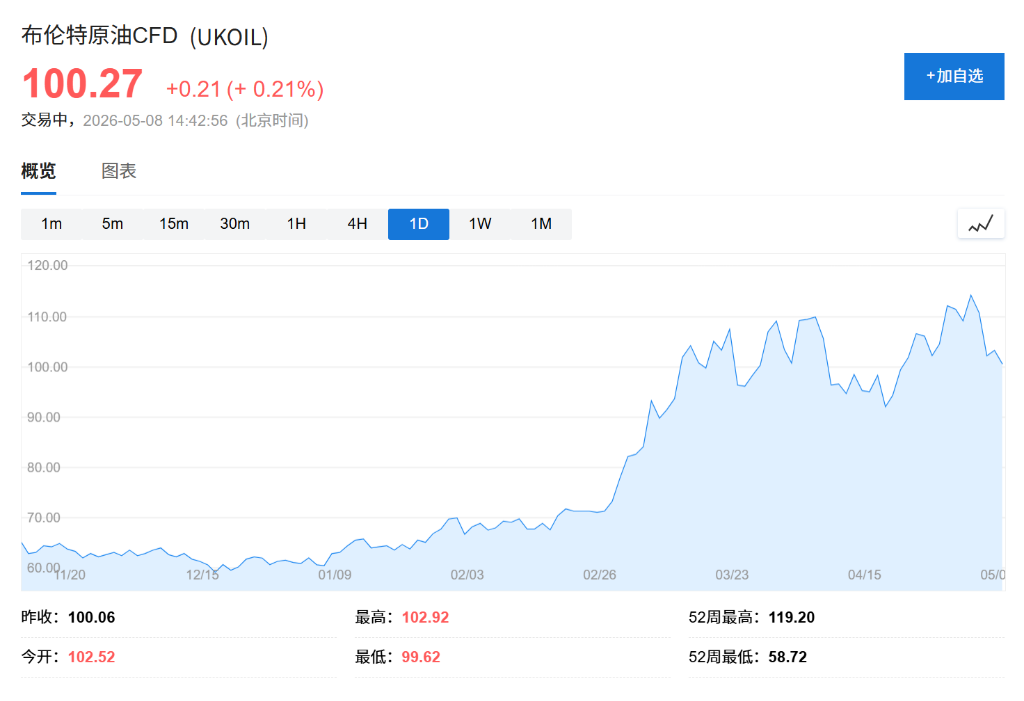
Ceasefire Becomes Empty Talk, Market Loses Patience
The formation of the "NACHO" trade has a clear market logic. Wong points out, "Through most of this crisis, every ceasefire headline triggered a sharp drop in oil prices, as traders kept pricing in reconciliation—but reconciliation never came."
Last Wednesday, Trump warned that if Iran refused to sign a peace agreement, it would face “more intense” bombing and used tough language; on Thursday, in an interview with ABC, he insisted the ceasefire was holding, describing the exchanges as "a gentle pat of love." These mixed signals have intensified uncertainties over the direction of the crisis.
Against this backdrop, the market has gradually shifted from ‘trading a resolution’ to ‘trading a stalemate.’ Wong states, “NACHO is a market perception—high oil prices are not a temporary shock to get around, they are the current market environment.”
Insurance Market Sends Strong Alert
Aside from oil prices, the pricing in the shipping insurance market has also been sounding the alarm. Wong points out that at its peak in March this year, war risk premium for ships transiting the Hormuz Strait soared to about 2.5% of hull value, compared to only about 0.1% before the conflict.
According to eToro data, although the premium has pulled back since, the current level is still about eight times that of the pre-war rate. “Insurers’ business is to price risks, and clearly, they aren’t seeing this as a short-term issue,” Wong said.
He believes insurance market pricing better reflects the market’s true assessment of the situation’s duration than oil prices themselves. “Signals come not only from oil prices, but also from the insurance market.”
TACO vs NACHO?
Analysts at State Street Global Advisors note that both “TACO” (“Trump Always Chickens Out”) and “NACHO” trades are playing out simultaneously in Q2.
The institution wrote in a recent report, “Despite high energy prices, the S&P 500 Index still rebounded to historic highs—both trades are playing out at the same time.”
State Street says that traders remain cautiously optimistic about a peace deal eventually opening the strait, but the market needs to see a “real peace agreement” before regaining strong expectations for substantial Fed rate cuts. The institution also pointed out that if $100 per barrel becomes the new normal for the next one to three months, gold’s upward momentum around $5,000 per ounce may be challenged; conversely, if oil falls to $80 per barrel because a peace deal is reached, gold might quickly break through $5,000 and eventually test $5,500.
Rates Market Admits Reality First, Risk Assets Remain Cautious
Despite the stock market’s unusual resilience, internal market divergence is deepening. Vasileios Gkionakis, senior economist and strategist at Aviva Investors, states, “Overall, the market’s reaction to the energy shock has been relatively orderly.”
However, he also points out that the rates market is clearly increasingly reflecting concerns of a prolonged energy shock. “The clearest signal comes from the rates market—short-term rates have been sharply repriced, and most yield curves have significantly flattened.” He warns that if the Hormuz Strait remains blocked for the long term, it could trigger “more persistent inflation shocks” and increase the probability of a global recession.
Gkionakis notes that only parts of the market have fully embraced the NACHO narrative—for oil, shipping insurance, and rates, prolonged blockade is already being priced in, while equities and broad risk assets are still relatively calm.
The Stalemate May Be a Stage, Not the End
Although pessimism is taking root among traders, analyst Zavier Wong himself has not given up hope that the strait may eventually reopen. He points out the blockade is hurting Iran’s export revenues, and other countries are pressuring for the strait to be reopened—these factors are potential forces pushing towards change.
“The road ahead will likely remain bumpy, but it seems the market is starting to accept this reality,” Wong said. For investors, the core message from the NACHO trade is: The structural impact of the Hormuz crisis on the macro landscape may be far deeper and longer lasting than previously expected.
Disclaimer: The content of this article solely reflects the author's opinion and does not represent the platform in any capacity. This article is not intended to serve as a reference for making investment decisions.
You may also like
Musk on chip production: China's large-scale manufacturing capacity often exceeds the sum of all other regions worldwide
After ChangXin Memory Technologies announced a key breakthrough in DDR5 server memory, the Philadelphia Semiconductor Index in the US stock market fell 2.7% overnight, with shares such as Micron and SK Hynix ADR dropping collectively. Musk commented on this trend, saying that when China figures out the manufacturing method of a product, its ability to scale production often exceeds that of the rest of the world combined, and stated that "China seems to be rapidly conquering" general standard specifications such as LP5 and LP6.

IREN reports $702.6 million net loss despite $4 billion in AI cloud contracts
The current AI frenzy: featuring both "Tech and Internet" and "Real Estate" bubble characteristics, reminiscent of the 2008 global capital cycle
This wave of the AI boom exhibits dual characteristics: On a micro level, the heavy-asset nature of AI data centers is driving the industry toward "real estate-like" debt financing models, such as corporate bonds, private credit, and computing power ABS. On a macro level, nearly $2 trillion in overseas excess savings is flowing into core AI assets in the U.S. stock market through private institutions, reconstructing a transnational capital cycle reminiscent of the period before the 2008 subprime mortgage crisis. With nearly $3 trillion in off-balance sheet debt and rising interest rates, the industry is facing an impending major liquidity test.

AI Trading Faces a "Vulnerable Moment"! Japan and South Korea Stock Markets Experience "Black Tuesday" as SK Hynix, Samsung, and SoftBank Plunge Together
On Tuesday, Asian tech stocks faced a new round of systemic sell-off as the overnight weakness in the US semiconductor sector spread to the Asia-Pacific market. Concerns intensified over increasingly fierce competition due to the technological breakthrough by Chinese memory chip manufacturer ChangXin Memory Technologies, as well as worries about the returns on AI capital expenditure and the overall financing environment.
Crypto prices
More


