
BlackRock Private Investments Fund’s tender offer comes up short on seller interest

When a fund opens a window for investors to cash out and most of them decide to stay, that is either a sign of confidence or a sign that investors have simply accepted they are in for the long haul. BlackRock’s Private Investments Fund just offered its investors a quarterly exit door, and not enough of them walked through it to fill the available capacity.
The fund’s latest tender offer was undersubscribed, meaning the volume of shares submitted for repurchase fell below the maximum the fund was prepared to buy back. Every share that was tendered got accepted.
How BPIF’s liquidity mechanism actually works
The BlackRock Private Investments Fund, known as BPIF, is a registered closed-end fund structured under the Investment Company Act of 1940, built specifically for accredited investors who want private equity exposure without capital calls or performance fees.
Liquidity is the trade-off. Unlike publicly traded funds, investors cannot simply sell shares on an exchange whenever they feel like it. Instead, BPIF runs quarterly tender offers, during which the fund may repurchase shares worth up to 5% of its net asset value, subject to board approval.
The process works roughly like a controlled auction. Investors submit shares. The fund evaluates how many it can take back. If demand exceeds the 5% cap, shares get prorated. If demand falls short of that cap, everyone who tendered gets fully accommodated. This latest cycle fell into the second category.
There is also a cost to exiting early. Investors who have not held their shares for at least one year face a 2% early repurchase fee, though waivers exist under certain conditions.
What undersubscription actually signals
BPIF targets a highly selective investment approach, with a historical selection rate of roughly 3% to 5% of deals reviewed. The management fee sits at 1.75%, though that is scheduled to decrease to 1.10% through December 31, 2025. For a fund with no performance fee, that fee structure is a meaningful part of its pitch to cost-conscious investors comparing it against traditional private equity vehicles that layer on carried interest.
The fund has accepted monthly subscriptions since its launch, allowing accredited investors to enter on a rolling basis. That accessibility, combined with the absence of capital calls, makes BPIF structurally different from most private equity partnerships, where investors commit capital upfront and then wait for the manager to deploy it over years.
What this means for investors in private equity-adjacent structures
For investors already in BPIF, the full acceptance of tendered shares is a clean outcome. Nobody got prorated. Nobody was left holding shares they wanted to sell. That matters because in oversubscribed tender offers, investors only get a fraction of their requested repurchase honored, which can strand capital in a position longer than intended.
For potential investors evaluating BPIF, the fee reduction to 1.10% through the end of 2025 is worth tracking. Lower fees on a fund with no performance charge and selective deal access represent a meaningful improvement in net return potential, assuming the underlying portfolio holds up.
Disclaimer: The content of this article solely reflects the author's opinion and does not represent the platform in any capacity. This article is not intended to serve as a reference for making investment decisions.
You may also like
XRP surges 47% from 2026 low as ETF inflows hit $39.7 million
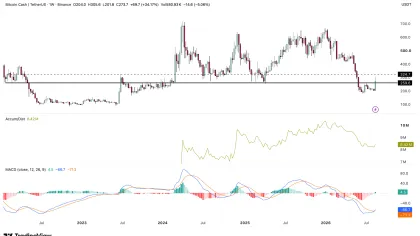
Bitcoin Cash Spot demand stays weak for 10 days – But overheating signals emerge
Trump Says America Will Lead the Crypto Revolution — Are These 5 Altcoins the Biggest Risk-Reward Bets of Altseason 2026?
July Returns! Goldman Sachs: Storage stocks with "poor performance" are most attractive, finance and hard assets become new hotspots
Goldman Sachs believes that the "easy win" era of AI trading is over. Current excess returns can only be found in accurately bottom-fishing when stock prices deviate significantly from earnings forecasts, with storage and data centers remaining the most tactically attractive areas. The market is rapidly moving beyond the single AI narrative and showing multiple points of growth: momentum factors are shifting toward software, European and Japanese banks are facing structural opportunities, gold miners and copper mining stocks have room for valuation and earnings recovery, and France's political risk premium is being underestimated.
Crypto prices
More


