
The United States is changing its "statistical methods"! Wall Street: Aims to "lower" core inflation, risk of manipulation exists

The Federal Reserve's preferred inflation gauge is quietly undergoing a "stealth revision."
The U.S. Bureau of Economic Analysis (BEA) has announced methodological changes to three components of the PCE price index. According to "Odaily Planet Daily," Goldman Sachs and UBS have released research reports suggesting that these changes will systematically lower core PCE inflation readings. UBS is more direct, pointing out that the choice of revisions "appears designed to suppress inflation," while warning that the new methodology lacks transparency, making independent verification by outsiders difficult and raising the risk of data manipulation.
Three Changes, One Outcome
BEA’s revisions affect three components, which will officially take effect on September 30, 2026, and, as usual, will retroactively revise historical data.
First: Computer Software and Accessories
Current method: Fully uses software and accessories prices from the CPI.
New method: Switches to a "composite price index" formed from data processing PPI, video game software PPI, and CPI software and accessories.
Goldman Sachs analysts including Manuel Abecasis estimate that, since data processing and video game PPI are currently rising slower than the CPI software component, this change will reduce year-on-year core PCE inflation by 0.05 to 0.1 percentage points in May and by 0.1 to 0.2 percentage points in December.
Analysts also note that even after this adjustment, the contribution of software and accessories to core PCE inflation may still be overestimated by about 0.1 percentage points (in May) and at peak, by about 0.3 percentage points.
Second: Portfolio Management Services
This is the biggest and most controversial of the three changes.
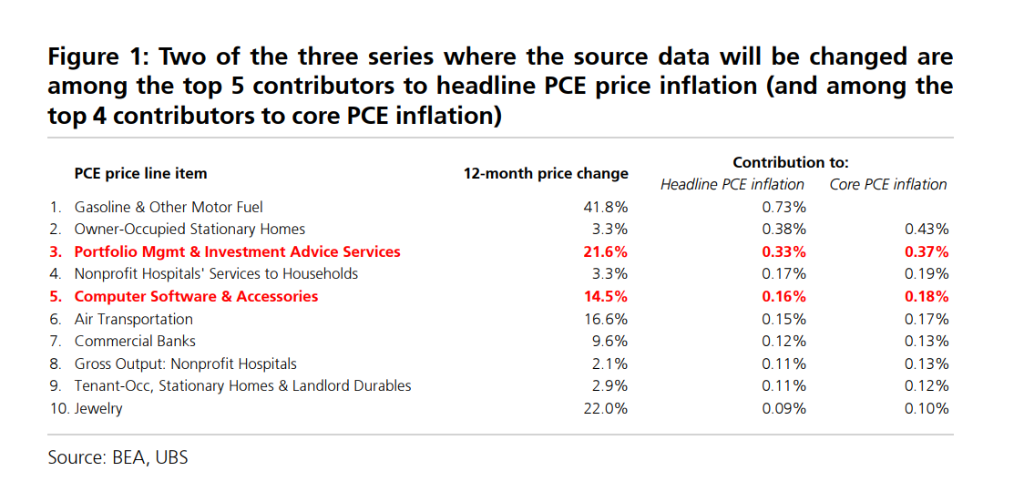
Current method: Directly uses the PPI for portfolio management services to deflate nominal expenditures to determine real prices. Since rising asset prices push up management fees (which are often based on asset size), PPI also rises, so this component’s year-on-year growth has reached 21.6% over the last 12 months, making it the second largest contributor to core PCE inflation.
New method: Uses total hours worked in the industry from employment surveys to measure "real service volume," then divides nominal spending by this real service volume to back out prices.
In summary, hours worked increase much more slowly than asset size, so the calculated "price increase" will drop significantly. Analysts estimate that this change will lower year-on-year core PCE inflation by 0.1 to 0.15 percentage points in May and by 0.1 to 0.2 percentage points in December.
UBS economists including Alan Detmeister estimate: Over the past 12 months, prices for portfolio management services have risen 21.6% year-on-year, making this component the second largest contributor to core PCE inflation (0.37 percentage points). Recalculated with the new method, this component's price increase over the past year would be only 9.0%, and its inflation contribution would decrease by about 0.21 percentage points (core PCE down 0.21 percentage points as well).
UBS believes that replacing a direct price index with labor data projections “may reduce the accuracy of the price index, and as employment data is revised monthly and annually, there is greater risk of further revisions in the future.”
Third: Legal Services
Current method: Uses the CPI legal services price.
New method: Switches to a composite price index based on specific legal services PPI.
Goldman Sachs estimates that this change will push up year-on-year core PCE inflation by about 0.04 percentage points in May, slightly less in December.
The background is: Due to sample quality issues, the U.S. Department of Labor has not published most CPI legal services data since 2023. BEA has quietly departed from the CPI data source in January and March this year, but did not publicly disclose this until outside researchers noticed abnormal data and it was acknowledged.
Currently, legal services PCE inflation is +2.5% year-on-year, while the corresponding CPI implied sequence is about +7.6%.
UBS points out that the specific PPI subseries and their weights used in the new method have not been disclosed. The increases in different subseries vary widely: from +1.6% for "other legal services" to +8.9% for "real estate legal services." If the overall PPI legal services index (+8.1%) is used, this would push PCE inflation higher by about 0.05 percentage points.
Combined Effect: Core PCE May Be Revised Down by 0.2 Percentage Points
Taken together, Goldman Sachs expects the above changes to cut year-on-year core PCE inflation in May by 0.2 percentage points to 3.2%.
On this basis, the bank revised its forecast for core PCE inflation in December 2026 down from 3.2% to 3.0%, and 2.2% for December 2027 remains unchanged.
The CPI is unaffected by these methodological changes. The bank maintains its forecasts for year-on-year core CPI at 2.6% in December 2026 and 2.2% in December 2027.
UBS estimates are close to Goldman Sachs: Over the past 12 months, if the new method is used, overall PCE inflation would be about 0.21 percentage points lower and core PCE inflation about 0.23 percentage points lower.
UBS: "The Series Chosen for Revision Appear Designed to Lower Inflation"
Goldman Sachs’ report is relatively neutral, focusing on quantifying the impact. UBS is more pointed in its wording.
UBS notes that of BEA’s three revised series, two are among the top four contributors to core PCE inflation over the past year: portfolio management services (the second largest) and computer software and accessories (the fourth largest).
UBS writes: "Only those series that currently have large positive impacts on inflation have been included in the revision plan. Series with problems that are inflation-neutral or negative—such as spectator sports, various household operation price series, photo processing, computer prices, etc.—were not included."
The conclusion: "The choice of series to revise is skewed toward those that contribute most to inflation, suggesting they were chosen in order to lower inflation."
The logic is similar to a student who, after an exam, only asks to have the questions they got wrong regraded, rather than requesting a review of the entire test—so the score can only go up, not down.
Lack of Transparency, Difficult for External Verification
Both institutions expressed concern about the transparency of the new methodology.
Goldman Sachs points out that the BEA has not disclosed the specific weights of the three inputs in the new software composite index, so its estimates carry uncertainty.
UBS uses stronger language: "The new methodology is clearly lacking in transparency, which in itself is an issue. It will make it more difficult for external parties to predict and verify official inflation data."
UBS further warns: "Lack of transparency in the key components of the Fed’s preferred inflation metric is especially concerning. If statistical agencies become subject to partisan political influence, this lack of transparency makes inflation data more susceptible to manipulation."
This means that after September 30, the predictability of core PCE data will decrease. The market’s interpretation of inflation data will become more difficult, and there will also be increased uncertainty in forecasting the Fed’s monetary policy path.
~~~~~~~~~~~~~~~~~~~~~~~~
Disclaimer: The content of this article solely reflects the author's opinion and does not represent the platform in any capacity. This article is not intended to serve as a reference for making investment decisions.
You may also like
Pivotal Moment for XRP's Price as It Hits New Local Resistance First
Federal Reserve: September hike risk stays on table – Nordea
Why Stablecoins and SWIFT May Shape the Future of Global Payments Together
Crypto prices
More


