
Sandisk In-Depth Update: Goldman Sachs Raises Target to $2,200, NAND Long-term Contracts, eSSD, and 80% Gross Margin Flexibility

TL;DR
1.Target price is based on profit benchmarks.The target price given by Goldman Sachs is not the most aggressive currently, but the valuation bridge is clearer: the multiples have not been further raised; instead, normalized profit assumptions have been systematically revised up. This indicates that the focus of this update is not on chasing the rally but on confirming the profit center.
2.Upward adjustment of estimates is more important.Goldman's projections for Sandisk's revenue and EPS over the next two years are significantly higher than the Street, especially for 2026 and 2027; this explains whether the stock price can continue to absorb expectations better than just a single target price, because the market ultimately trades on whether profits can be achieved.
3.Long-term agreements remain the deciding factor.Goldman puts the focus of the conference call on the number, scope, and pricing basis of new LTAs for a simple reason: If NAND price increases can only be achieved through spot market shortages, Sandisk is still a high beta cyclical stock; if client agreements can lock in supply, price floors, and financial commitments, then peak profits have room for capitalization.
4.eSSD determines profit durability.Goldman explicitly mentioned that the introduction of eSSD designs by key hyperscale clients is improving Sandisk’s product mix. The investment implication is that NAND is no longer only about the industry-wide ASP but rather whether AI inference, KV cache, enterprise SSD mix, and client concentration can support gross margins above 80%.
5.The risks are not without stories.Goldman also reminds that investors’ expectations are already high; short-term earnings must simultaneously deliver quarterly outperformance, strong guidance, and details of long-term agreements. Should the YMTC roadmap advance, supply increases, or eSSD share not meet expectations, Sandisk will return from a contract cash flow asset to the ordinary cyclical stock framework.
6.Four sets of evidence to watch next.First, whether 2Q26 and 3Q26 guidance continues to exceed the Street; second, the number, coverage, and guarantee structure of new LTA/NBM; third, whether both eSSD clients and gross profit margins can be achieved; fourth, whether the increase in supply after 2027 will interrupt the upward trend of NAND prices.
Table of ContentsJoin Knowledge Planet to access the full original report and reference research reports.
- 1. The key to Goldman’s latest update: Target price isn’t the highest, but profit bridge is clearest
- 2. Most important numbers in the Goldman model: CY26 and CY27 both significantly higher than the Street
- 3. NAND supply and demand: shortage may last longer than DRAM, but short-term threshold is very high
- 4. Long-term contract/NBM: transitioning from price hike trading to profit floor trading
- 5. eSSD: Can Sandisk evolve from NAND beta to AI storage asset
- 6.
- 7.
- 8.
- 9.
Goldman Sachs raised its target price for Sandisk from $1,200 to $2,200. It's not the highest target given, but it is the clearest profit bridge: 20x normalized EPS, CY26 EPS about 33% above the Street, and whether NAND long-term agreements and eSSD can turn the price cycle into a cash flow cycle.
1. The key to Goldman’s latest update: Target price isn’t the highest, but profit bridge is clearest
Sandisk has been pushed to a very crowded position by multiple rounds of target price upward revisions recently.Citi, Jefferies, and Bernstein have all issued higher target prices or more aggressive scenarios; the market is already familiar with the narratives of NAND shortages, NBM long-term agreements, and enterprise SSD. Goldman seems less aggressive this time, but its significance lies in breaking down valuation more clearly: raising profit benchmarks rather than further expanding multiples.
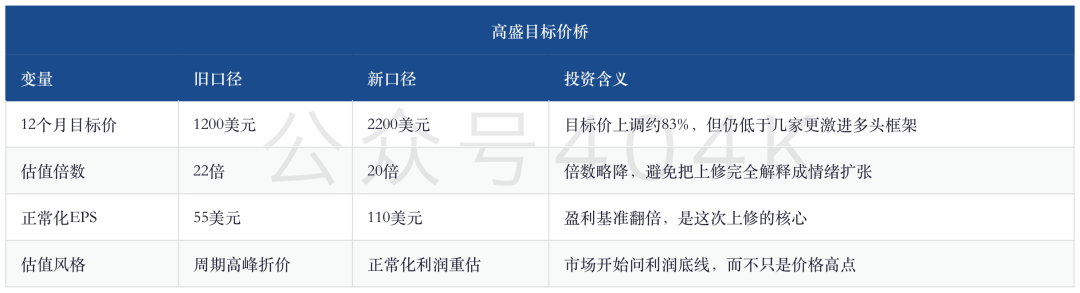
This shows that Goldman is explaining the upward revision with profit benchmark adjustments, not multiples.In other words, the market focus shifts from “can Sandisk keep rising” to “has normalized EPS in the future already moved from tens of dollars to over a hundred.” If $110 normalized EPS holds, 20x isn’t excessive; if $110 is just a one-time high price extrapolation, 20x actually becomes over-capitalization.
The difference between this update and the frameworks of Citi, Jefferies, and Bernstein lies here.Citi emphasizes that Micron’s report verifies NAND supply-demand tension will last until after CY27; Jefferies focuses more on the return of eSSD share; Bernstein stresses floor pricing and guarantee structures in new memory long-term agreements. Goldman converges these three into a more standard valuation bridge: persistent NAND supply-demand tightness, improved eSSD product mix, and LTA/NBM raising visibility, ultimately reflected in normalized EPS and target multiple.
Differentiation among sell-side target prices is no longer a linear “who’s more optimistic”, but rather three different worldviews.
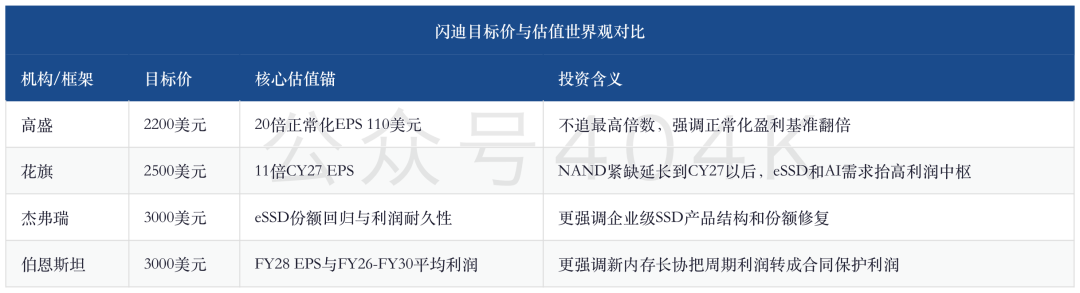
The judgment is straightforward: Goldman’s target price does not push imagination to the extreme but makes it clear whether “it can still be put into the model.”If Sandisk continues to be re-rated in the future, the driving force will not be just another investment bank raising its target price, but more models recognizing that CY26-27 profits are not just a temporary spike.
2. Most important numbers in the Goldman model: CY26 and CY27 both significantly higher than the Street
Goldman's upward adjustment for Sandisk’s estimates is significant, especially for 2026 and 2027.Specific numbers are shown in the two tables below. More importantly, Goldman isn’t just betting on next quarter’s beat but has already made high profits for 2027 the core of its model.
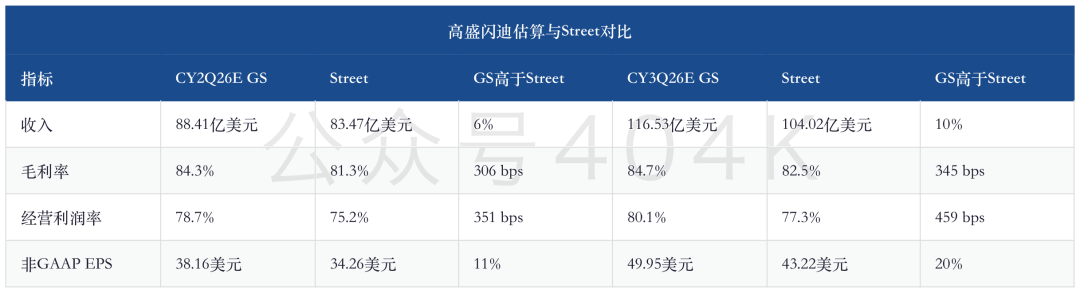
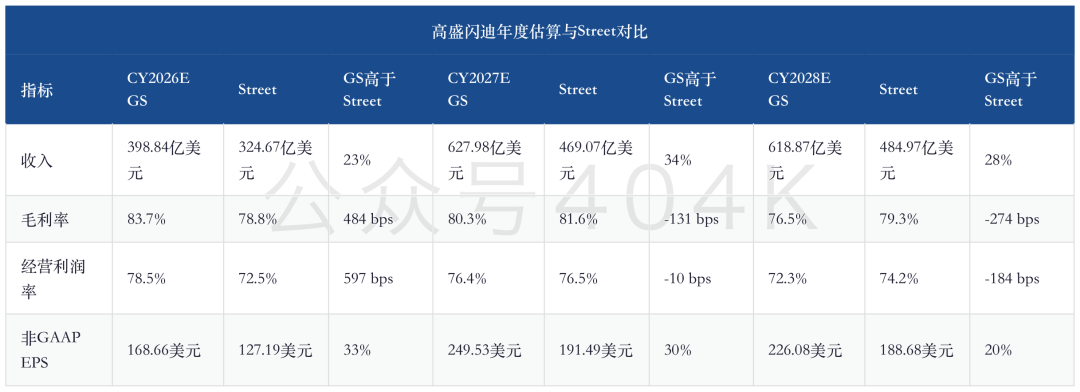
There’s an easily overlooked detail in the two tables: for CY27 and CY28, Goldman's margins and operating profit rates aren't universally higher than the Street.CY27 gross margin is 80.3%, below the Street's 81.6%; CY28 gross margin is 76.5%, also lower than Street’s 79.3%. But Goldman’s revenue and EPS are still significantly higher, meaning they’re really betting on revenue size, NAND price levels, shipment mix, and operating leverage, not just simply assuming that margins will always remain at the extremity.
This actually makes the model more credible.The easiest models for the market to discount are those that push NAND price, gross margin, and multiples all to the top. Here, Goldman seems to admit profitability is extremely high in 2026 but gradually falls back in 2027-2028; even so, revenue volume and eSSD mix still keep EPS well above traditional cyclical levels.
So, instead of just watching Goldman's target price, pay attention to two specific numbers: can normalized EPS of $110 gain broader sell-side acceptance, and will CY27 EPS of $249.53 become a new consensus for bulls.If these two numbers are revised up further, $2,200 is just a stage anchor; if they start to revise down, even if the target price doesn’t immediately change, the trade will fade first.
3. NAND supply and demand: shortage may last longer than DRAM, but short-term threshold is very high
Goldman maintains a buy on Sandisk, core reasoning being that NAND supply-demand tension will persist, possibly longer than DRAM.The reason is limited new NAND supply, still conservative approaches from vendors for new capacity, and lessons from losses and balance sheets over recent years tempering motivation to flood the market with supply in the short term.
This ties directly to the July memory report, Citi’s mapping of Micron’s earnings, and Bernstein’s LTA analysis: the storage cycle isn’t just ordinary restocking—AI is bringing storage into the compute infrastructure hierarchy.HBM addresses the highest performance memory, DRAM handles active data, and NAND plus enterprise SSD now handle cheaper, larger capacity, and more inference/system-level context and data layers. As long as AI inference keeps expanding, NAND demand is no longer determined just by mobile, PC, and consumer electronics.
But Goldman also reminds that short-term earnings thresholds are already extremely high.Sandisk’s 2Q guidance was already strong, and management has recently issued positive comments; the market has priced in many good news items in advance. This means that on earnings day, “strong results” alone may not suffice—strong guidance, price commentary, updates on LTA/NBM and supply discipline commentary will all be needed as well.
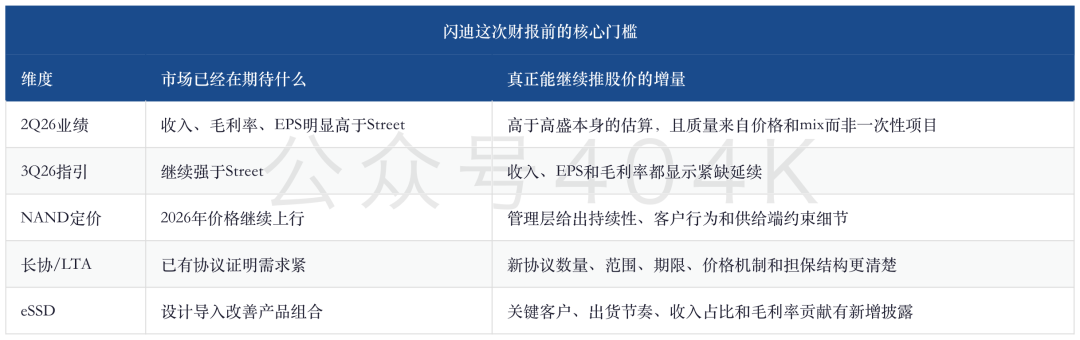
This is Sandisk’s current “high expectations paradox”: the stronger the fundamentals, the higher the earnings bar; the higher the expectations, the less a normal beat suffices.Bulls have to prove not that NAND is still tight, but that the supply shortage can last long enough to support the 2027 and 2028 profit models.
4. Long-term contract/NBM: transitioning from price hike trading to profit floor trading
One of Goldman’s key conference call topics is LTAs, especially after Micron recently announced multiple client agreements. Investors will ask Sandisk directly: how many new agreements, how much coverage, what are price and guarantee mechanisms, and can you lock in future demand and profit floors like Micron?
This fits perfectly with Sandisk’s main line over the past month.Previous features have discussed how Sandisk’s new business model isn’t just ordinary long-term supply, but a combination of customer supply security, price ranges, minimum revenue, and financial commitments. BofA’s June management meeting minutes mentioned that over one-third of F27 revenue is now through NBM contracts, five deals with over $11 billion commitments, including the first three providing around $42 billion minimum contract revenue, plus another $400 million in prepayments and additional third-party financial institutional arrangements.
Goldman did not elaborate on this old information, but putting LTA as the top focus for the earnings call shows the market is really buying the “profit floor”.If Sandisk only sells spot NAND, investors will discount peak profits as cyclical; if Sandisk can lock in a third, a half or even more future supply into agreements with price floors and guarantees, then the market will start to value it based on visible cash flows.
Long-term contracts change not the upside flexibility but the nature of the downside explanation.
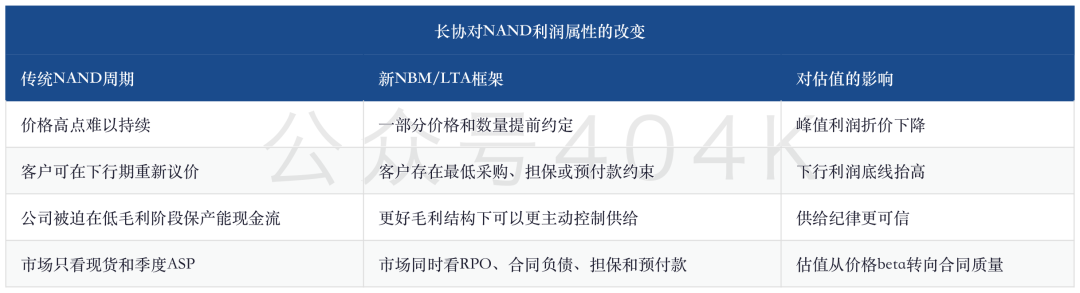
This is why even lowering the target multiple from 22x to 20x, Goldman could almost double the target price.With no more aggressive multiple, the profit benchmark moves substantially higher. Whether the profit benchmark can be accepted depends on if LTA/NBM can make profits less dependent on quarterly spot prices.
5. eSSD: Can Sandisk evolve from NAND beta to AI storage asset
Goldman explicitly points out that Sandisk’s product mix improvement comes from key hyperscale clients adopting eSSD designs.This is critical because it determines whether Sandisk is just a high-beta vehicle for NAND price increases, or a storage asset in AI inference infrastructure.
If you look only at NAND prices, Sandisk, Kioxia, Micron, Samsung, and SK Hynix are all in the same cycle.They all benefit when prices rise and face headwinds when supply opens up. eSSD is different—it is directly connected to cloud providers, AI inference, KV cache, RAG, cold/warm data tiers, and per-token costs. The larger the AI inference, the less the system can put all context into GPU HBM. Whether high-performance SSD can serve as a cheap expansion layer determines the price elasticity and client stickiness of enterprise NAND.
This is also where Sandisk’s challenge lies.One of Goldman’s downside risks is eSSD traction falling short of expectations. In short, NAND tightness benefits everyone with higher prices, but it takes eSSD market share to capture better mix and gross margins. If Sandisk’s design wins become stable shipments at key hyperscale clients, both its revenue and margin will look more like an AI infrastructure supplier; if it’s just short-term price momentum, valuation returns to ordinary NAND cyclicality.
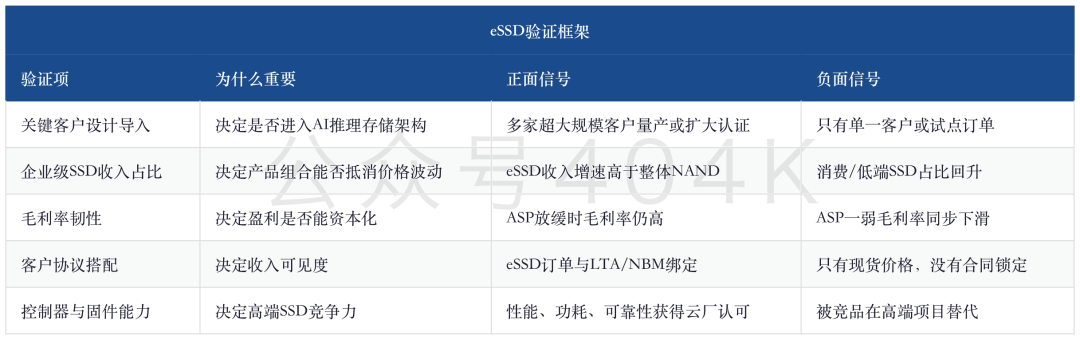
So this update is more than just “Goldman raises the target price.”More accurate would be: Goldman has put Sandisk into a higher-quality profit framework, where the core isn’t just NAND price increases, but eSSD design wins and LTA/NBM that keep price hike profits in-house.
You can check out the remaining 30% of the chapter by joining Knowledge Planet. The complete original text and reference reports are already available there, feel free to join.

Disclaimer: The content of this article solely reflects the author's opinion and does not represent the platform in any capacity. This article is not intended to serve as a reference for making investment decisions.
You may also like
Marvell: "Paying to Partner" with Google—Can It "Poach" from Broadcom?
Nvidia Earnings Report "In the Spotlight": Rubin Cycle, Cyclical Financing, and Forward Market Share
Nvidia will release its quarterly financial report next week. Brokerages expect strong fundamentals, with Jefferies projecting July quarter revenue at $95 billion, higher than market consensus. However, market attention has shifted beyond single-quarter results to three major long-term issues: whether Rubin can successfully succeed Blackwell, whether AI demand will continue to outpace supply, and the financing responsibilities required to secure future demand.
Bitcoin rallies to $79,500, invalidating Peter Brandt’s $58,000 downside call
Grayscale Zcash Trust shares to begin NYSE trading on Aug. 25
Crypto prices
More


