
BIS warns stablecoins could weaken capital controls in emerging markets

Researchers at the Bank for International Settlements (BIS) found that dollar-backed stablecoins are creating a new form of “digital dollarization” that appears largely unaffected by capital controls, particularly in emerging markets.
The new study suggests governments may have less ability to curb stablecoin adoption than traditional foreign-currency bank deposits.
BIS researchers analyzed foreign-currency deposits and dollar-pegged stablecoin inflows across more than 130 economies, finding that both tend to increase during periods of macroeconomic stress. Unlike traditional bank deposits, however, stablecoin flows showed little response to capital controls or other FX restrictions. The authors said this likely occurs because “stablecoins are partly circulating outside the regulatory perimeter.”
Stablecoins could still undermine monetary sovereignty by allowing households and businesses to shift into dollars outside the banking system, particularly in emerging markets with weak currencies or limited access to reliable financial services, the study said.
Despite those risks, the researchers found little evidence that deposit dollarization weakens the transmission of monetary policy, though countries with higher foreign-currency deposits faced a somewhat greater risk of elevated inflation.
BIS said the findings suggest policymakers may need new tools to manage financial stability as stablecoins become more widely used, arguing that regulations designed for traditional banking and foreign-currency deposits may be less effective in a tokenized financial system.
Related: Japanese logistics company eyes JPYC stablecoin to pay drivers
Dollar-backed stablecoins expand in emerging economies
The findings come as use of stablecoins as a payment tool is growing in several emerging markets.
In its recent analysis of Nigeria, the International Monetary Fund (IMF) found households and small businesses are using US dollar-pegged stablecoins for cross-border payments, remittances and access to dollar-denominated assets as inflation, currency depreciation and limited access to foreign exchange drive demand.
The IMF said stablecoins have reduced the cost and time required to move money across borders while expanding access to financial services for users outside the traditional banking system. At the same time, it warned that widespread adoption of dollar-backed tokens could weaken monetary sovereignty by reducing demand for local currencies and shifting more financial activity outside conventional banking channels.
Stablecoin adoption has accelerated across Latin America as well. Bitso Business, the enterprise payments arm of crypto exchange Bitso, reported an 81% year-over-year increase in stablecoin payment volume during the first half of 2026. The company also said that Circle’s USDC (USDT) and Tether’s USDT (USDT) accounted for 40% of all crypto purchases in the region in 2025, surpassing Bitcoin for the first time.
stablecoin market capitalization has increased to about $309.7 billion, up from roughly $260 billion a year ago.
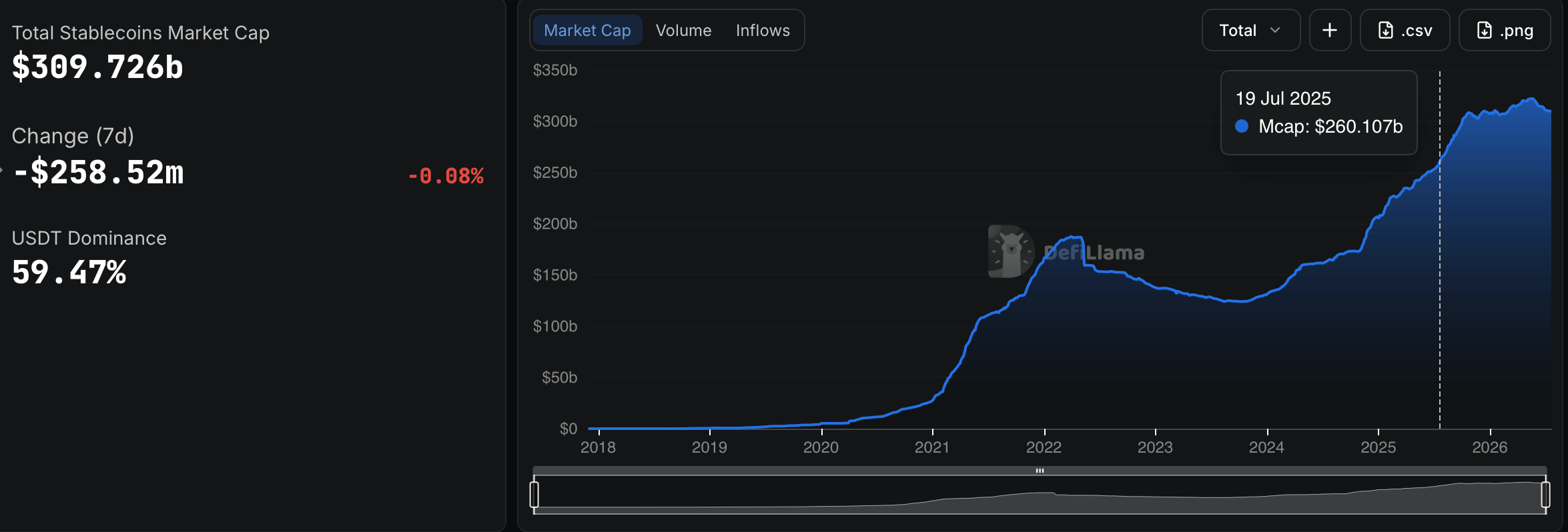
Stablecoin market cap. Source: DefiLlama
Magazine: Binance & OKX users face $1,900 fines in Vietnam, Coinbase in China? Asia Express
Disclaimer: The content of this article solely reflects the author's opinion and does not represent the platform in any capacity. This article is not intended to serve as a reference for making investment decisions.
You may also like
Tokenized funds expand across chains, yet liquidity remains fragmented – Why?
Japan Reportedly Plans to Double Defense Spending to 3.5% of GDP, Ministry of Defense Denies, Yet Japanese Bond Yields Hit 30-Year High
According to reports, Japanese defense officials have expressed their willingness to significantly increase defense spending during meetings with the United States. One proposal is to raise defense spending to 3.5% of GDP within ten years, while another, lower target is 3%. Japanese officials previously stated that this fiscal year's defense and related expenditures are approximately $68.8 billion, equivalent to about 1.9% of Japan's nominal GDP in 2022.
Besent Defends US Intervention to Buy Yen: Only "Symbolic" Funds Invested; Yen Appreciation Benefits US Exports and Treasury Market
U.S. Treasury Secretary Janet Yellen said on Tuesday that when the U.S. Treasury coordinated with Japan to purchase yen, only a "symbolic" amount of funds was used. She defended this rare intervention in the foreign exchange market.

Overnight US Stocks | Three Major Indexes Fall for Second Consecutive Day, 10-Year Treasury Yield Rises to Highest Level Since 2007, WTI Crude Oil Surges 4%
At the close, the Dow Jones fell 328.09 points, down 0.63%, to 52,093.10 points; the S&P 500 Index fell 34.25 points, down 0.45%, to 7,585.73 points; the Nasdaq fell 204.84 points, down 0.78%, to 25,981.57 points.

Crypto prices
More


