
July 28 Financial Morning Brief: Renewed Hopes for US-Iran Talks Weaken Safe-haven Demand, Gold Surges and Falls Below 4115, Crude Oil Suffers "Black Monday" Plunging Over 9%

FX168 July 28 News—— In early Asian trading on July 28, spot gold was trading near $4,075 per ounce. On Monday, gold prices once touched above $4,115 per ounce, boosted by a sharp drop in oil prices to a one-week low due to a temporary easing of U.S.-Iran tensions, and a slight weakening of the U.S. dollar index also increased the appeal of gold.
In early Asian trading on Tuesday (UTC+8, July 28), spot gold was trading near $4,075 per ounce. On Monday, gold prices once broke above $4,115 per ounce, supported by a sharp drop in oil prices to one-week lows as U.S.-Iran tensions abated and the dollar index weakened, making gold more attractive; U.S. crude oil prices fell 9.46% on Monday, hitting the lowest since mid-July. Over the weekend, the U.S. unexpectedly paused airstrikes on Iran, with President Trump stating both sides are having “good discussions” and an agreement may be reached. Hopes for a diplomatic solution to ease tensions and restore shipping in the Strait of Hormuz increased. U.S. crude oil is currently trading near $81.87 per barrel.
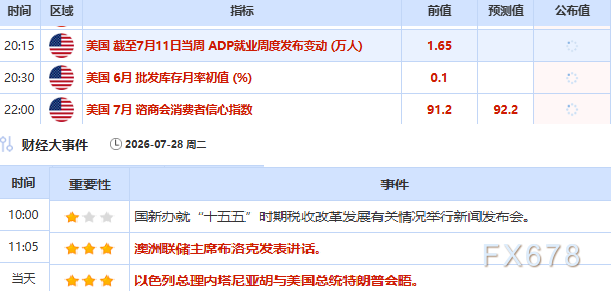
Focus of the Day
Stock Market
U.S. stocks ended mixed on Monday, with the S&P 500 edging up 0.02% to 7,413.18, the Nasdaq falling 0.18% to 24,932.08, and the Dow Jones Industrial Average rising 0.51% to 52,210.08. Investors stayed cautious ahead of a busy earnings week as AI giants such as Microsoft, Amazon, Meta, and Apple are set to report quarterly results. Previously, earnings from Tesla and Google raised concerns about the return on AI investments.
The sharp drop in oil prices was another focus of the day. Influenced by President Trump's comments that Washington is having “good discussions” with Iran and hopes to reach a peace agreement, oil prices retreated and energy stocks came under pressure: Occidental Petroleum fell 4.1%, Exxon Mobil dropped 1.4%, while gains in Walmart, Microsoft, and Johnson & Johnson supported the S&P 500, with consumer staples and information technology sectors leading.
Meanwhile, the Philadelphia Semiconductor Index continued its recent decline, dropping another 2.2%. It has now fallen 21% from its June record high. The market is also awaiting the Federal Reserve’s rate decision on Wednesday, with traders pricing in a 62% chance of no change and a 38% probability of a 25-basis-point hike. Friday’s June PCE data will affect subsequent rate expectations. The S&P 500’s current P/E ratio is about 20, in line with historical averages, but Q2 earnings are expected to surge 39% year-on-year, mainly driven by AI. Bank of America analysts noted that sector rotation is being fueled by doubts about potential Fed rate hikes.
Gold Market
Gold prices rose on Monday, with spot gold up 0.57% at $4,076.45 per ounce, mainly supported by a sharp drop in oil prices to a one-week low after a temporary easing in U.S.-Iran tensions. President Trump previously announced that the U.S. is now having “good discussions” with Iran; both sides paused military strikes over the weekend, easing concerns about disruptions to shipping in the Strait of Hormuz.
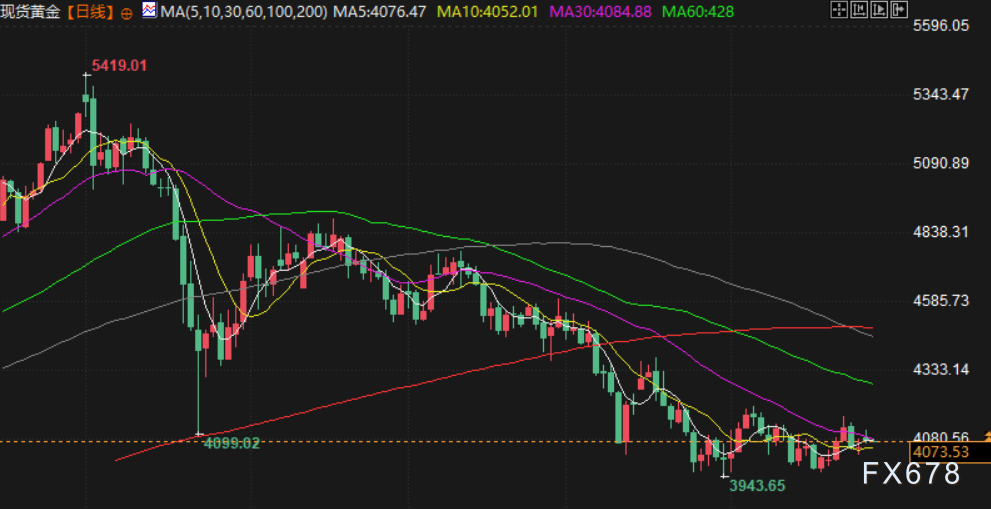
The decline in oil prices has alleviated inflationary pressures and reduced expectations for “higher for longer” interest rates, while the slight weakening of the dollar has also increased gold’s appeal for overseas buyers.
TD Securities' head of commodities strategy noted that lower oil prices are pushing down rate hike expectations, and investors are waiting for the Fed rate decision on Wednesday (with traders seeing a 62% chance of no change), as well as the release of June U.S. PCE inflation data on Thursday for more policy signals.
In other precious metals, spot silver gained 0.34% to $58.37, platinum rose 2% to $1,620.34, and palladium jumped 3.5% to $1,286.25.
Oil Market
Oil prices plunged over 10% on Monday, with Brent crude falling 10.76% to $87.79 per barrel and U.S. crude dropping 9.46% to $81.91, both the lowest since mid-July. The main driver was the U.S. unexpectedly pausing airstrikes on Iran over the weekend, with President Trump saying both sides are having “good discussions” and may reach an agreement, lifting hopes that diplomacy could ease tensions and restore shipping in the Strait of Hormuz.
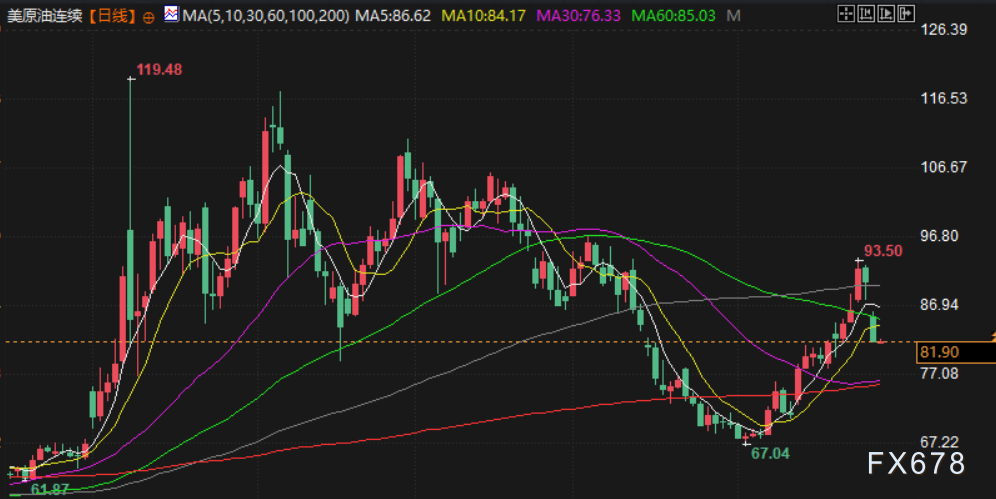
Last week, Brent crude briefly broke above $100 as the conflict affected the Red Sea and blocked Saudi oil exports via the Bab-el-Mandeb Strait: Saudi air defense intercepted drones launched from Iraq, and Houthi forces in Yemen claimed to have attacked supply facilities from the Saudi eastern oilfields to Yanbu port. The U.S. ambassador to the United Nations confirmed that the pause in airstrikes was to buy time for diplomacy, while President Trump warned that military strikes will resume if talks fail. Analysts point out that this pause does not guarantee a rapid recovery in supply.
PVM analysts noted that the market is searching for good news amid a lack of bullish signals. StoneX strategists emphasized that the ceasefire situation may still trigger sharp volatility and real supply remains constrained. Kpler data shows that fewer than 10 ships pass through the Strait of Hormuz daily, and SEB analysts stated that transport volume is now only about 15% of the level before the conflict. Political stoppage will not immediately increase actual oil export volume.
Forex Market
On Monday, the U.S. dollar weakened against the euro and yen. The euro was little changed against the dollar at $1.1366, while the dollar fell 0.07% to 163.32 yen. The main reason was the U.S. pause in airstrikes on Iran, which led to falling oil prices. Tehran stated that Iran would also halt attacks if the U.S. maintains its suspension, boosting hopes for diplomatic de-escalation and improving risk appetite. However, the dollar moved off the day’s lows because U.S. Treasury yields fell less than those in other markets, providing support for the greenback.
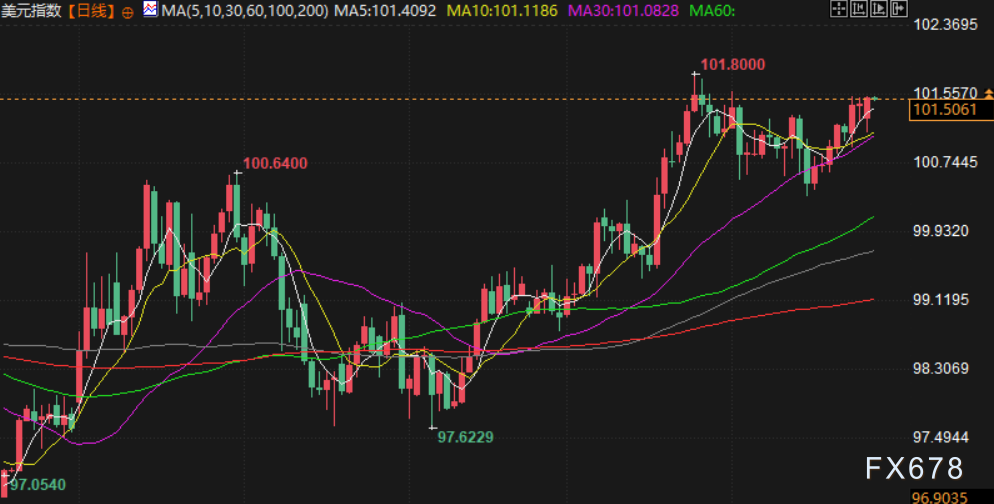
The market is now focused on policy meetings at several central banks this week. The Fed will announce its rate decision on Wednesday. CME FedWatch shows the probability of a 25-basis-point hike at about 33% (down from 37% last weekend, but up from the previous week). Goldman Sachs' chief economist says the FOMC Statement may acknowledge that geopolitical tensions pose upside risks to inflation. Investors are also watching U.S. Q2 GDP and core PCE data.
The Bank of England and Bank of Japan are expected to keep rates unchanged on Thursday and Friday, respectively. However, the BOJ may hint at further rate hikes to curb yen depreciation, though analysts believe the window for Ministry of Finance intervention may have passed, and clear signals are needed such as a topping of the dollar and a reversal in oil prices.
The pound gave up earlier gains, falling 0.23% to $1.3288 against the dollar, as the new UK government faces inflation pressures from rising oil prices.
International News
According to CME “FedWatch”: There is a 63.7% chance the Fed will keep rates unchanged in July, a 36.3% chance of a cumulative 25-basis-point hike. By September, the probability of no change is 18.5%, for a total hike of 25 basis points is 55.7%, and for a total 50-basis-point hike is 25.8%. By December, the probability of no change is 7.9%, for a 25-basis-point hike is 32.3%, and for at least a 50-basis-point hike is 59.8%.
U.S. President Trump said on Monday regarding the Fed that while Chair Walsh is outstanding, he has to deal with the committee. Trump believes Walsh will do the right thing—he knows what Walsh wants. On interest rates, Trump said rates should be even lower, and the U.S. should have the lowest rates in the world. He also mentioned costs are falling rapidly.
In an interview with Axios on Monday, President Trump said he decided to pause strikes on Iran to give negotiations another chance but emphasized that if diplomacy fails, he will order the resumption of large-scale military operations. The talks are mainly led by Iran and Oman, with Qatar, Pakistan, Egypt, and Trump’s envoys Steve Vitkov and Jared Kushner deeply involved. “We are engaged in deep negotiations with Iran. If they fail, we’ll return to intense military strikes,” he said. Asked how long he would reserve for diplomacy, Trump replied: “Not much time: either a quick consensus or talks end immediately.” Trump revealed he decided to delay strikes last Friday because many mediators pleaded for negotiation space: “Everyone dealing with Iran told me: don’t use force.” He believes Iran is willing to make a deal. Asked why he agreed, Trump said: “There is no downside or risk.” He also mentioned that after announcing the pause, international oil prices immediately fell and stock markets rose in tandem.
On July 27 local time, Iranian Foreign Ministry spokesman Baghai stated at a press conference that the Strait of Hormuz is still closed. The spokesman also noted positive progress in talks between Iran and Oman on the strait’s management.
On July 27, CME Group in Chicago launched cash-settled single stock futures based on 55 U.S. equities as well as micro contracts for 22 stocks, marking the exchange’s entry into a market for around-the-clock leveraged trading. These contracts trade from Sunday evening to Friday afternoon on CME’s Globex platform, with a one-hour daily maintenance break, enabling investors to react to earnings reports and other news outside of regular U.S. stock market hours.
On July 27, Israeli Prime Minister Netanyahu departed for Washington. He will hold face-to-face talks with President Trump on July 28 local time. This will be the eighth meeting between the two since Trump’s return to the White House and their first in-person meeting since they led large-scale joint airstrikes against Iran at the end of February this year. Netanyahu's visit comes as Trump suspends strikes on Iran and considers whether to expand the military campaign. Before departure, Netanyahu said he and Trump would “discuss all topics, with Iran the top priority.” In recent weeks, Netanyahu has acknowledged some differences with Trump, as the two countries' interests in the Middle East appear to diverge. Some analysts believe a display of their close relationship during the meeting may boost Netanyahu’s position in the domestic elections coming up on October 27, as current polls show weak support. (CCTV International News)
Domestic News
At a recent report meeting themed “Ensuring and Improving Well-being in High-Quality Development,” Yin Hejun, CPC Secretary and Minister of the Ministry of Science and Technology, stated that the “New Three” industries of AI, robotics, and innovative drugs are developing rapidly and are expected to become new pillar industries. According to platform data, during July 13-19, China’s large language models were called upon 36.11 trillion times, up 30.93% week-on-week, marking eight consecutive weeks of growth and remaining ranked first globally for twelve weeks in a row. In the first half of this year, China’s robot exports reached 6.29 billion yuan, with products sold to 141 countries and regions; exports of surgical robots jumped by 3.3 times. In H1, China’s out-licensing of innovative drugs reached about $110 billion, with Chinese pharmaceutical firms holding eight of the top ten spots in global pharma deals. (CCTV News)
Orders of 4.4GW in half a year, over 10 billion yuan in orders on hand, with operations spanning three continents—this is not for photovoltaics or lithium batteries, but wind power’s “overseas report card.” In Sheyang, Jiangsu, large offshore intelligent wind turbines are being assembled and tested, destined for Vietnam’s Vinh Long 128MW offshore wind project—which will be the leading group in per-unit capacity in Vietnam and Southeast Asia when completed. According to ENVISION Energy’s Offshore Product GM Deng Heng, this is the first time Vietnam is using large rotor, high-capacity intelligent offshore turbines. From January to June 2026, ENVISION Energy received over 4.4GW in new overseas orders, covering North Africa, Southern Europe, and Southeast Asia. In Caofeidian, Tangshan, the deep-sea base built by Dajin Heavy Engineering started operations smoothly this year. It is the world’s first all-indoor giant offshore engineering product factory, capable of mass-producing fixed and floating foundations for 15–25MW large units, addressing high cost, slow delivery, and coordination difficulties in deep-sea wind power. Dajin’s VP Jiang Haitao revealed their overseas orders exceed 10 billion yuan, with products exported to more than 30 countries and regions. Visits to multiple companies show that since this year, overseas orders have grown significantly, overseas deployment is speeding up, and overseas markets have become a key growth driver for the industry. (CCTV Finance)
Disclaimer: The content of this article solely reflects the author's opinion and does not represent the platform in any capacity. This article is not intended to serve as a reference for making investment decisions.
You may also like
Super Micro Computer (SMCI.US) Q4 Earnings Call: Gross Margin Surges to 17.6% Surpassing Guidance, AI Infrastructure Leader Enters Harvest Season
Super Micro Computer (SMCI.US) announced its fiscal Q4 2026 results after market close on August 11, with the stock surging over 10% at one point.

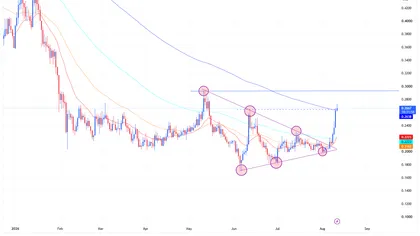
Curve DAO targets $0.30 – Can a 15% OI surge fuel CRV’s rally?
Federal Reserve officials unanimously warn of inflation risks! Tonight’s July CPI expected to be the key decision for rate hike path
Chicago Federal Reserve President Austan Goolsbee stated that he is more concerned about inflation being too high than any weakness in the labor market. However, it is still unclear whether this concern will translate into support for the interest rate hikes that several of his colleagues called for last month.

What if you can't afford chips? Nvidia partners with Wall Street to turn AI computing power into financeable and securitizable assets
Nvidia has partnered with Apollo, BlackRock, Blackstone, and other Wall Street giants to build a $500 billion AI chip securitization financing system. By packaging GPUs into a new asset class similar to mortgage-backed loans through SPVs, the aim is to create capital channels for small and medium-sized AI enterprises struggling with financing. However, concerns remain over the "lettuce-short" shelf life of chips, potential circular financing arising from Nvidia's self-guaranteeing, and the reality of zero actual fundraising so far. These factors leave this financial innovation, likened to the MBS revolution of the 1970s, teetering between idealism and risk.
Crypto prices
More


