
A Sharp Reversal in Just One Month! The Indonesian Stock Market Moves from a "Five-Year Low" to a "Technical Bull Market"

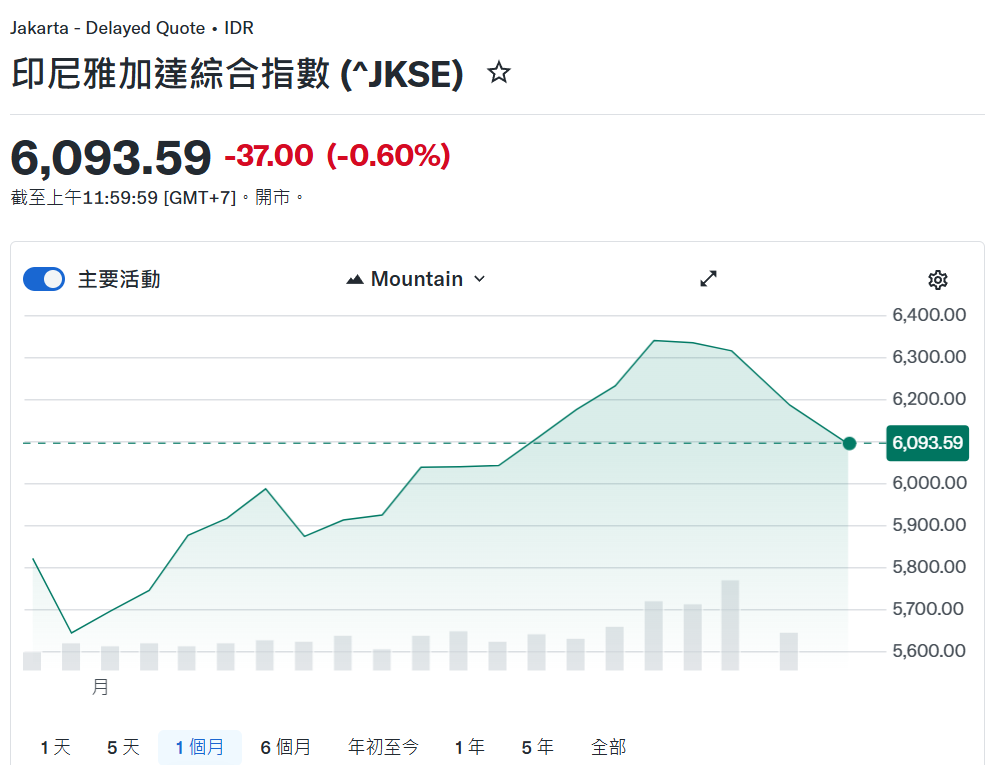
After months of sell-off, the Indonesian stock market has completed a dramatic reversal, rebounding strongly from the five-year lows touched last month and officially entering bull market territory. This turnaround was driven by valuation recovery, swift regulatory intervention, and a gradual return of foreign capital.
The Jakarta Composite Index is still down about 29% year-to-date, but according to LSEG data, the index has rebounded more than 10% since its early June lows, reaching the threshold for a bull market.
A few weeks ago, S&P Global affirmed Indonesia's BBB sovereign credit rating with a stable outlook, further boosting market sentiment. Mohit Mirpuri, senior partner at SGMC Capital, said, "S&P's confirmation removed a key macro uncertainty, and over the past month the market's pricing logic has shifted from reflecting deteriorating fundamentals to stabilization of corporate fundamentals."
This rebound is significant for investors—Indonesian equities were previously under dual pressure from governance disputes and an exodus of foreign capital, with market confidence reaching a freezing point. As multiple favorable factors have converged, there has been a substantive shift in sentiment, offering emerging market investors an opportunity to reconsider Indonesian assets.
MSCI Pauses Downgrade, Panic Selling Curbed
Throughout most of 2026, the Indonesian stock market has experienced intense volatility, triggered by index compiler MSCI raising concerns over corporate governance for several Indonesian stocks and signaling it might downgrade Indonesia from an emerging market to a frontier market. Persistent issues such as a low free-float ratio and high shareholding concentration have been core structural problems drawing MSCI's focus.
According to CNBC, Gareth Leather, Senior Economist at Capital Economics, said that MSCI's decision to pause the downgrade was a "huge relief" for investors, effectively curbing panic-driven selling. Meanwhile, some investors have begun to lock in profits on relatively highly valued AI and tech stocks, shifting capital towards markets with more attractive valuations.
Valuation Bottom Effect Emerges, Foreign Capital Interest Rekindled
As share prices continued to fall, the valuation appeal of Indonesian stocks became increasingly apparent. Liza Camelia, Research Head at Kiwoom Sekuritas Indonesia, told CNBC, "After months of heavy selling, Indonesian stocks have become too cheap to ignore."
Positive fiscal signals have also injected confidence into the market. Camelia pointed out that government tax revenues rebounded strongly in the first half of the year, with fiscal income exceeding expectations, easing fears about fiscal risks that had previously troubled the market. The reality was better than the earlier pessimistic projections.
Proactive action from Indonesian financial regulators has also been an important factor supporting the rebound. The regulators introduced measures to increase the minimum free-float ratio and strengthen shareholding disclosure requirements, directly addressing market concerns over insufficient liquidity and lack of transparency.
Jeemin Bang, Associate Economist at Moody’s Analytics, stated that these measures help “address weak market liquidity as well as the resulting transparency and ownership concentration issues, which had driven some investors to exit previously.” The regulators’ rapid response has, to some extent, restored basic trust in Indonesia’s capital market institutional environment.
Disclaimer: The content of this article solely reflects the author's opinion and does not represent the platform in any capacity. This article is not intended to serve as a reference for making investment decisions.
You may also like
The Federal Reserve's "all talk, no action" stance steepens the U.S. Treasury yield curve! "New Bond King" Gundlach warns: Real action is necessary to fight inflation.
Gundlach stated bluntly that the U.S. Treasury market is sending a signal to the Federal Reserve—if policymakers truly wish to achieve the 2% inflation target, tough rhetoric alone is not enough; the Federal Reserve must take more concrete actions.

Uniswap activates fee switch on v4 pools, boosting protocol revenue to $325K per day
AI storage demand remains strong! Samsung delivers an explosive financial report: Q2 chip profits increase 250 times, revenue and profits reach new record highs
Samsung's second-quarter profits skyrocketed 19-fold, as demand for AI chips offset losses in its mobile business.

Bond Market "Votes with Its Feet": Walsh's Hawkish Remarks Can't Compete with Staying Put, 30-Year US Treasury Yield Soars to 19-Year High
The bond market is sending a clear signal: although Federal Reserve Chairman Kevin Walsh has used strong language regarding curbing inflation, he does not seem to be in a hurry to use the central bank's policy tools to deliver on his commitments.

Crypto prices
More


