
Amazon Q2 Earnings Preview: AWS Acceleration vs. AI Capex Trade-off
 Bitget2026/07/30 06:08
1. Investment Highlights Snapshot
Amazon will report its second-quarter results after the U.S. market close on July 30, 2026. Wall Street consensus expects revenue of approximately $196–197 billion (+17% YoY, versus $167.7 billion a year earlier) and diluted EPS of about $1.82 (+8.3% YoY, versus $1.68). The company’s prior guidance calls for net sales of $194–199 billion (+16%–19% YoY) and operating income of $20–24 billion.
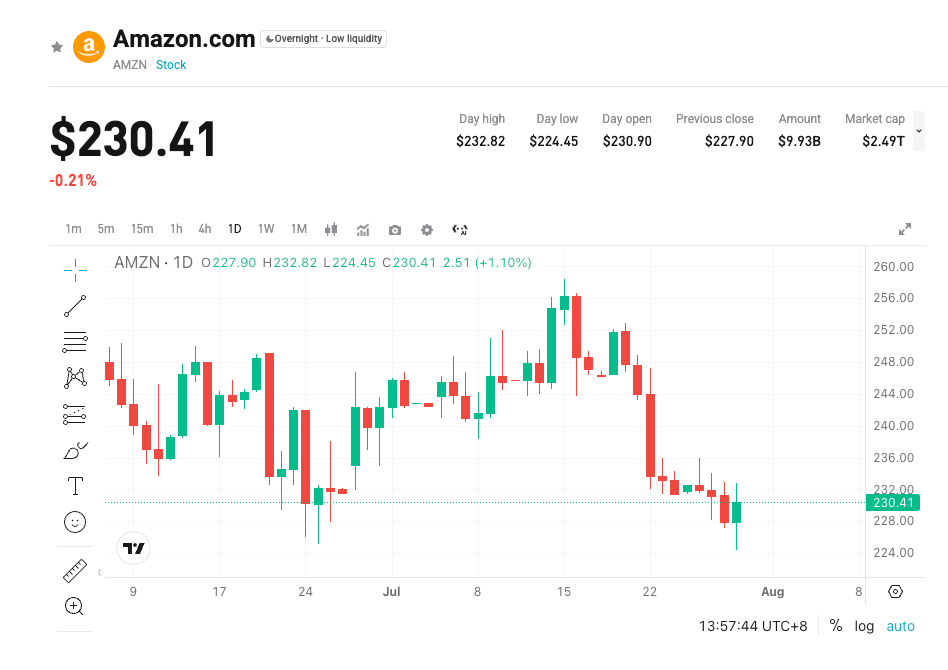
The key debate is not whether headline revenue will land inside the guided range, but whether AWS can continue accelerating and whether the full-year capital expenditure target of roughly $200 billion will be raised further. Alphabet’s recent capex hike and subsequent share-price reaction have made investors more sensitive to the combination of strong growth and elevated spending.
2. Four Key Focus Areas
Focus 1: Can AWS Growth Re-accelerate?
AWS revenue reached $37.6 billion in Q1 (+28% YoY), the fastest pace in 15 quarters. Consensus now looks for further acceleration to 31%–33% in Q2 (roughly $40–41 billion). Some houses have already lifted their forecasts to 33%, citing sustained Anthropic and OpenAI workloads flowing through Bedrock and ongoing enterprise AI demand. A print in this range would reinforce the narrative that AI demand is converting into durable cloud revenue; a figure below 28% would raise questions about the durability of the re-acceleration.
Focus 2: AI Capital Spending and Free-Cash-Flow Pressure
Management previously guided to approximately $200 billion of capital expenditure for full-year 2026, primarily for data centers, custom silicon (Trainium and related chips), and supporting infrastructure. Several analysts now expect the figure could rise toward $210 billion on higher memory costs and stronger demand. Free cash flow already collapsed to $1.2 billion in Q1. Markets will scrutinize the actual Q2 spend and any update to the full-year outlook. Elevated spending can be tolerated if framed as growth-oriented investment backed by customer commitments (RPO stood at $364 billion at the end of Q1); a material upward revision risks an Alphabet-style sell-off.
Focus 3: Retail and Advertising Resilience
Online stores are expected to generate roughly $69.8 billion (+13% YoY), while advertising revenue is seen near $19.2–19.3 billion (around +22% YoY). Prime Day was pulled forward into Q2, providing a potential retail tailwind, though household spend data points to greater value-seeking behavior. Stability in North America and International retail operating margins will be important in determining whether overall operating income lands near the midpoint of guidance.
Focus 4: Q3 Guidance and Non-Operating Items
Beyond core operating metrics, attention will turn to the Q3 revenue and profit outlook, as well as any mark-to-market impact from the Anthropic equity stake on EPS. Q1 included a sizable non-operating gain; a similar swing in Q2 would lead investors to place greater weight on the underlying operating picture.
3. Risks and Opportunities
Upside Catalysts:
- AWS growth at or above 33%, accompanied by constructive commentary on Bedrock and custom-chip progress.
- Full-year capex guidance raised only modestly or held near $200 billion, with emphasis on locked-in customer commitments.
- Retail margin improvement or stronger-than-expected advertising growth that lifts operating income toward the high end of the guided range.
Downside Risks:
- Capex guidance lifted significantly above $210 billion, intensifying concerns over near-term free-cash-flow pressure and payback periods.
- AWS growth falling short of 30% or margins coming under material pressure.
- Conservative Q3 guidance or incremental regulatory/macro headwinds weighing on the retail business.
4. Trading Strategy Considerations
Bull Case: AWS growth clearly accelerates (≥32%–33%), the capex increase remains contained, and management underscores the high returns and customer lock-in associated with AI investments. In this scenario, the stock could look through the spending concerns and re-rate toward a growth premium.
Bear Case: A sizable capex upward revision combined with softer-than-expected AWS growth, or continued free-cash-flow pressure, would likely prompt the market to prioritize the “high spend, delayed monetization” narrative and produce a short-term pullback.
Key Metrics to Watch:
- AWS revenue and year-over-year growth rate
- Operating income relative to the $20–24 billion guidance range
- Any update to full-year capex guidance
- Q3 revenue and profit outlook, plus changes in RPO
Positioning Notes: Options markets are pricing roughly a 6%–7% move around the print. Short-term traders should focus on the post-market and next-day reaction, particularly the AWS-plus-capex combination. Medium-term investors should prioritize management commentary on the return timeline for AI investments rather than reacting solely to headline revenue or EPS. Position sizing and risk controls remain essential.
Have a view on earnings but not sure how to size it? Learn how options cap your downside and keep your upside.
Stock Limited-time Offer:July new user gift: Buy U.S. stocks and get free NVIDIA stock.Trade Now for Better Deals
Disclaimer: The above is for informational purposes only and does not constitute investment advice.
Disclaimer: The content of this article solely reflects the author's opinion and does not represent the platform in any capacity. This article is not intended to serve as a reference for making investment decisions.
You may also like
Meta (META.US)'s AI Gamble: Q2 Revenue Hits New High, But Profit Pain Persists as Free Cash Flow Plummets to Four-Year Low
After the market closed on July 29, Meta Platforms (META.US) released its financial report for the second quarter of 2026 ending June 30. In after-hours trading on Wednesday, Meta's stock price once plunged nearly 10%.

Nasdaq-Listed Zeta Network Group Secures $10M Private Investment in Bitcoin
Uniswap posts third highest UNI burn day with 106,000 tokens destroyed
Arm (ARM.US) Q1 performance exceeds expectations but faces sell-off! AI demand surge can't overcome the shadow of slowing mobile business; Q2 revenue guidance falls short of most optimistic forecasts
After a massive sell-off in global semiconductor stocks, chip companies including Arm are now facing increased scrutiny. Even when these companies release optimistic overall earnings reports, it is becoming increasingly difficult to meet investors’ expectations.

Crypto prices
More


