
US memory stocks rebound strongly, SanDisk surges 26%—what's behind the jump?

On July 30, US stocks, particularly AI and semiconductors, surged. Among them, SanDisk posted a high-volatility V-shaped recovery after a sharp plunge, but it remains far from recouping its July losses.
On July 30 local time, US stocks rebounded strongly, with artificial intelligence (AI) and semiconductors as the main sectors.
The Dow Jones Industrial Average closed at 52,208.06 points, up 613.92 points, a gain of 1.19%; the S&P 500 closed at 7,437.63 points, up 121.48 points, or 1.66%; the Nasdaq Composite Index closed at 25,122.18 points, up 679.24 points, an increase of 2.78%.
The "Magnificent Seven" saw significant divergence in their performance. Microsoft surged 15.51% to close at $451.10, as strong earnings and growth in cloud business eased market concerns over AI capital expenditures. Nvidia was up 2.65%, Amazon up 3.90%, Tesla up 3.53%; Apple slipped 1.41%, Alphabet (Google’s parent company) lost 0.91%, and Meta Platforms (Facebook’s parent) dropped 7.95%.
Memory and AI semiconductor stocks led the rally. Micron rose 18.36% to $874.66; SanDisk surged 25.99% to $1,279.96; Western Digital climbed 15.37%, Seagate gained 11.41%, and Broadcom was up 4.73%. The iShares Semiconductor ETF gained 8.50%, and the Philadelphia Semiconductor Index rose about 8% on the day.
SanDisk formed a high-volatility V-shaped recovery after its sharp tumble, but remains far from recouping July's losses. During the session, it reached as high as $1,365, up 34.37% from the previous close, and finished at $1,279.96, gaining $264.1 in a single day.
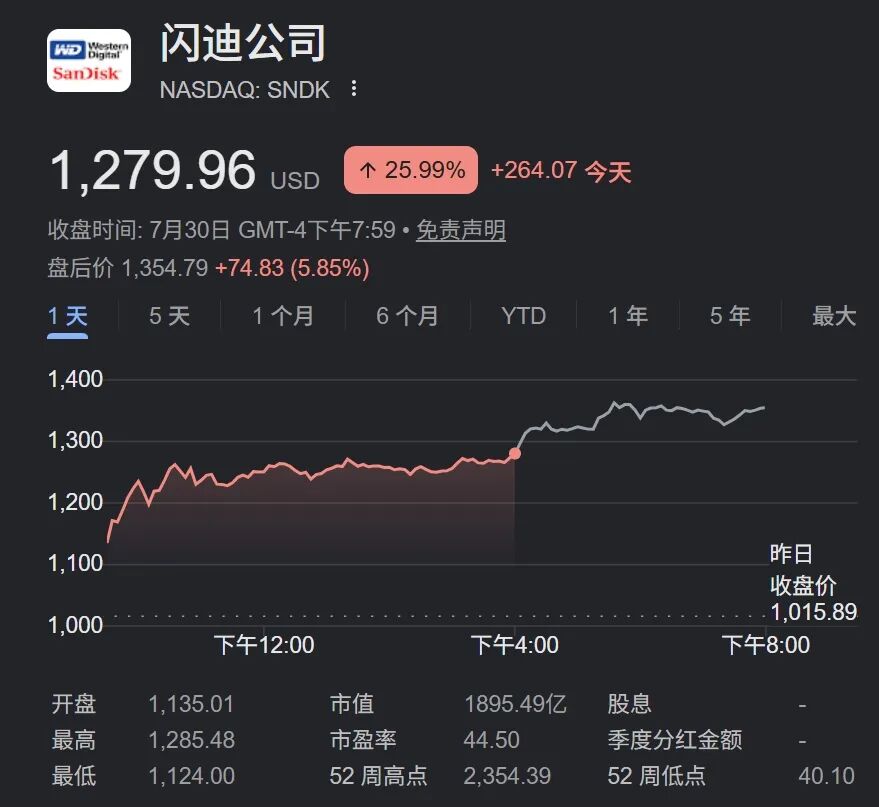
This rebound was driven by the entire AI and semiconductor sector, rather than any major positive news released solely by SanDisk. Microsoft’s earnings showed strong Azure growth, restoring market confidence that big tech companies’ AI investments are translating into revenue and profit, thereby sparking a rebound in storage, processor, and semiconductor equipment stocks.
Moreover, whether among chip or memory stocks, SanDisk has recorded the most dramatic ups and downs in previous cycles. Using the June 30 closing price of $2,273.73 as a reference, even after surging 26% on July 30, its share price was still down 43.71% cumulatively as of that day. In other words, this surge is more of a repair after a prior sell-off, rather than returning to its original price level.
SanDisk is set to announce its fiscal 2026 Q4 and full-year results on August 5. As the earnings window approaches, short covering, bargain hunting by investors, and option hedging are likely to reinforce one another.
Microsoft’s latest quarterly revenue and profit both exceeded market expectations, with Azure and other cloud services revenue growing 43% year-over-year, and overall cloud revenue rising 27% to $59.3 billion; the company also stated there is no change to its 2026 capital expenditure forecast. For the memory industry, these figures are important because the world's largest AI infrastructure buyer continues to expand computing power, and new servers require not only GPUs but also high-bandwidth memory (HBM), server DRAM, and enterprise SSDs. Earlier market fears that cloud providers would cut back investment have at least been alleviated for now by Microsoft’s results.
HBM requires more complex stacking and packaging, occupying more wafer capacity; manufacturers are prioritizing production capacity for HBM and server DRAM, further tightening the supply of traditional DRAM and NAND flash memory. Bloomberg cited industry sources as saying the global basic wafer supply still falls short of demand by over 20%, a tight balance that may persist for years. This is a core reason why Micron, SK Hynix and Samsung can maintain pricing power.
Warnings from the July crash have not disappeared. Memory stocks saw parabolic rises in the first half of the year, and prices already reflect very high earnings expectations. Recent market worries focus on three main areas: first, while Microsoft, Meta, Alphabet, and Amazon are investing more in AI, whether free cash flow and returns on investment will rise in tandem remains to be seen; second, Samsung, SK Hynix and Micron are all accelerating capacity expansions, which could undermine pricing power after 2027; third, the expansion and IPO of Chinese memory manufacturer ChangXin Memory are prompting the market to reassess the competitive landscape in the mature DRAM field. In addition, high interest rates and rising long-term US Treasury yields are seen as amplifying the valuation pressure on high-volatility tech stocks.
Reporter Zhou Zimo
Disclaimer: The content of this article solely reflects the author's opinion and does not represent the platform in any capacity. This article is not intended to serve as a reference for making investment decisions.
You may also like
UK and US central banks “three dissenting votes in unison”! War clouds overshadow inflation outlook as the Bank of England holds rates at 6-3
The Bank of England has kept interest rates unchanged at 3.75%, as UK officials seek to balance the threat posed by renewed U.S.–Iran tensions with signs that domestic price pressures are easing faster than expected.

Madrid to host the banks building the next generation of European digital money
Are stablecoins for remittances truly cheaper? Bank of Italy tests say no
Korean stock market slump can't overshadow the high prosperity of storage chips! South Korea, the "canary in the coal mine" of the global economy, is expected to see a 59% surge in July exports.
Economists said that exports in July are expected to increase by 59.0% year-on-year (compared to 70.7% in June), and the fundamentals of the chip industry remain strong. Although memory chip manufacturers reported record profits, the stock market still experienced a significant decline.

Crypto prices
More


