
The Cost of the Hashpower Arms Race: CoreWeave (CRWV.US) Faces Rising Bond Issuance Costs, Investors Grow Wary of "Renewal Risk"

Although AI cloud computing star company CoreWeave is already accustomed to sharp fluctuations in the stock market, recent turbulence in the capital markets has had a substantial impact on its crucial debt financing costs.
According to zhihuofinance APP, although artificial intelligence cloud computing star company CoreWeave (CRWV.US) has long been accustomed to sharp stock market fluctuations, recent volatility in the capital markets has had a material impact on its critical debt financing costs. After experiencing a roller-coaster ride of plunging and surging stock prices, the company was forced to finalize a large leveraged loan deal at a higher cost.
Previously, CoreWeave launched a $2.6 billion leveraged loan issuance plan, initially targeting rates at 425 to 450 basis points above the benchmark rate. However, due to sudden changes in market conditions, the company was forced to raise the rates. According to Bloomberg's calculations, the final rate locked in this Thursday was a full 100 basis points above the original top end, which means the company will incur about $30 million in additional annual interest expenses.
Sources said that despite higher pricing and some term adjustments, the deal still attracted about $9 billion in subscription orders, showing that market interest in AI infrastructure assets remains robust.
For a computing power leasing company in a period of rapid expansion and high cash burn, any increase in financing costs is critical. CoreWeave’s core business—providing high-performance cloud computing services for AI models—is a typical capital-intensive industry, with growth heavily dependent on high-yield bond market funding.
Regarding this financing, a CoreWeave representative said in a written statement: “CoreWeave consistently expands the boundaries of AI infrastructure financing with a rigorous and standard approach. This deal reflects increased market confidence in the long-term value of these assets, as well as recognition of our execution track record. This is a very good result.”
However, the overall market environment is changing. Investors are weary of the significant supply flooding both investment-grade and junk bond markets, especially given that future capital expenditures by tech giants are expected to rise further. Enormous pressure on the supply side is systematically pushing up borrowing costs for various asset classes.
CoreWeave's turbulent week was accompanied by a side story: reports said that AI-focused hedge fund Situational Awareness has recently been clearing its public market positions, putting pressure on the share prices of several tech companies, including CoreWeave. Meanwhile, Ken Griffin's Citadel took the opportunity to acquire a large amount of AI stocks. Data shows that as of March 31, Situational Awareness held about 1.6% of CoreWeave's public float.
Severe market volatility briefly sent some of CoreWeave’s bond prices below 90% of face value, pushing yields up to the 13% range, which is typically a signal of financial stress. Fortunately, as the market rebounded overall on Thursday, its bond trading levels improved. A spokesperson for JPMorgan Chase, who led the transaction, declined to comment.
Debt Rotation and Maturity Mismatch Concerns
CoreWeave has long been diversifying its debt financing toolkit. After going public and gaining more customer contracts, its investor base has continued to expand. In just a few short years, it has tapped private credit, bank loans, convertible bonds, junk bonds, and now the leveraged loan market.
Currently, CoreWeave mainly uses two debt modes for financing: one is corporate-level credit bonds, which have recently been hit the hardest. Although these bonds carry coupons of 8.5%-9.75%, their current trading prices have fallen below par, pushing effective yields to as high as 11%-12%. The other is project financing using client contracts and hardware assets such as chips as collateral. Thanks to high-quality clients (such as Anthropic and Jane Street), these usually obtain higher ratings and lower rates.
The current $2.6 billion leveraged loan is the second loan in this asset-backed category. The first was issued in May last year and was in high demand, marking “chip loans” as a new category in syndicated lending markets and greatly expanding the investor pool.
However, there is a key difference with the previous deal: for this loan, some of the client contracts mature before the loan is fully due.
This means that lenders now need to bear "renewal risk"—that is, bet that market demand for AI computing power will remain robust over the next few years and clients will renew their contracts. According to sources, it was this change that caused some lenders to back out or demand higher risk premiums. In CoreWeave's view, though, including this clause can unlock future financing for more (including short-term) customer contracts.
Ratings agencies do not agree on the outlook. Moody’s and Fitch gave the loan Ba2 and BB+, respectively—the highest levels among junk bonds—reflecting the collateral value. Moody’s report points out that the risk lies in the customer contracts’ weighted average remaining term being just 3.1 years, shorter than the loan’s five-year term. As a balance, CoreWeave promises that “if existing tenants do not renew, it will cover any cash flow gaps during the search for replacement tenants.” According to Moody’s estimates, the initial contract revenues represented by these customer agreements are about $4 billion.
Worth mentioning, the loan includes a clause for principal to be gradually amortized to zero during the term, reducing lender risk. This is common in chip asset-backed loans but is rare in the traditional corporate bond market.
Overall, pricing for CoreWeave’s contract- and chip-backed loans has decreased over time, but still varies based on client quality. Company documents show its first such loan in 2023 had an actual rate as high as 15%; while this March, a loan collateralized by a Meta Platforms contract received an investment-grade rating, with a rate just 225 basis points above the benchmark, translating to about 6% at current levels.
Disclaimer: The content of this article solely reflects the author's opinion and does not represent the platform in any capacity. This article is not intended to serve as a reference for making investment decisions.
You may also like
AAVE holds $96.71 as buyers defend key support, breakout expected above $100
Gold has value at $4,000 as investors look beyond Fed hawkishness
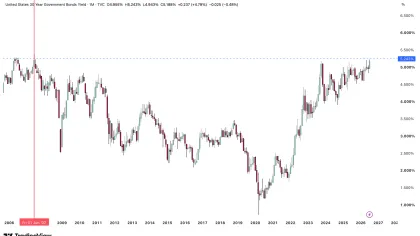
U.S. Treasury yield hits 2007 high – What it means for Bitcoin
Bitcoin faces $65,000 resistance as spot demand rises, next targets at $67,000–$68,000
Crypto prices
More


