
Effectiveness of Japan-US Joint Intervention Fades as Yen Returns to 159 Level, Testing Policy Limits

The effectiveness of the US-Japan joint intervention is fading, as interest rate-driven carry trades suppress the yen’s value back to the 159 level.
On August 12, the yen once fell by 0.1%, reaching 159.39, and finally closed nearly unchanged. However, the yen's recent persistent devaluation has already erased about half the gains brought by the US-Japan joint intervention.
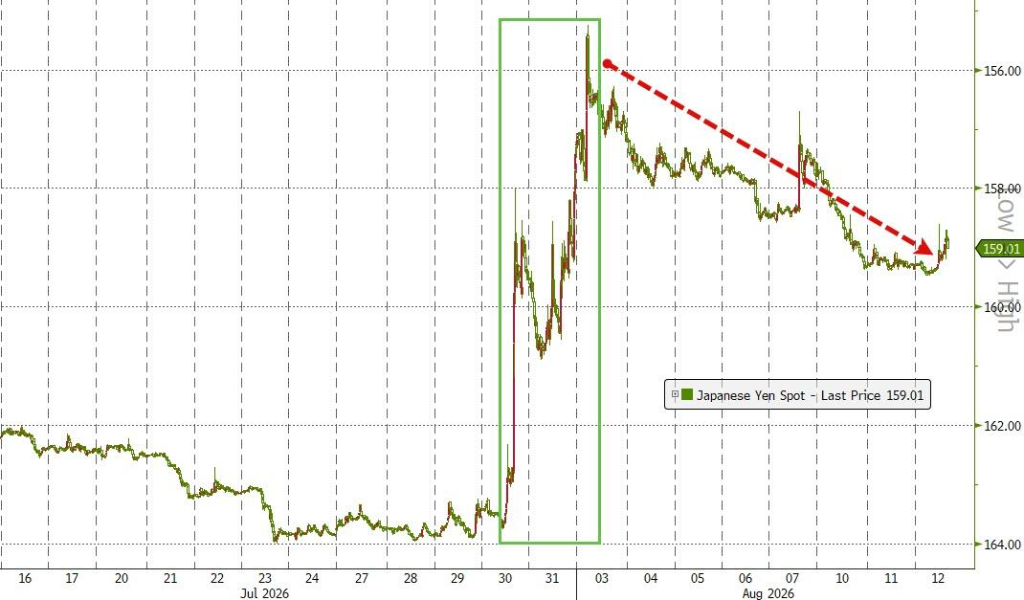
According to Wallstreet Insights, on July 31, the US Treasury passed orders through the New York Fed to Goldman Sachs and Morgan Stanley to sell euros and buy yen, marking the first direct intervention in nearly 30 years.
This intervention had pulled the yen up from around 163 to 155, a historic move in which Washington unusually joined Tokyo in buying yen. Both sides later signaled that further action would be taken if necessary.
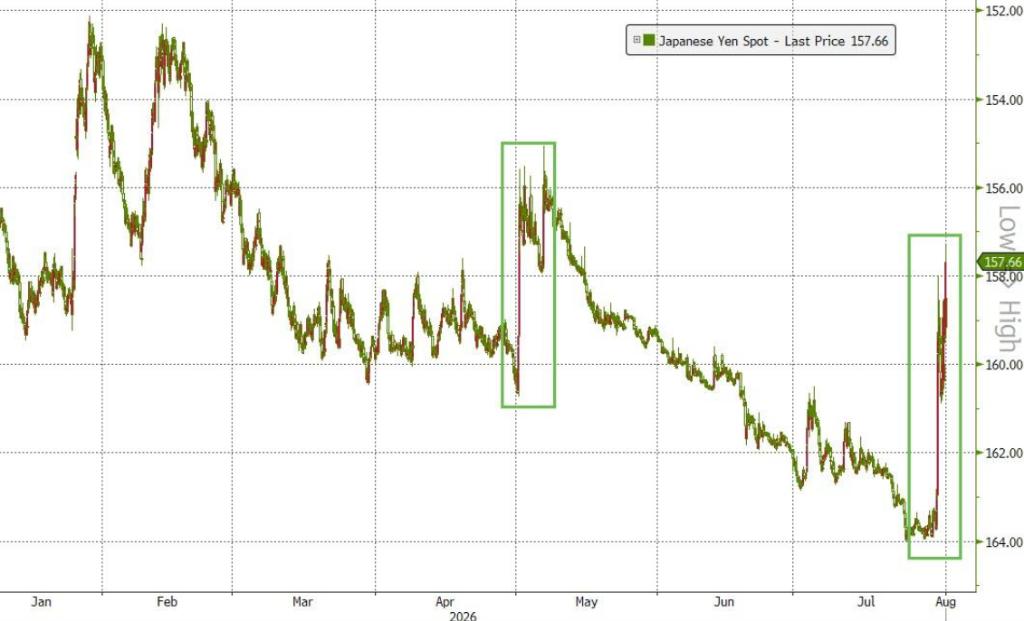
However, persistently high US Treasury yields plus surging international oil prices have added extra pressure on Japan, which imports energy, providing renewed support for dollar bulls and causing the yen's gains to quickly retreat.
The market is now focusing on the Bank of Japan, whose next monetary policy meeting is scheduled for September. Several strategists believe that if the Bank of Japan does not actively proceed with policy normalization, the effect of interventions will be extremely limited.The 160 level is already seen as a political red line for authorities; once the exchange rate rapidly approaches this level, a new round of intervention could be triggered at any time.
The Interest Rate Differential Remains, Carry Trades Dominate Exchange Rate Movements
The core reason behind the failure of this intervention lies in the continued widening interest rate gap between the US and Japan.
The yield on 10-year US Treasuries is currently 4.686%, while Japanese government bonds with the same maturity offer only 2.846%, resulting in a spread of more than 180 basis points. This provides strong motivation for investors to borrow low-interest yen and switch to higher-yielding dollar assets.
Jesper Koll, Senior Director at Monex Group, commented:
The intervention startled the market but cannot stop financial logic from unfolding—funds always flow to where returns are highest. As long as Japan’s funding cost is lower than overseas returns, carry trades will come back.
Masahiko Loo, a forex strategist at State Street Global Markets, believes that the intervention is not meaningless, but its role is more in suppressing excessive speculation than changing the fundamentals. He said:
The intervention successfully reset market psychology and demonstrated an unusual level of policy coordination between the US and Japan, but it has not yet removed the yield advantage supporting the dollar. More accurately: The intervention has been effective in slowing speculation, but not in altering the fundamentals.
Intervention Acts More as a Guardrail, 160 Is the Authorities’ Political Red Line
Before the above structural contradiction is resolved, the market's assessment of intervention is changing. Its role may be less about reversing the yen’s decline, and more about preventing the decline from accelerating out of control.
Loo from State Street points out that the 160 threshold has now become the “authorities’ political red line”. If the exchange rate again quickly approaches this level, the likelihood of official market action will clearly rise. He commented:
I do not rule out the possibility of further intervention, especially in the case of rapid or disorderly market moves, but ultimately, intervention can only buy time; the real task still lies with the Bank of Japan to begin policy normalization as soon as September.
To enhance the deterrent effect of intervention, both the US and Japan are promoting the Federal Reserve’s Foreign and International Monetary Authorities (FIMA) repo facility.
This facility allows Japan to obtain dollar liquidity by using US Treasuries as collateral, thus reducing the need to sell US Treasuries to raise intervention funds. US Treasury Secretary Bessent has already sent supportive signals about expanding the mechanism.
The Bank of Japan Is the Key Variable; Rate Hikes Alone May Not Be Enough
Given Japan’s interest rates are unlikely to rise rapidly and US yields show no sign of falling in the short term, investors will continue to have strong incentive to allocate funds offshore.
John Wood, Chief Investment Officer for Asia at Lombard Odier, said the latest round of intervention had a “limited duration of effect”, and that the Bank of Japan may need at least two rate hikes to truly put an end to the yen’s sustained weakness.
Koll from Monex pointed out that what shocks investors even more than intervention is the Bank of Japan’s persistent unwillingness to adopt a more aggressive tightening stance, raising questions externally about whether Japan’s banking system distress or massive government debt burden is constraining decision-makers.
Crédit Agricole Corporate & Investment Bank believes the deeper root of yen weakness lies in the “asymmetry in investment capacity” between the US and Japan. The US’s massive investment in artificial intelligence and other fields continues to attract global capital, while Prime Minister Sanae Takaichi’s planned public-private partnership investment program has yet to be fully implemented.
The institution commented:
What is needed to correct yen weakness is not a rate hike, but an expansion in investment.
This means that for the yen to achieve a sustainable rebound, the fundamental requirement is to enhance the attractiveness of Japanese assets themselves, encouraging domestic savings to stay at home, rather than continuing to seek overseas returns.
Disclaimer: The content of this article solely reflects the author's opinion and does not represent the platform in any capacity. This article is not intended to serve as a reference for making investment decisions.
You may also like
JPMorgan bullish on JOYY (JOYY.US): target price $98, gives "Overweight" rating
Recently, the international investment bank J.P. Morgan released its latest research report, assigning an "Overweight" rating to the stock of the world's leading technology company JOYY (JOYY.US), with a target price of $98.

GLOBAL MARKETS-Stocks rise with oil price below $90, euro edges up, Iran in focus
Stock Markets Beware: AI Funding Plans Have Shades of the Financial Crisis -- Barrons.com
Metaplanet launches BitBonds program as Gerovich denies Bitcoin sale
Crypto prices
More


