
Euro bounces off one-week low, holds above 1.1500 vs USD as traders look to US PPI

The EUR/USD pair drops to a one-and-a-half-week low during the first half of the European session, though it manages to recover a few pips from the vicinity of the 1.1500 psychological mark. That said, the fundamental backdrop seems tilted in favor of bearish traders and suggests that the path of least resistance for spot prices is to the downside.
The lack of an upside surprise from the US Consumer Price Index (CPI), released on Wednesday, eased pressure on the Federal Reserve (Fed) regarding potential interest rate hikes. Investors, however, are still pricing in a high chance that the US central bank will raise borrowing costs by the end of this year amid concerns that higher energy prices will rekindle inflation. This, in turn, lifts the US Dollar (USD) to a two-week high and exerts some pressure on the EUR/USD pair.
In the latest developments surrounding the Middle East crisis, President Donald Trump claimed that the US has total control over the Strait of Hormuz, while Iran has pledged to keep the vital waterway closed until all its demands are met. Moreover, Iran-backed Houthis in Yemen escalated attacks on vessels in the Red Sea and Bab el-Mandeb Strait, targeting Saudi ships. This leads to increased war-risk premiums, which support crude oil prices and the safe-haven Greenback.
Meanwhile, money markets price in roughly a 90% probability that the European Central Bank (ECB) will raise interest rates by 25 basis points (bps) at its September policy meeting. The hawkish outlook holds back traders from placing aggressive bearish bets on the shared currency and limits the downside for the EUR/USD pair. The focus now shifts to the US macro data – the Producer Price Index (PPI) and the usual Weekly Initial Jobless Claims data, which will drive the USD.
Analysts at HSBC highlight a growing divergence in policy challenges across major central banks, noting that "although we expect the European Central Bank (ECB) to now deliver another rate rise in September, for other major central banks it is a much tougher balancing act." The bank argues that while the ECB is likely to press ahead with further tightening, policymakers elsewhere are confronting more complex trade-offs as they weigh inflation risks against the need to avoid over-tightening.
EUR/USD 4-hour chart
Technical Analysis
In the four-hour chart, the EUR/USD pair holds above the 200-period Simple Moving Average (SMA) at 1.1451, , which acts as the key structural floor that would need to give way to revive a deeper bearish phase. Momentum is less supportive, with the Relative Strength Index around 44 hinting at a lack of strong buying pressure, while the Moving Average Convergence Divergence (MACD) stays marginally below zero, suggesting that upside traction is tentative despite the constructive price location.
Disclaimer: The content of this article solely reflects the author's opinion and does not represent the platform in any capacity. This article is not intended to serve as a reference for making investment decisions.
You may also like
The NAND Boom in the Era of AI Inference: Western Digital (SNDK.US) Investor Day May Reveal a New Growth Curve! The Storage Bull Market Awaits the Next Fundamental Catalyst
Any signals of growth prospects or indications of NAND demand and technological iteration released by management during the "SanDisk Investor Day" could serve as a fundamental confirmation for the continued rally in global storage stocks.

Driven by declines in energy and food, the U.S. July PPI year-on-year increase narrowed to 4.7%, echoing the cooling trend of CPI
Due to further declines in energy and food costs, the year-on-year increase in U.S. wholesale inflation in July was lower than market expectations, continuing its downward trend.

Andre Cronje says DeFi is dead, long live ‘onchain finance’
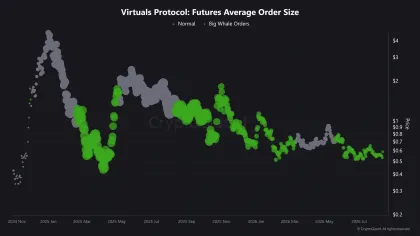
VIRTUAL crypto rallies 10% – Can surging volume push price to $0.68?
Crypto prices
More


