
How Far Has AI Come in Treating Diseases?

“Saying that AI can cure cancer sounds more like a cliché than an inspiring message, and most people consider it misleading.”
On August 16, Anthropic CEO Dario Amodei wrote this sentence on X. Two days later, Anthropic announced a protein design experiment: Claude, operating a suite of specialized models and research tools, designed new proteins capable of binding to multiple target proteins. The next day, Moderna and Merck announced that a personalized cancer vaccine, involving machine learning in the design phase, met its primary endpoint in a phase 3 melanoma trial.
This cluster of breakthroughs once again sparked outside attention on AI and healthcare, and the capital markets quickly responded. On August 19, Moderna's stock surged approximately 177%, Merck rose about 13%; verification partner Twist's stock for Anthropic-related research jumped 22.64% in a single day, and Tempus AI, focused on AI-enabled precision medicine, was also up 22%. The excitement soon spread to the entire biotech sector, with iShares Biotechnology ETF and SPDR S&P Biotech ETF rising 6.6% and 5.9% that day, respectively.
From protein design, AI drug discovery, to the phase 3 trial of personalized cancer vaccines, “AI healthcare” is beginning to correspond to increasingly concrete research outcomes. So, what stage have these advances reached? Which have undergone clinical validation in humans, and which remain in the lab; and what role is AI actually playing in them? Has it truly helped humanity “cure” cancer?
“Cure” Comes with Very Strict Criteria
“AI healthcare” sounds like a single industry, but in reality, it encompasses a series of very different tasks.
Algorithms can read medical records, identify images, predict disease risks, as well as search for drug targets, generate molecular structures, and screen clinical trial participants. They can also assist doctors in selecting treatment plans, calculating radiotherapy doses, or monitoring a patient's reaction to medication.
While all of these tasks are connected to medicine, the standard of evidence required for each is vastly different.
A model answering medical exam questions correctly proves its ability to understand certain forms of text; accurately predicting diagnoses from retrospective cases demonstrates the ability to reproduce patterns in data; helping doctors improve diagnosis rates in hospitals requires prospective trials; and whether a drug designed with AI is effective ultimately depends on head-to-head comparison with existing treatments or placebos in patients.
The US Food and Drug Administration (FDA) states that, since 2016, they have received over 500 regulatory submissions for drugs and biologics involving AI components. “Using AI,” in this context, might mean predicting pharmacokinetics, optimizing dosages, analyzing clinical endpoints, integrating natural history data, or assisting with manufacturing and quality control. This indicates that AI is already a common tool in drug development, but it doesn't mean 500 drugs were independently invented by AI.
Most FDA-authorized medical AI so far is concentrated in information processing. A 2025 JAMA systematic review counted 950 FDA-authorized AI medical devices, with 723 belonging to radiology—about 76%. These systems process highly digitized data such as X-rays, CT, MRI, and ultrasound.
Medical images have relatively standardized input formats, and hospitals have accumulated vast digital libraries. Many tasks also have clear answers, such as whether a nodule appears in an image, where the lesion boundary is, and what has changed between two exams. Therefore, this is the medical domain with the highest concentration of AI products to date.
Treatment, on the other hand, poses a different set of challenges.
Diagnostic models attempt to answer, “What is happening to this patient now?” Treatment decisions must answer, “What will happen if we intervene?” A patient cannot undergo two mutually exclusive treatments simultaneously, so researchers can’t directly observe what might have happened with the untreated option. Highly correlated models may misattribute effects, confusing a patient population’s characteristics for treatment efficacy.
This is why randomized controlled trials remain crucial. Nature Medicine's review of causal machine learning notes that AI can combine clinical trials and real-world data to estimate individualized treatment effects, but bias, confounding, and erroneous causal assumptions can still result in bad predictions.
As for “cure,” medicine requires more than cancer cells being undetectable after treatment—the absence of recurrence must be confirmed as well. The US National Cancer Institute explains “cure” as all traces of cancer disappearing, with no recurrence in the future. Even after patients enter prolonged complete remission, doctors are usually cautious with the word, because the future has not yet happened.
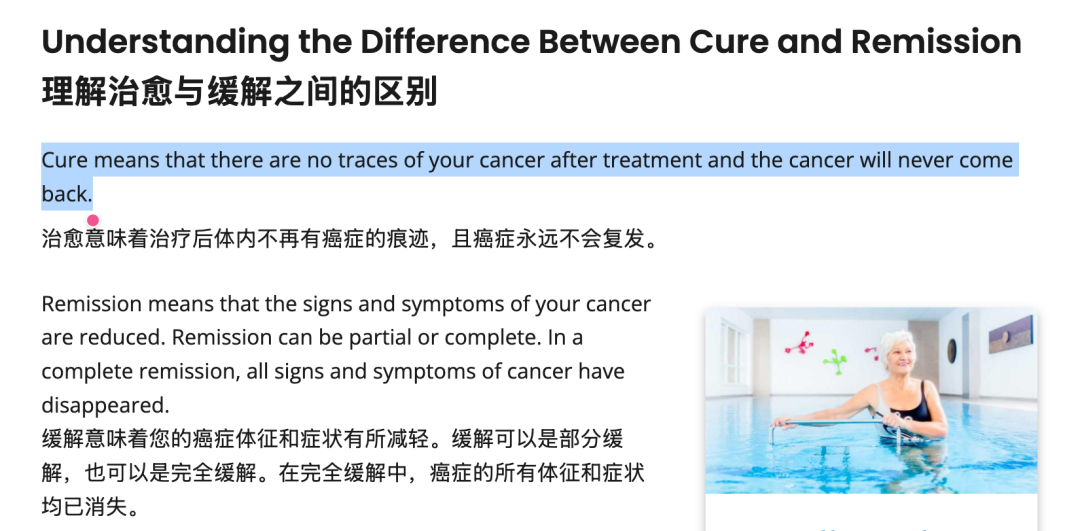
Image | FDA definition of a cure (Source: FDA)
A model that scores highly on benchmarks or retrospective cases can only show it completed the assigned prediction task. Whether patients benefit long-term depends on controlled experiments and years of follow-up.
Three Milestones, Each at a Different Door
This distinction can be illustrated by Anthropic’s recently announced experiment.
Over a series of 24 to 48-hour tasks, Claude read papers and databases, invoked open protein structure prediction and design tools, selected binding sites, and generated candidate proteins, iteratively optimizing designs based on computational results.
Researchers selected 16 target proteins, obtaining interpretable measurements for 15 of them. Labs synthesized and tested 1,320 candidate designs, confirming 354 bound with their targets. 14 out of 15 targets were matched with a binder. Some tasks outperformed Anthropic’s previous workflows.
This is a robust research result. Claude did more than summarize existing knowledge—it worked continuously for dozens of hours, orchestrated specialized models, adjusted experimental strategies, and produced new designs that passed wet-lab verification. Third-party labs synthesized and tested the designs, reducing the risk of self-assessment bias for the model.
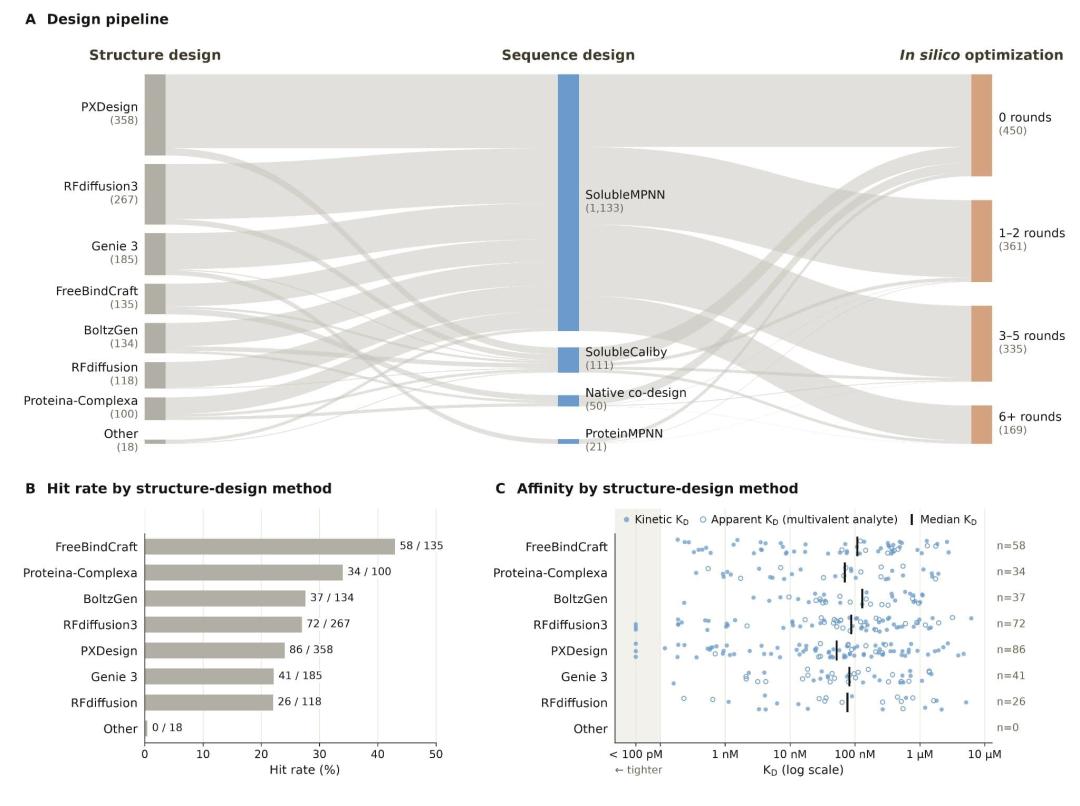
Image | Claude successfully coordinated multiple open-source protein design models, generating high-affinity binders with strong success rates. (Source: Anthropic)
However, the experiment’s targets are 15 interpretable protein targets, not 15 diseases; the 354 outcomes are protein binders, not 354 drugs.
A protein that binds to a target only means the researcher has found a possible key for a lock. Whether it actually opens the correct door, whether it damages other doors, whether it will reach the lock inside the human body, whether the immune system will clear it away—all require further experiments. Anthropic’s report clearly states these small binding proteins are not drugs in the conventional sense; binding is only the first step in drug development.
By contrast, Rentosertib has advanced further. This candidate small-molecule drug for idiopathic pulmonary fibrosis was developed by Insilico Medicine through AI-driven target identification (TNIK) and generative molecular design. A 2025 randomized phase 2 trial enrolled 71 patients for 12 weeks and observed initial signals of efficacy and acceptable overall tolerability.
However, the study was small, with 16 dropouts across all groups, and the follow-up was too short to judge long-term benefits. Researchers called the results “encouraging and deserving of further study,” not a definitive therapeutic breakthrough.
In July 2026, Rentosertib entered phase 3 trials. It's among the most advanced AI drug development cases: AI helped with target discovery and molecule design; the candidate drug subsequently underwent preclinical studies, phase 1 safety data, randomized phase 2 testing, and now larger human trials. It is still not approved for marketing, nor has it cured idiopathic pulmonary fibrosis.
Moderna’s personalized cancer vaccine sits in a different position still.
Developers sequence each patient’s tumor and normal tissue, identify tumor-specific mutations, and use machine learning and bioinformatics to prioritize potential neoantigens. Up to 34 new antigens are encoded into a personalized mRNA molecule, meant to train the immune system to recognize the patient’s cancer cells.
In the just-reported INTerpath-001 phase 3 trial, 1,137 high-risk melanoma patients were treated. All had their tumors surgically removed, and the trial assessed whether the vaccine plus Keytruda could reduce recurrence and distant metastasis after surgery.
The company reports that both the pre-set primary endpoints—recurrence-free survival and distant metastasis-free survival—were met in the interim analysis. Overall survival is still being followed up; hazard ratios, absolute event rates, confidence intervals, and survival curves have not been disclosed.
This phase 3 trial verified the incremental benefit of the full “personalized vaccine plus Keytruda” regimen. There was no group with personalized vaccines developed by non-AI human selection of antigens, nor a comparison of “using AI” versus “not using AI.” Therefore, the research can prove the efficacy of a therapy with an ML component, but cannot quantify how much benefit is attributable to the algorithm.
The three advances answer three questions: Can models design proteins that bind to targets in the lab? Can AI-designed candidate drugs show preliminary efficacy in humans? Can a personalized therapy with machine learning components improve clinical endpoints in phase 3?
We need not boost their status with the label "cure." Anthropic has improved experimental hit rates in protein design, Rentosertib has pushed AI-generated drugs into late-stage clinical trials, and Moderna has achieved a phase 3 positive result for personalized cancer vaccination. These are already significant steps forward.
The Most Costly Failures Happen After the Algorithm’s Job
Modern drug development is a system built on relentless elimination of answers.
Researchers find a disease mechanism, select promising targets, then sift through huge numbers of candidates, optimizing activity, stability, selectivity, and manufacturability, followed by bench, animal, and human studies. Each successive stage eliminates previously promising candidates.
A review of clinical development failures estimates drug development from discovery to approval usually takes 10–15 years. Even reaching phase 1 trials, around 90% of candidates fail. Between 40%–50% of failures are due to insufficient efficacy, around 30% due to unacceptable toxicity.
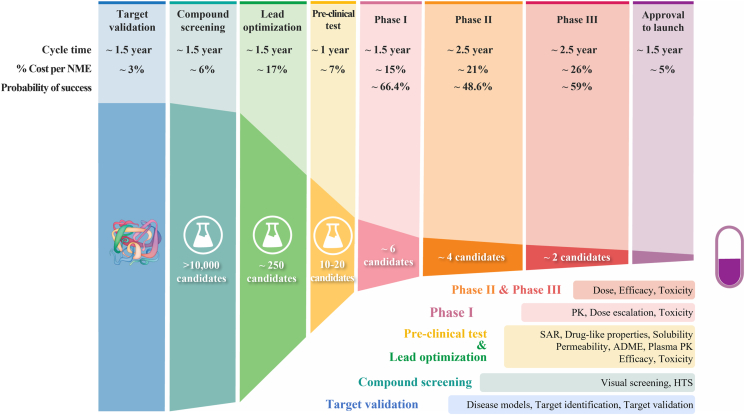
Image | The drug discovery and development process and failure rates at every stage. (Source: Acta Pharm Sin B)
This data reveals the most easily overlooked aspect of AI in drug R&D: Generating a computationally excellent candidate may only accelerate the front half of the highest-failure segment of the pipeline.
Just because a target is disease-relevant doesn’t mean intervention works; molecules showing efficacy in a dish may not reach sufficient concentrations in the body; animal model success does not always predict clinical benefit in humans. Many “perfect” candidates don’t show clinical efficacy until they fail in phase 2 or 3 trials.
AlphaFold is a good example of this distinction. It has predicted around 200 million protein structures, greatly expanding structural resources. Clues that once took months or years can now appear in minutes. Scientists can propose hypotheses faster and study proteins previously lacking in experimental data.
However, the model provides a predicted conformation, while real proteins change shape under different temperatures, solutions, binding states, and may interact with other proteins, ions, molecules. When researchers compared AlphaFold predictions to experiments, even high-confidence models could still diverge in local conformations, side-chain positions, or domain directions. Thus, these predictions are “extremely valuable hypotheses,” with critical interactions still needing experimental verification.
AI can generate more candidate answers, but what life science most often lacks are high-quality questions and sufficient data to test those answers.
In August 2026, Nature Reviews Drug Discovery published an industry review arguing that, while technical progress abounds, AI’s clinically meaningful impact is still limited. The authors attribute this to several factors: overfocus on model metrics, life science data’s dependence on experimental context, real-world tasks poorly defined, and technical teams solving problems that are computationally straightforward but don’t remove genuine drug development roadblocks.
For instance, a generative model can create millions of molecules in hours. But most can’t be feasibly synthesized and tested, and flooding the pipeline may only amplify downstream screening bottlenecks. The truly valuable advance is early elimination of nearly certain failures, so limited experimental capacity can validate the most promising possibilities.
In that sense, “failing faster” could be AI’s most valuable contribution to medicine: not a “cure,” but potentially saving years and hundreds of millions of dollars.
Cancer Changes the Question During Treatment
Cancer, the central issue in this latest wave of hype, is even more complex. The US National Cancer Institute describes cancer as a collection of related diseases, with more than 100 known types. Tumors from different organs arise from different cells, influenced by distinct genes, immune contexts, and environmental factors. Even sharing a pathological label, two patients may have distinct mutations and treatment responses.
A patient’s cancer is not a uniform cell mass. Tumors accumulate mutations as they replicate, forming diverse subclones. A biopsy only samples a certain site and moment, and may miss cells driving metastasis or resistance.
More troublingly, treatment itself alters the tumor. Drugs may kill sensitive cells, leaving resistant ones to expand; the immune system may clear recognizable cells but select for stealthier subpopulations. A 2025 Nature Reviews Immunology article notes tumor-internal heterogeneity relates to poorer outcomes and diminished responses to immune checkpoint inhibitors, and immunologic pressure itself shapes tumor evolution.
AI is no longer facing a static recognition test. Models learn from past patients’ data, but new therapies and regimens change disease selection pressures. As diagnostics and treatment evolve, historic data relationships can break down.
Cancer data include another paradox: hospitals and research centers store vast numbers of images, genomics, and records, but usable samples shrink rapidly for actual treatment decisions.
Split patients by cancer subtype, mutation, prior therapy, age, immune state, and comorbidities, and you may end up with only a handful per group. The rare combinations most in need of personalized medicine are the places training data are scarcest. Inconsistent recordkeeping, missing follow-up, biased treatment selection, and underrepresentation further erode model reliability.
AI can still play a role here: integrating pathology, genomic, and clinical data to identify patient subgroups unnoticed by any single source; predicting candidate neoantigens, optimizing radiotherapy, matching trials, or helping spot relapse sooner.
These tools enhance observation, prioritization, and decision-making. Whether their treatment suggestions truly outperform doctors’ original choices still needs prospective study; whether a recommendation works broadly across hospitals, populations, and changing standards must be proven in the real world.
As AI moves from recognizing disease to intervening in it, it confronts causality, ethical obligations, and risk allocation. A model misclassification may result in duplicate tests; a wrong therapeutic suggestion could deprive a patient of effective drugs or expose them to needless toxicity. The closer the impact on the body, the greater the burden of proof.
Thus, on the road to “curing cancer”—or even more common diseases—AI’s challenge remains formidable.
Everything Before Success Is Accelerating
But to turn things around, AI’s true impact on medicine need not wait for a “fully AI-invented” drug to be approved.
It has already transformed the speed at which researchers read knowledge, broadened the range of searchable molecules and proteins, and begun to aid with experimental design, patient recruitment, clinical data analysis, and regulatory paperwork.
The Good Machine Learning Practice guidelines jointly issued by the FDA and EMA in 2026 put “clear use cases” at the core: reliability depends on which questions the model is answering and how much risk is attached to the answers.
This offers a more meaningful metric. In drug discovery, we can ask whether AI shortens candidate design and optimization, raises experimental hit rates, and so on. In clinical development, we should watch whether it reduces trial failure, improves patient recruitment, or uncovers meaningful responder subgroups. Ultimately, the standard remains: are patients living longer, healthier, and getting effective, affordable therapy?
Rentosertib, Anthropic's protein design, and Moderna's personalized vaccines are pushing AI into different parts of this chain. They are closer to biology than pure model benchmarks, but far more complex than the slogan “AI cures cancer.”
Dario’s cliché perhaps points to this problem: it writes a still-unfolding process into a finished ending and causes incremental but genuine advances to lack proper names.
As of today, AI has begun shaping which target scientists pursue next, which molecules they design, and which experiments they conduct. But whether patients will actually be cured still depends on experiments, clinics, and time.
Operations/Layout: He Chenlong
Note: Cover/Main image generated with AI assistance
Disclaimer: The content of this article solely reflects the author's opinion and does not represent the platform in any capacity. This article is not intended to serve as a reference for making investment decisions.
You may also like
SHIB Gains as Meme Coins Rally, But Shiba Inu Continues to Underperform

Solana surges 25%, hits $90 as $4.6 billion shorts liquidated after SEC proposal
Unknown Whale Pulls $192.81M USDC From Aave — Then Redeposits $192.81M

Ethereum Surges Nearly 30% in One Week — Spot ETF Inflows Return, Shorts Squeezed

Crypto prices
More


