
U.S. Debt Support Fuels Gold and Bitcoin Rally

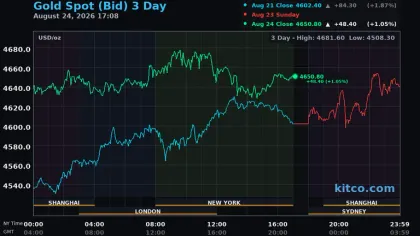
Gold has just climbed to 4,620 dollars an ounce, its highest level in three months. Bitcoin is trading around 78,000 dollars after a rise of about 20% since the U.S. Treasury announcement on August 19. Both assets benefit from the same movement: the dollar falls and investors start looking for alternatives again.
In brief
- Gold gains about 5% over the week and reaches 4,620 dollars.
- Bitcoin trades near 78,000 dollars after its recent rally.
- The dollar index dropped to 98.723 after the U.S. Treasury announcement.
Bitcoin and gold benefit from the dollar’s decline
The movement contrasts with the beginning of the year, when the strength of the dollar weighed heavily on Bitcoin and the crypto market. This time, the greenback falls. The DXY index dropped to 98.723 on August 19, its lowest level since May 14. A few days later, gold exceeded 4,600 dollars and Bitcoin hovered around 78,000 dollars.
The yellow metal gains about 5% over a week. Futures contracts even approached 4,650 dollars. Ole Hansen, strategist at Saxo Bank, is now watching the 4,770 dollar area. A move above could open the way toward 5,000 dollars an ounce.
Bitcoin follows a different pace. BTC gained nearly 20% in the days following the Treasury announcement. It had still struggled to hold 65,000 dollars a few days earlier. Gold and Bitcoin rise together. The dollar takes the opposite direction.
The U.S. Treasury triggered the movement
It all started with the bond market. The yield on 30-year U.S. bonds had reached 5.337%, a 19-year high. The Treasury reacted by doubling its long-term bond buyback program between September and November. Yields then returned around 5.198%. The dollar fell.
These buybacks allow the Treasury to withdraw certain old bonds from the market and replace them with new issuances. This is not Fed quantitative easing. The difference matters. For the markets, the immediate effect still resembles a loosening of financial conditions.
Robert Kiyosaki even sees a new form of money creation here. He has long recommended gold and Bitcoin when U.S. debt rises. The debate between the two assets is not new. Gold and Bitcoin still divide analysts on their ability to serve as a safe haven.
Buyers also do not always come from the same place. Central banks remain very active in gold. Bitcoin attracts more private investors, companies, and listed funds. This week, both camps are buying.
The “debasement trade” returns to the markets
The term is circulating again on Wall Street: “debasement trade.” The principle remains quite simple. When investors fear a sustained decline in the value of currencies, they look for assets whose supply does not directly depend on governments.
Gold has fulfilled this role for centuries. Bitcoin is trying to take part of that place. Mohamed El-Erian simultaneously cited BTC near 79,000 dollars and gold above 4,600 dollars among the most notable movements currently.
Not everyone puts them in the same category, though. Robin Brooks, former Goldman Sachs strategist, prefers gold and silver. He believes Bitcoin does not yet benefit from the same status when investors really seek to protect against currency risk.
The market will decide. Bitcoin has at least one very visible advantage in this debate: its cap of 21 million BTC. Gold, for its part, has a much longer history and remains massively held by central banks. Even Robert Kiyosaki continues to put the two in the same basket. He still presents gold and Bitcoin among assets capable of withstanding a monetary crisis. For now, the markets’ message comes down to three figures. Gold: 4,620 dollars. Bitcoin: 78,000 dollars. Dollar index: 98.723. The greenback sits in the middle.
Maximize your Cointribune experience with our "Read to Earn" program! For every article you read, earn points and access exclusive rewards. Sign up now and start earning benefits.
Disclaimer: The content of this article solely reflects the author's opinion and does not represent the platform in any capacity. This article is not intended to serve as a reference for making investment decisions.
You may also like
Xpeng Robotics raises $900 million in first round of financing, setting a new record with a $6.3 billion valuation, but Q2 net loss widens by nearly 1.8 times year-on-year
The financing round was led by IDG Capital, with strategic investments from Tencent and Alibaba. Meanwhile, the company reported a net loss of 1.34 billion yuan in the second quarter, and its guidance for the third quarter was also below market expectations, causing its US stock price to drop by more than 8%. Management has positioned robots and Robotaxi as the core engines for transforming the company into a physical AI technology enterprise and has set a goal of achieving driverless passenger operations by 2027. However, the capital market remains cautious about the transformation prospects.
Ledger CTO breaks down NIST’s post-quantum signatures and what they mean for Bitcoin and Ethereum
Gold rises, silver slips as fiscal-risk trade holds - Kitco PM Report
Banking consortium tests MPC with lattice-based cryptography on NEAR Protocol’s quantum-resistant testnet
Crypto prices
More


