
Federal Reserve Chairman Waller Signals Rate Hike! Warns Inflation Has Not Yet Consistently Slowed, Firmly Defends 2% Target

Federal Reserve Chair Waller said on Friday that there has not yet been a meaningful and sustained slowdown in U.S. inflation. The Fed must be confident that underlying inflation is falling toward the 2% target at a sufficiently fast pace; otherwise, policymakers will still need to take action.
According to Zhitong Finance APP, Federal Reserve Chair Walsh stated on Friday that U.S. inflation has not yet shown a meaningful and sustained slowdown, and the Federal Reserve must be assured that underlying inflation is falling back to the 2% target at a sufficiently rapid pace; otherwise, policymakers still need to take action. He also emphasized that the 2% inflation target is firm and fixed, and that the Fed's current primary focus should be on price stability.
This was Walsh's first comprehensive policy speech since taking office as Federal Reserve Chair in May this year. At the Fed’s annual Economic Policy Symposium in Jackson Hole, Wyoming, Walsh reiterated that the Fed will bring inflation back to the 2% target. “We must be confident that underlying inflation is moving clearly and at a fast enough pace toward our goal,” Walsh said in his prepared remarks. “Otherwise, we have more work to do. That is our responsibility.”
The Current Financial Environment is Not Restrictive
Walsh also stated that current financial conditions are not restrictive and that interest rates remain the Fed’s “main tool” to achieve its policy mission.
Although both the Personal Consumption Expenditures Price Index (PCE) and the Consumer Price Index (CPI) released this summer were better than market expectations, Walsh believes that these data are not sufficient to prove that the underlying trend of U.S. inflation has materially improved. “While this summer’s PCE and CPI data exceeded expectations, they do not convince me that the underlying trend has meaningfully improved,” Walsh said. “Market prices show that investors believe we can achieve price stability. I can assure you, their judgment is correct.”
He further pointed out that with the current inflation rate still above 2%, the Fed’s main focus at this stage should be on prices. He also specifically emphasized that price stability does not occur automatically, and inflation does not necessarily fall back to its long-term average on its own. “Price stability is not automatic, nor is mean reversion of inflation. Achieving stable prices is the Fed’s job.”
First Explicitly Hardline Anti-Inflation Signal
Walsh’s speech attracted significant market attention. Previously, his strategy of narrowing the Fed’s external communications had drawn criticism from some economists and investors, who believed the Fed’s statements on the short-term economic outlook and monetary policy direction lacked clarity.
This Jackson Hole speech clearly responded to these concerns. Compared with before, Walsh outlined his views on the U.S. economy, inflation, and the Fed’s policy priorities more clearly, and reaffirmed the Fed’s commitment to the 2% inflation target.
Earlier, the market was even concerned that under Walsh’s leadership, the Fed might adjust the 2% inflation target. At the press conference following the July policy meeting, Walsh hinted that there could be adjustments to the FOMC’s inflation target, while avoiding questions about possible rate hikes in the coming months.
This performance drew widespread criticism and triggered a sell-off in long-term U.S. Treasuries, with yields on long-term bonds rising to near 20-year highs—viewed by some investors as a sign of declining confidence in the Fed’s commitment to the 2% inflation target.
This time, however, Walsh clearly emphasized that the 2% inflation target is “firm and unshakable,” directly responding to earlier concerns that the Fed might adjust its inflation target.
Divisions Remain Within the Fed on Whether to Raise Rates
Currently, economists remain sharply divided over whether the Federal Reserve needs to resume raising interest rates in the coming months.
At the July monetary policy meeting, the Fed decided to keep rates unchanged, but meeting minutes show that several officials supported a rate hike, while quite a few others believe that if inflation does not continue to decline, further monetary policy tightening would be necessary.
This was the fifth consecutive meeting in which the Fed maintained rates unchanged, following three consecutive rate cuts by the end of 2025.
However, a series of economic data released since the July meeting shows that U.S. economic activity is cooling, which has somewhat eased the immediate pressure on the Fed to raise rates.
In July, U.S. retail sales saw the biggest monthly drop in more than a year; core inflation remained relatively subdued; meanwhile, U.S. employers unexpectedly cut jobs in July, and new job gains for the previous two months were revised downward. These signs all indicate that economic growth and the labor market are losing some momentum.
Market Significantly Lowers Probability of September Rate Hike
As economic data weakens, investors have recently scaled back their bets on further Fed rate hikes. As of Friday, federal funds futures pricing shows the market expects the probability of a Fed rate hike in September to be about 36%, a significant drop from over 70% at the end of July.
This has made the Fed’s current policy trade-off even more complex. On the one hand, inflation remains above the 2% target, and Walsh explicitly stated there can be no premature declaration of victory over inflation; on the other hand, consumption, employment, and overall economic activity are showing signs of slowing down, and continued tightening of monetary policy could further increase downward pressure on the economy.
The core message from Walsh’s Jackson Hole speech is that even though recent inflation data has improved, the Federal Reserve is not yet ready to declare victory over inflation. Until underlying inflation clearly and rapidly falls back to 2%, the Fed will retain the possibility of further tightening, and the 2% inflation target will not be easily changed due to short-term economic pressures.
Disclaimer: The content of this article solely reflects the author's opinion and does not represent the platform in any capacity. This article is not intended to serve as a reference for making investment decisions.
You may also like
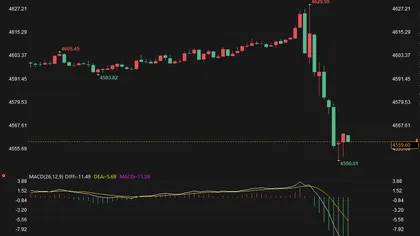
US Dollar Index rallies as Warsh puts September rate hike back on the table
Rumors claim US Senate secretly passed CLARITY Act, public vote on September 15
Why Banks Are Suddenly Embracing the Stablecoins They Once Feared
Crypto prices
More


