
Oil prices surge combined with hawkish Fed expectations, gold falls below $4,400

Huitong Network, September 1—— The global rise in bond yields and heightened expectations of Federal Reserve rate hikes are weakening gold’s appeal as a non-interest-bearing asset. Rising oil prices have reignited inflation expectations, while hawkish remarks from Federal Reserve Chairman Kevin Walsh have further intensified market bets on policy tightening. Spot gold hovered just below $4,500 on Tuesday. In the short term, the market is watching whether US employment data can shift interest rate expectations.
Gold has clearly cooled off recently, with spot prices once again trading below $4,400/oz. Some of the funds that previously drove gold higher have begun to take profits, and the market is reassessing the Federal Reserve’s future interest rate path. Compared to pure safe-haven demand, the main pressures facing gold now come from rising bond yields, the relative strength of the dollar, and improved real interest rate expectations.
Major global bond markets have recently suffered sell-offs, with long-term government bond yields rising sharply. The US 10-year Treasury yield once rose to about 4.78%, and the 30-year yield approached 5.27%. The high yield environment increases the attractiveness of interest-bearing assets like bonds for capital, while also raising the opportunity cost of holding gold. Rising oil prices have amplified this effect. The Middle Eastern situation has driven crude oil prices up again, and energy supply risks have rekindled inflation expectations. The market logic has shifted from “geopolitical risks benefiting gold” to “geopolitical risks driving up oil prices, oil prices boosting inflation, and inflation strengthening rate hike expectations.” This shift means gold cannot fully benefit from traditional safe-haven demand.
Recent hawkish statements from Federal Reserve Chairman Kevin Walsh at the Jackson Hole symposium have been a key catalyst for gold’s recent adjustment. He emphasized that if policymakers cannot confirm underlying inflation is falling toward the 2% target rapidly enough, the Federal Reserve would still need to act further. The market subsequently raised its bets on a September rate hike, with related probabilities now rising to about 66%.
From a capital flow perspective, changing interest rate expectations are weakening gold's short-term appeal. ANZ Bank analysts believe the market is adapting to changes in monetary policy, and gold is currently more vulnerable to selling pressure. Meanwhile, holdings in the world’s largest gold ETF remain around 1,042 tonnes, with no significant increase, suggesting investors remain cautious about chasing higher prices in the short term.
However, gold’s long-term support has not completely disappeared. Geopolitical risks, global fiscal pressures, and continued gold allocations by some central banks still provide medium- and long-term value support. Therefore, this correction is better understood as a cyclical shift in macro-pricing logic, rather than a complete reversal of gold’s long-term trend. Going forward, US economic data will become the key variable determining whether gold can stabilize. This week, the market will focus on JOLTS job openings, ADP employment data, and the August nonfarm payrolls report. If the job market performs strongly, expectations for a Fed rate hike may further rise, with room for US Treasury yields and the dollar to climb higher, exerting more pressure on gold.
Conversely, if US employment data weakens noticeably, the market may lower expectations for further Fed tightening, Treasury yields could retreat, and gold could regain capital allocation momentum. Therefore, the next definitive direction for gold prices will largely depend on the “employment data—interest rate expectations—dollar and US Treasury yields” transmission chain.
On the daily chart, gold has pulled back significantly from previous highs, and the market is now focused on the support zone around $4,350. If this zone holds, gold prices could rebound toward $4,500–4,550; recapturing $4,550 would shift focus to resistance near $4,600. Conversely, if $4,350 fails to hold, the downside may test the $4,300 and $4,200 areas. Overall, the short-term trend has shifted from strong highs to a corrective structure.
On the 4-hour chart, gold remains in a weak, volatile pattern, with rebound momentum yet to fully recover. $4,500 has now changed from support to a key resistance zone; regaining this level would help alleviate short-term downside pressure. If the rebound is repeatedly blocked and gold falls below $4,350 again, bears may further test $4,300. The technical picture currently favors awaiting a direction breakthrough driven by data.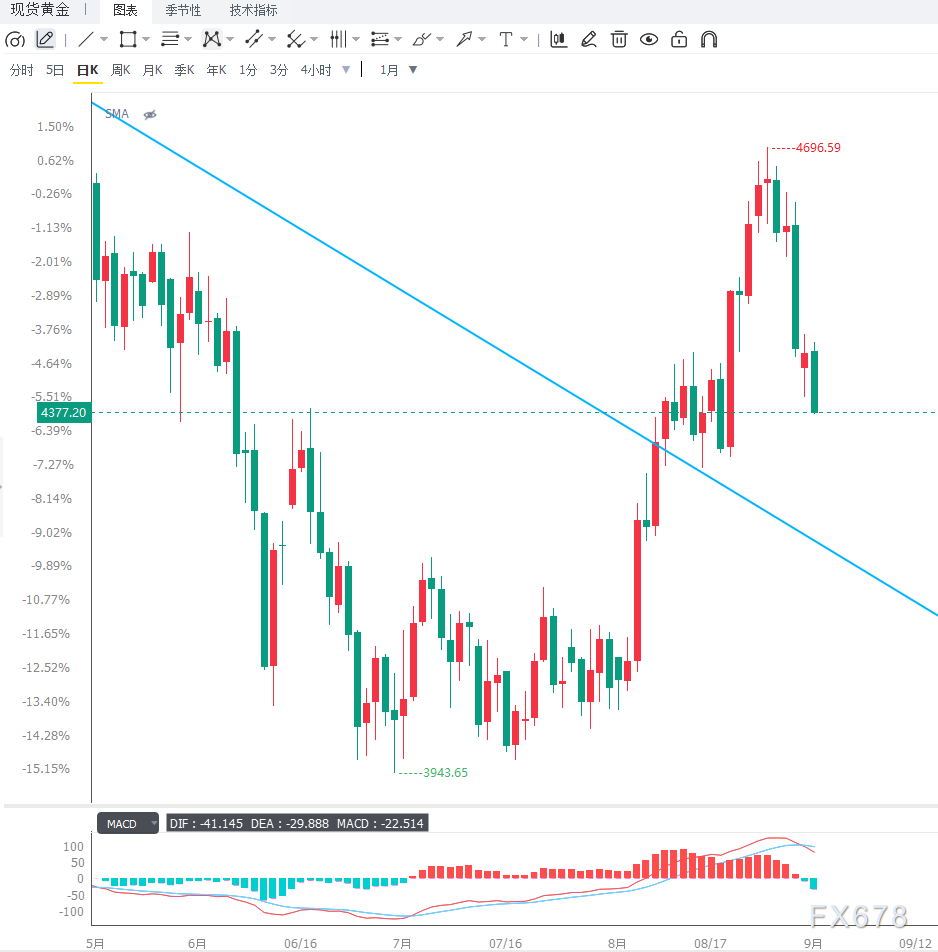
The core contradiction currently facing gold is the tug-of-war between geopolitical safe-haven demand and the pressure from rising interest rates. In theory, escalating tensions in the Middle East should benefit gold, but the inflationary pressure from higher oil prices in turn reinforces expectations of more Fed rate hikes, which push up the dollar and Treasury yields—directly suppressing gold. $4,500 has become an important short-term battleground for bulls and bears. If US jobs data remains strong, gold is likely to stay in a corrective pattern; if the labor market cools and yields pull back, gold may see a technical rebound. Focus on US employment data, the dollar index, US real Treasury yields, and changes in crude oil prices. As long as rate hike expectations have not cooled substantially, gold faces continued short-term downside risk, though its medium- and long-term fundamental support remains intact.
Disclaimer: The content of this article solely reflects the author's opinion and does not represent the platform in any capacity. This article is not intended to serve as a reference for making investment decisions.
You may also like
Another Blow to the Oil Market: Supply Panic Meets Fed Hawkishness, What About Gold?
South Korea arrests 4 Uzbek nationals over $121,000 crypto-financed vehicle shipments to Syria
Gold price hits two-week low as Warsh repricing, oil shock lift yields - Kitco AM Report
Crypto prices
More


