
Trump Says Iran Will Face Stronger Retaliation if It Responds, Iran Threatens Massive Counterattack, Iranian Energy Hub Port Attacked, US Oil Prices Surge Over 5% Intraday

The US-Iran conflict has escalated once again. On September 1 local time, US President Trump threatened that if Iran retaliated against the latest US military actions, it would face an even more fierce and intense strike; while Iran released a tough statement, saying it would launch a larger-scale, even “devastating” counterattack against the US.
According to China Central Television (CCTV), on September 1, President Trump posted on Truth Social, stating that the US military was striking Iranian targets near the Strait of Hormuz in retaliation for Iran’s attempt to mine the area and attack a US base in Jordan. He warned that if Iran retaliated against this attack, it would face an even more forceful and intense blow, and the US is preparing an “ultimate strike” that would leave Iran with “almost nothing.” US media reported that Trump said the new round of US airstrikes was targeting Iran’s radar systems.
Iranian media subsequently reported that Iran would launch a “larger-scale” retaliation against the US attacks, with the Iranian military issuing tough statements. According to the Iranian Fars News Agency, Iran has launched missiles and drones at enemy positions. CCTV, citing Iranian media, reported that Iran’s key energy hub, Asaluyeh Port, was hit by US forces.
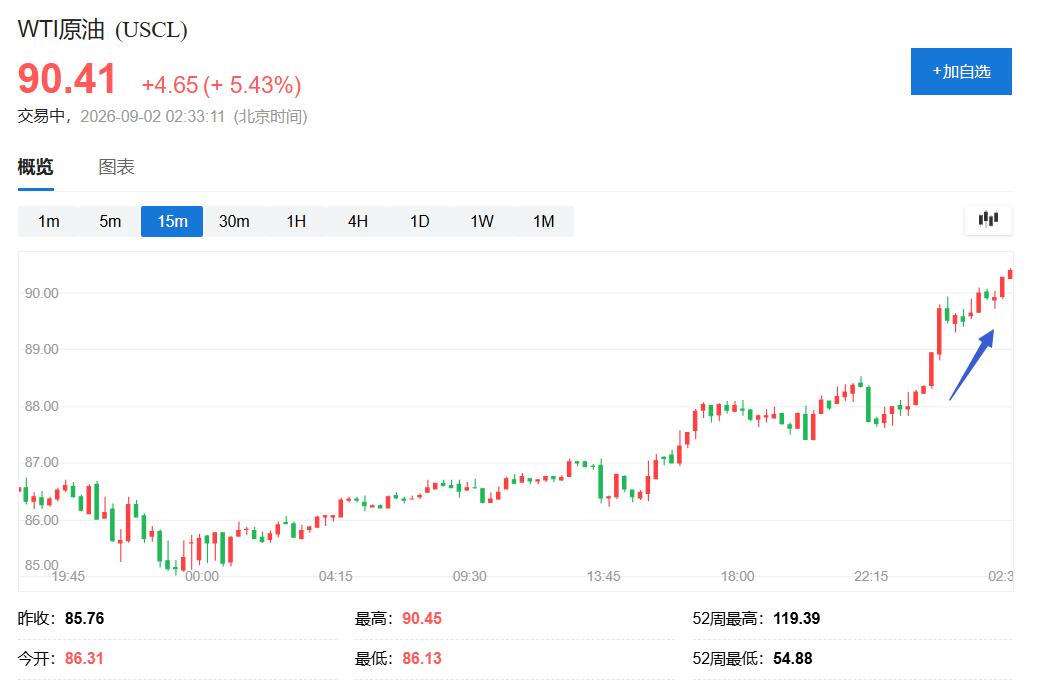
The market quickly priced in the risk of escalating US-Iran tensions. International crude oil futures surged during Tuesday afternoon US trading. US WTI crude oil broke above the $90 mark for the first time since late July, reaching as high as $90.13 per barrel, up more than 5% on the day; Brent crude rose above $94.60, also hitting an intraday high since late July, up nearly 5% on the day.
Trump warns: Iranian retaliation will face “more fierce and intense” strikes; US preparing “ultimate strike”
This warning from Trump directly targets possible retaliatory actions by Iran.
According to CCTV, Trump posted on Truth Social stating, “Right now, the US military is striking Iranian targets near the Strait of Hormuz. This operation is large-scale and powerful, in retaliation for the Iranians’ attempt to lay mines in the Strait of Hormuz — at this moment, there are no mines in the Strait, all have been cleared or detonated — as well as for launching eight missiles at our military base in Jordan (all of which were successfully intercepted).”
CCTV noted Trump said, “If this failed Iranian regime retaliates against this ‘very justified’ attack, they will face even more fierce and intense strikes. But this is not our most powerful attack yet, the ultimate strike is in preparation. Once it hits, Iran will have almost nothing left.”
The US Central Command also stated on September 1 local time that the US military began striking targets of Iran’s Islamic Revolutionary Guard Corps, saying the operation was in response to Iran’s recent attacks on commercial shipping in the Strait of Hormuz and strikes against US forces stationed in the Middle East.
Iranian media: Key energy hub port in Iran targeted by US attack
Facing a new round of US military strikes, Iran quickly issued signals of retaliation.
According to Iranian media Tasnim, Iran will launch a “larger-scale” counterattack against the US strikes. The spokesperson for the Islamic Revolutionary Guard Corps stated that the aggressors will be severely punished and that the US will regret its new round of attacks.
Reports said Iran’s armed forces declared they would deliver a “devastating” blow to the US.
According to CCTV citing Iran’s Fars News Agency, a key energy hub port in Iran was hit by US forces; on the night of September 1 local time, explosions were heard at Iran’s important energy hub, Asaluyeh Port, on the Persian Gulf coast.
Iran has previously taken military action against US targets in the Middle East. CCTV reported that on August 31, Iran’s armed forces General Staff issued a statement saying Iran “will not tolerate any acts of aggression” and will respond “even more forcefully” to such actions.
As both sides continued to release tough statements, the market grew concerned about further escalation of the conflict, especially as shipping in the Strait of Hormuz and Middle Eastern oil supplies faced increasing uncertainty.
US oil tops $90 for the first time since late July; Brent crude nears $95 intraday
The escalation of US-Iran military conflict first impacted the crude oil market.
During Tuesday’s US stock market midday session, WTI crude oil futures broke above the $90 mark for the first time since late July, with daily gains expanding to over 5%. Meanwhile, Brent crude approached $95 per barrel, also hitting the highest level since late July.
Last weekend, the first direct clash in a month between the US and Iran already pushed international oil prices higher on Monday.
Market data show that on Monday, August 31, Brent crude regained the $90 mark and US oil rose by more than 4% intraday. By Monday’s close, WTI October crude oil futures rose by 2.83% to $85.76 per barrel, the highest close since August 21; Brent November crude oil futures rose by 2.71% to $90.49 per barrel, the highest close since August 24 last Monday.
This further rise in oil prices reflects the market re-pricing risk of supply disruptions in the Strait of Hormuz. According to Reuters, renewed US-Iran hostilities and shipping risks near the Strait of Hormuz have revived concerns that Middle East energy supplies may be impacted.
For the crude oil market, the most critical variable now is whether Iran follows through on its “large-scale” counterattack and whether the US escalates military strikes as Trump suggested. If both sides continue down a tit-for-tat escalation path, shipping risks in the Strait of Hormuz may continue to raise the geopolitical risk premium for crude oil prices.
Disclaimer: The content of this article solely reflects the author's opinion and does not represent the platform in any capacity. This article is not intended to serve as a reference for making investment decisions.
You may also like
Micron’s Taiwan workers threaten to escalate chip shortage over bonuses
Samsung Unveils Next-Generation Storage Roadmap: HBM5 Performance Doubles HBM4E, zHBM Delivers 8x Acceleration
The HBM5 base chip process will be upgraded to 2 nanometers, aiming to achieve twice the performance of HBM4E, with a 20% improvement in performance per watt and a 20% reduction in thermal resistance. Mass production is expected in 2028. The newly architected zHBM targets 8 times the performance of HBM4E, a 3-fold increase in performance per watt, and a reduction in thermal resistance by 75% to 90%. It is expected to launch after 2029.
Felix Pago raises $200 million in Series B to expand stablecoin remittance services
Belgium Police Target Crypto Wallets In Cross-Border Piracy Crackdown
Crypto prices
More


