
AI "Capital Game": When Big Companies' Operating Cash Flow Is Not Enough to Burn

Hard·AI
Author | Dong Jing
Editor | Hard AI
The AI infrastructure arms race is pushing tech giants into an unprecedented financing dilemma — operating cash flows can no longer cover capital expenditures, and the majors are raising funds through every means available: leasing, issuing debt, cutting buybacks, and even issuing new shares. Off-balance-sheet commitments now exceed $3.1 trillion, and the real financial risk behind the industry's AI compute expansion is far deeper than what corporate reports reveal.
According to a recent Morgan Stanley report, hyperscalers are expected to surpass $1.2 trillion in cash capital expenditures by 2027, while operating cash flows are estimated to total only around $1 trillion in the same period—a shortfall is already emerging. Amazon and Google saw free cash flow (FCF) turn negative in Q2 2026, and Meta is expected to do the same next quarter. This inflection point signals a new stage for AI investment: Endogenous cash generation has reached its limit, and external financing is accelerating across the board.
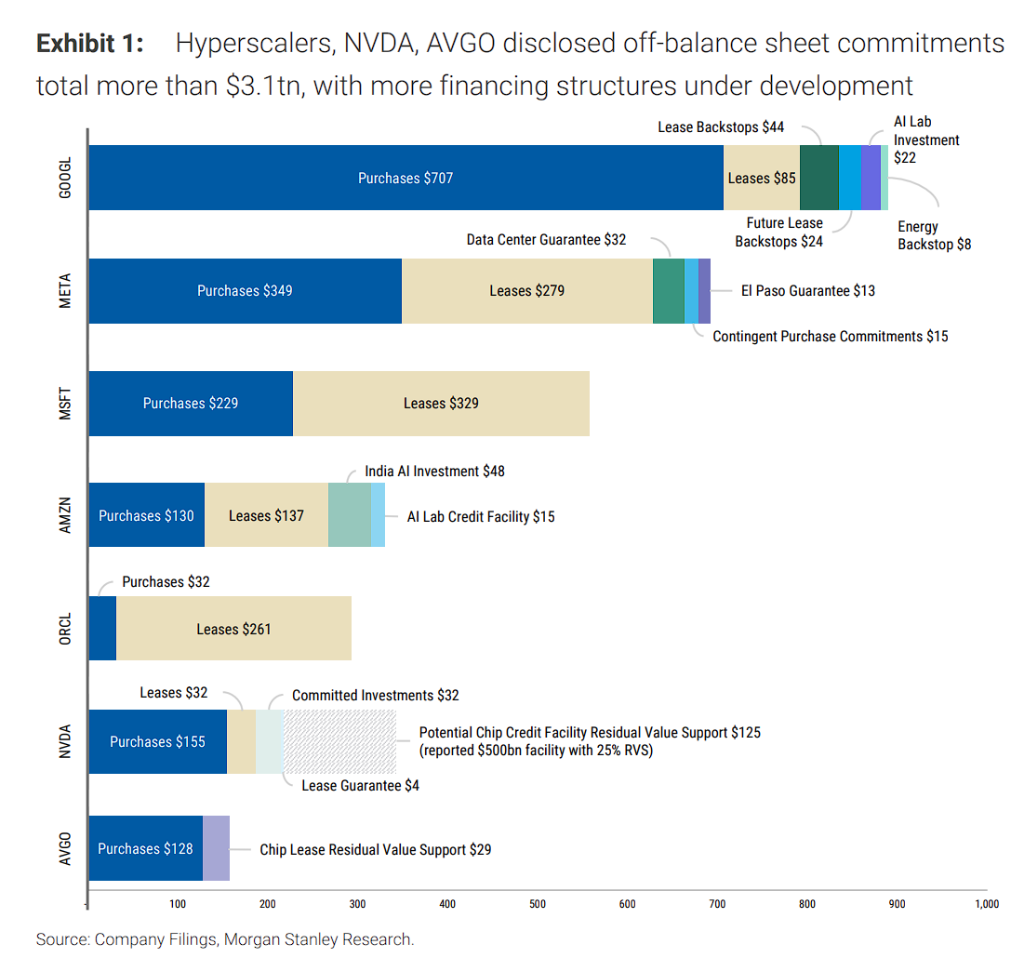
The scale and complexity of this financing expansion has raised red flags in the market. Morgan Stanley notes that, adding in NVIDIA and Broadcom, disclosed off-balance-sheet commitments and guarantees from hyperscalers now total over $3.1 trillion, spanning leases, purchase commitments, guarantees, and a variety of credit support mechanisms.
Meanwhile, concerns about accounting practices that understate capital expenditures and overstate free cash flow are drawing increasing investor scrutiny—if financing costs keep rising along with mounting commitments, whether returns on new AI infrastructure can cover the cost of capital will become the core question overshadowing the entire industry.
01
Cash Flow Squeeze: AI investment intensity exceeds organic self-financing capacity
Morgan Stanley reports that hyperscalers are now reinvesting over 40% of their revenue back into AI capital expenditure, an intensity far exceeding the upper limit their operating cash flows can support. Although these companies' traditional lines of business still boast strong margins, endogenous cash is no longer sufficient to sustain current investment pacing.
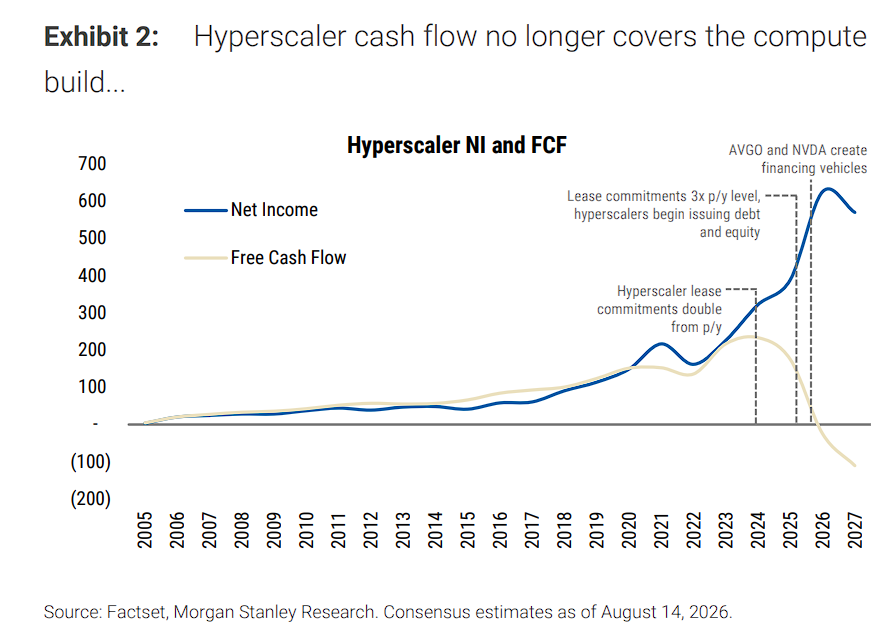
This transformation is rapidly accelerating over the timeline. By the end of 2025, hyperscalers began issuing bonds; by 2026, both debt and equity financings ramped up.
Google has slashed annual share buybacks from over $60 billion to zero and issued $50 billion in new stock in Q2 2026, freeing up a total of more than $110 billion for AI infrastructure build-out. The cost, however, is shareholder dilution — after shrinking outstanding share count by 13% over the last decade, that trend is reversing.
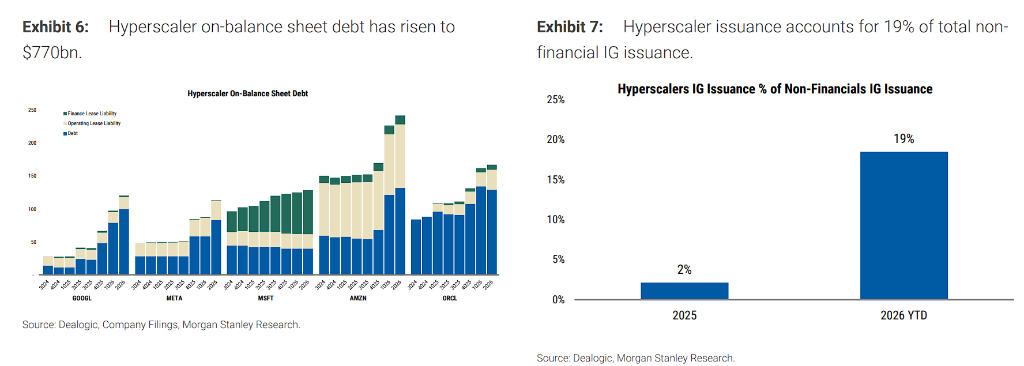
According to Morgan Stanley, total on-balance-sheet debt and lease liabilities for hyperscalers have now reached $770 billion. Of note, hyperscaler issuance in the investment-grade non-financial corporate bond market has surged from 2% in 2025 to 19% so far in 2026, highlighting the growing importance of debt in funding AI capital expenditures.
02
AI investments pay back in three years, sustained by cash flow
Off-balance-sheet 'hidden debt': Real risks behind $3.1 trillion in commitments
Beyond on-balance-sheet liabilities, even larger risks are lurking off the books.
Morgan Stanley reveals that hyperscalers provide lease guarantees, purchase commitments, and various credit supports to suppliers and data center developers, allowing the latter to secure financing and begin construction even before the hyperscalers pay or formally recognize the liabilities.
Specifically, unexecuted lease payment commitments from hyperscalers (and NVIDIA) come to $1.1 trillion (undiscounted), including $329 billion for Microsoft, $261 billion for Oracle, $279 billion for Meta, $137 billion for Amazon, and $85 billion for Google. Meanwhile, purchase commitments disclosed by NVIDIA, Broadcom, and the hyperscalers total $1.7 trillion, with Google alone accounting for $707 billion.
Morgan Stanley sees the core logic of these structures as: the investment-grade credit of hyperscalers enables special purpose vehicles (SPVs) to raise private market credit at lower cost, with the hyperscalers then leasing facilities upon completion.
However, the bank also warns that while such contracts have strategic value before supply and demand normalize, if equilibrium is reached earlier than expected, companies may be forced to pay for overcapacity or renegotiate terms.
03
Accounting fog: understated capex, overstated free cash flow
Morgan Stanley specifically points out that current accounting practices make the true financial burden of AI infrastructure construction difficult for investors to accurately discern.
The classic case is Microsoft. Last quarter, Microsoft announced an extension of data center asset life from 15 years to 25 years, leading to a reclassification of a significant portion of data center leases from finance leases to operating leases.
Because Microsoft includes finance lease capex but excludes operating lease payments in its free cash flow calculation, this change lowers reported capex and inflates free cash flow—even though, economically, the obligation is unchanged and leasing still functions as debt-financed data center construction.
SPV structures also create accounting blind spots. Both Meta and Google disclose that their data center SPVs are not consolidated during construction, reasoning that neither company is the 'primary beneficiary,' i.e., neither controls the SPV's most significant economic activities.
Morgan Stanley notes that this assessment can change—if the likelihood of providing residual value support increases, consolidation decisions could shift at any time, impacting reported leverage ratios and balance sheet presentation.
04
Emerging financing tools: customer prepayments and chipmaker 'balance sheet borrowing'
As traditional financing channels reach saturation, more creative funding structures are emerging.
Oracle was first to introduce customer prepayments as a financing source for capex. In its latest quarter, Oracle reported receiving $4.6 billion in customer prepayments for capital expenditures. These prepayments appear as deferred revenue on the balance sheet, but function more like debt—customers pay more than a year before revenue is actually recognized, and Oracle must recognize interest expense at its incremental borrowing rate. Currently, Oracle’s 10-year and 30-year bonds yield 6.9% and 7.9% to maturity, respectively; customer prepayment interest costs should be roughly similar.
Chipmakers are offering direct financing to customers via SPV structures. Broadcom and NVIDIA have announced chip financing SPVs that issue bonds to purchase chips and subsequently lease them to unrated AI labs, with the companies providing residual value guarantees to cover cases where leases default and chip resale values fall short of repaying bondholders. Broadcom’s announced chip leasing structure can back up to 20 GW worth of capital expenditure, and NVIDIA reportedly has a similar arrangement. As a result, unrated AI labs can access chips at near investment-grade financing rates.
Morgan Stanley notes that chipmakers, when selling chips to SPVs, may need to split revenue recognition between chip sales and the residual value guarantee, with the guarantee liability measured at fair value upon sale; if the guarantee is not exercised, associated income typically does not count towards operating income.
Ultimately, Morgan Stanley boils down the issue to a core logic: As each round of new commitments lifts financing costs, returns on new AI infrastructure investments must exceed the rising cost of capital—or the entire investment thesis will need to be re-examined. The bank believes current focus should include:
First, free cash flow numbers are much less comparable due to accounting differences; it is necessary to pierce through lease classifications and SPV structures to recalculate real capex. Second, the ongoing reduction and potential issuance of hyperscaler stock buybacks will have a substantial dilution effect on EPS. Third, hyperscaler share of the investment-grade bond market has soared from 2% to 19%, and there is growing pressure on credit spreads to widen. Finally, if $3.1 trillion in off-balance-sheet commitments are triggered for consolidation or supply/demand reverses, corporate leverage ratios could be meaningfully impacted.
This expansion of AI infrastructure financing has gone far beyond what technology company balance sheets can carry, rapidly reshaping the capital structure of the entire tech sector.

Disclaimer: The content of this article solely reflects the author's opinion and does not represent the platform in any capacity. This article is not intended to serve as a reference for making investment decisions.
You may also like
Japanese Yen jumps as BoJ opens door to faster rate hikes
Uniswap’s Token UNI Rallies over 100% as Robinhood Chain Trading Drives 66% of Uniswap Revenue
Altcoin FET Shows Bullish Possibility to Claim $3 to $4.5 by 2027 – 2028, New ATHs Ahead?

Commentator projects $100–$150 XRP as Japan eyes rate hike on US prompt
Crypto prices
More


