
The negative correlation between real interest rates and gold prices is weakening, and institutions say gold is receiving structural support.

ForexChannel September 22— Suki Cooper, Head of Global Commodities Research at Standard Chartered Bank, pointed out that the traditional negative correlation between gold and real interest rates is weakening. Despite the Federal Reserve raising rates and rising US Treasury yields, gold ETF inflows have continued and speculative positions are not overly crowded. In the short term, a stronger US dollar is the main bearish risk, but structural supports such as central bank gold purchases and de-dollarization remain solid. The bank forecasts gold’s average price in Q4 could reach $4,650 per ounce, with room for recovery by year-end.
For a long time, real interest rates have been considered the most critical variable influencing gold prices, with the two traditionally exhibiting a significant negative correlation. But
Traditional Correlation Weakens, Gold’s Sensitivity to Real Yields Declines
Suki Cooper stated that after the Federal Reserve raised rates by 25 basis points last week, gold prices have already absorbed the negative news and recovered previous losses, with current prices seeking technical support at the 50-day moving average. Market attention is shifting from short-term monetary policy to broader long-term issues, including de-dollarization, currency depreciation risks, and the potential for market intervention. Gold’s volatile pattern will persist, but persistent official sector demand driven by central bank gold buying continues to provide support at the lower end. Various structural drivers still exist, though the pace of gold’s ascent may slow.
Data intuitively confirms this shift in correlation. Cooper said: “Gold’s correlation with 10-year and 30-year US Treasury yields has already approached neutral levels, at -20% and -10% respectively. Gold’s negative correlation with 2-year and 5-year real yields has also weakened, with both sets of correlation coefficients dropping from -30% and -38% a month ago to -16% and -22%. However, these correlations are still meaningful.”
The market’s expectations for monetary policy in 2026 have reversed dramatically, making this change even more significant. At the start of the year, the market bet the Federal Reserve would cut rates twice, with gold prices around $4,500 per ounce. Yet
Investment Flows Continue to Return; Speculative Positions Not Excessively Crowded
Even with US Treasury yields remaining high, investment demand for gold is picking up again.
From the perspective of speculative positioning, the market is not currently overheated or crowded. Ahead of the Federal Reserve’s decision in September, short-term investors mainly reduced their gold holdings through profit-taking; in the two weeks prior to the decision, net long positions held by funds decreased by 11,800 contracts, the largest drop since March this year, including a reduction of 14,000 long positions.
Cooper said: “Short-term funds tend to price in rate hikes in advance and react faster than rate cut expectations, so after a rate hike is implemented, the downside for gold prices is compressed.” Currently, net long positions held by funds account for 34% of total positions—still high overall. However, Standard Chartered judges that positions are not excessively crowded and there is no significant risk of a mass exit.
The Dollar Remains the Main Short-term Risk; Gold Price Outlook Emerges for Q4
Standard Chartered’s economists predict that the Federal Reserve will raise rates once more in December and then hold rates steady through all of 2027. After raising its terminal rate estimate for the Fed by 50 basis points, the bank also raised its yield-curve forecasts for US Treasuries. While the long-term outlook supports a recovery in year-end gold prices, gold still faces bearish factors.
Suki Cooper believes,
The rate hike in September eased market concerns over dollar depreciation and bolstered the dollar’s relative yield advantage; therefore, if the dollar strengthens further it will put temporary pressure on gold prices. However, investors had already largely priced-in the rate hike ahead of the Fed meeting, so the wave of profit taking after the hike is expected to be short-lived. Standard Chartered forecasts gold’s average price in Q4 this year will be around $4,650 per ounce, while the average spot gold price in Q3 is about $4,350 per ounce; the institution is optimistic about a price recovery by year-end.
Conclusion
The gold pricing framework is undergoing a shift: the influence of real rates—which once dominated—is waning, while long-term structural factors like de-dollarization and central bank gold buying are gaining ground. In the short run, a strong US dollar and expectations of more Fed rate hikes will cause volatility and limit upside, but speculative positions aren’t crowded and ETF fund inflows continue to buffer gold prices.
Standard Chartered’s judgment suggests that
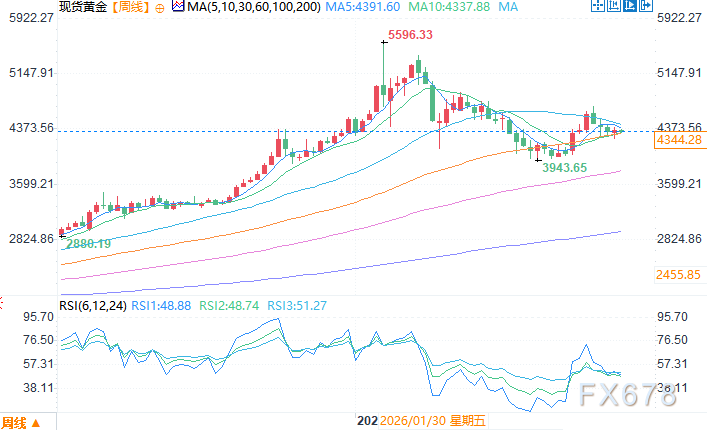
Spot gold weekly chart Source: EForexChannel
At 11:15 Beijing time on September 22, spot gold was at $4,346.28 per ounce
Disclaimer: The content of this article solely reflects the author's opinion and does not represent the platform in any capacity. This article is not intended to serve as a reference for making investment decisions.
You may also like
After Meta, Google (GOOGL.US) is tied to nuclear power: funding the expansion of two nuclear power plants by approximately 96 MW
Google will fund the upgrade of power generation capacity at two nuclear power plants in Georgia.
U.S. IPO Preview | WODO.US Races to Nasdaq: Integrated Logistics Accounts for Nearly 96%, Yet Revenue Drops 17.9%
Waldtong primarily provides cross-border logistics solutions for clients by integrating resources such as aviation, maritime transport, customs clearance, warehousing, and overseas last-mile delivery.
US Stock New Listing Analysis | Jingrui Wangpu: Raised About $37.5 Million; Can the Dual Model of "Retail Store + Wholesale" Support the Valuation?
Small and medium-sized retailers find alternative ways to break through.
Blackstone: We Are at the "Dawn of 1870," Seize the "Meat" of the AI Era
Blackstone President Jon Gray refuted the notion of an “AI trillion-dollar investment bubble” in his latest closed-door speech. He noted that large models and AI company revenues are exhibiting explosive growth by hundreds of times, and macro productivity has already surged. He likened the current AI wave to "the dawn of the Industrial Revolution in 1870," emphasizing that demand far exceeds supply. He stated that the true investment focus lies in addressing real-world “hard shortages,” specifically by heavily investing in chips, data centers, and power infrastructure, all of which face extremely high capital and capacity barriers.
Crypto prices
More


