
Researchers propose Zcash-style private Bitcoin transfers without a soft fork

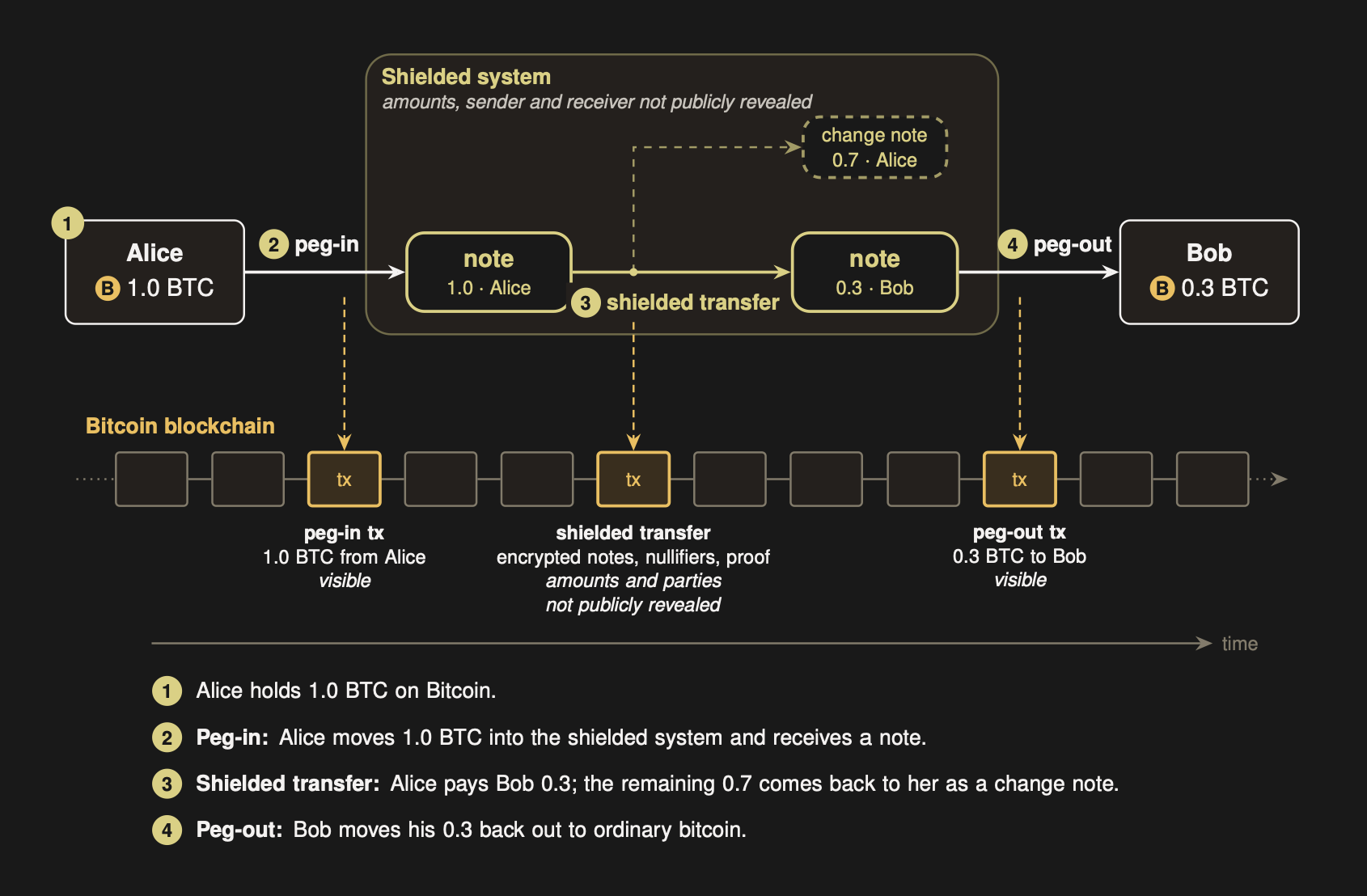
Researchers at the cryptography research firm Alloc Init have proposed a system for bringing Zcash-style private transfers to Bitcoin without requiring a soft fork.
The proposal, called Shielded Bitcoin, would conceal transaction amounts, senders, receivers and links to previously spent funds using encrypted notes and zero-knowledge proofs. The paper was published on Thursday by Clara Shikhelman, Mikhail Komarov and Aleksei Moskvin.
The proposal offers a potential path to stronger privacy for Bitcoin users without requiring consensus changes to the base protocol.
Instead of having miners enforce the privacy protocol, Shielded Bitcoin would use Bitcoin as “a neutral publication and ordering layer,” the researchers wrote. Separate software called indexers would then verify zero-knowledge proofs, check that funds haven’t been double-spent, and reconstruct the state of the shielded system.
Shielded Bitcoin’s design explicitly draws from Zcash’s architecture. The researchers said it similarly uses encrypted notes, public nullifiers that mark notes as spent, and zero-knowledge proofs that show transactions are valid. Unlike Zcash, Shielded Bitcoin would not operate its own blockchain or consensus mechanism.
Shielded Bitcoin draws mixed reactions
“Privacy is a function of the crowd. Zcash has a real shielded pool built over years,” he wrote. “A brand new metaprotocol starts at zero, so your first private transfer hides in a crowd of one.”
In a companion post explaining the proposal, the Shielded Bitcoin researchers acknowledged a similar limitation, saying that large deposits do not automatically create a large anonymity set. They said observers may still be able to narrow down relationships between transfers if a small number of actors create most notes or wallets exhibit distinctive behavior.
Ben-Sasson said he had not yet read the Shielded Bitcoin paper but would like to see the vision of privacy and scalability through zero-knowledge proofs materialize on Bitcoin’s base layer.
Disclaimer: The content of this article solely reflects the author's opinion and does not represent the platform in any capacity. This article is not intended to serve as a reference for making investment decisions.
You may also like
Under continuous pressure from inflation and interest rate hike concerns, US Treasury sell-off intensifies; 30-year yield once surpassed 5.6%, hitting a more than 24-year high
U.S. long-term Treasury yields continued to rise on Tuesday, extending the recent sharp upward trend.
The US releases the final batch of strategic oil reserves, up to 40 million barrels, urging Europe to follow suit.
This is the final batch of the 172 million barrels of reserves released by the United States in this round; after this release, the U.S. Strategic Petroleum Reserve will drop to its lowest level since 1982, approaching legal and operational red lines. Meanwhile, the U.S. Secretary of Energy criticized some European countries for releasing far less than expected, urging them to fulfill their commitments. Currently, gasoline and diesel prices in the U.S. remain high, and less than two months remain until the midterm elections. On Tuesday, WTI crude oil futures fell by 3.95%.
Raphael Zagury: Bitcoin will eventually surpass gold
Federal Reserve Bowman: AI Brings Both Opportunities and Risks to the Banking Industry, Fed Urges Strengthening of System Security Protections
Federal Reserve Vice Chair for Supervision, Bowman, warned that AI has a dual impact on the banking industry, serving both as a defensive tool and introducing new emerging risks. She urged banks to strengthen basic cybersecurity measures, including updating asset inventories, deploying multi-factor authentication, and improving vulnerability management. Bowman also stated that regulators will continue to adjust their examination approaches, implementing differentiated supervision for community banks instead of imposing blanket mandatory requirements.
Crypto prices
More


