
AI capital expenditure “peaks”; is the US economy also “peaking”?

AI capital expenditures are approaching a historic inflection point, and the fate of U.S. economic growth may be deeply intertwined with this development.
According to Wind Chaser Trading Desk, Jefferies strategist Christopher Wood warned in his latest report that financial markets have sent clear signals that the AI capital expenditure cycle may be peaking—evidenced by widening credit spreads and a continued decline in semiconductor stocks. The macro implications of this judgment extend far beyond the technology sector itself.
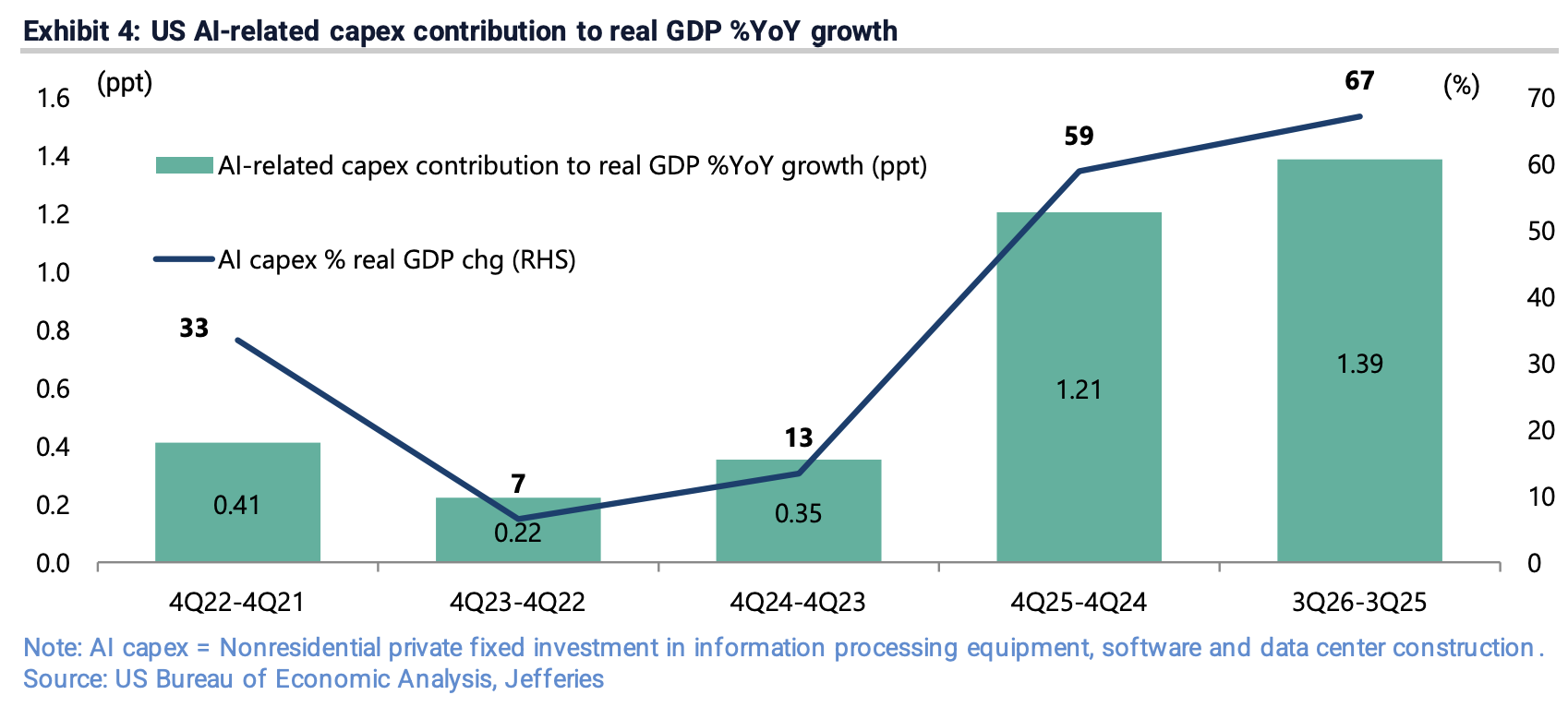
According to the Jefferies report, over the four quarters ending in Q3 2026, real AI-related capital expenditures in the U.S. will contribute as much as 1.39 percentage points to year-over-year real GDP growth—accounting for 67% of the total 2.1% growth rate. Meanwhile, investment in information processing equipment and software as a share of nominal GDP has risen to 5.35%, surpassing the 4.46% seen at the peak of the internet bubble in 2000 and setting a new historical high. This means that any substantial contraction in AI capital expenditures would deliver a direct and significant downside shock to U.S. economic growth.
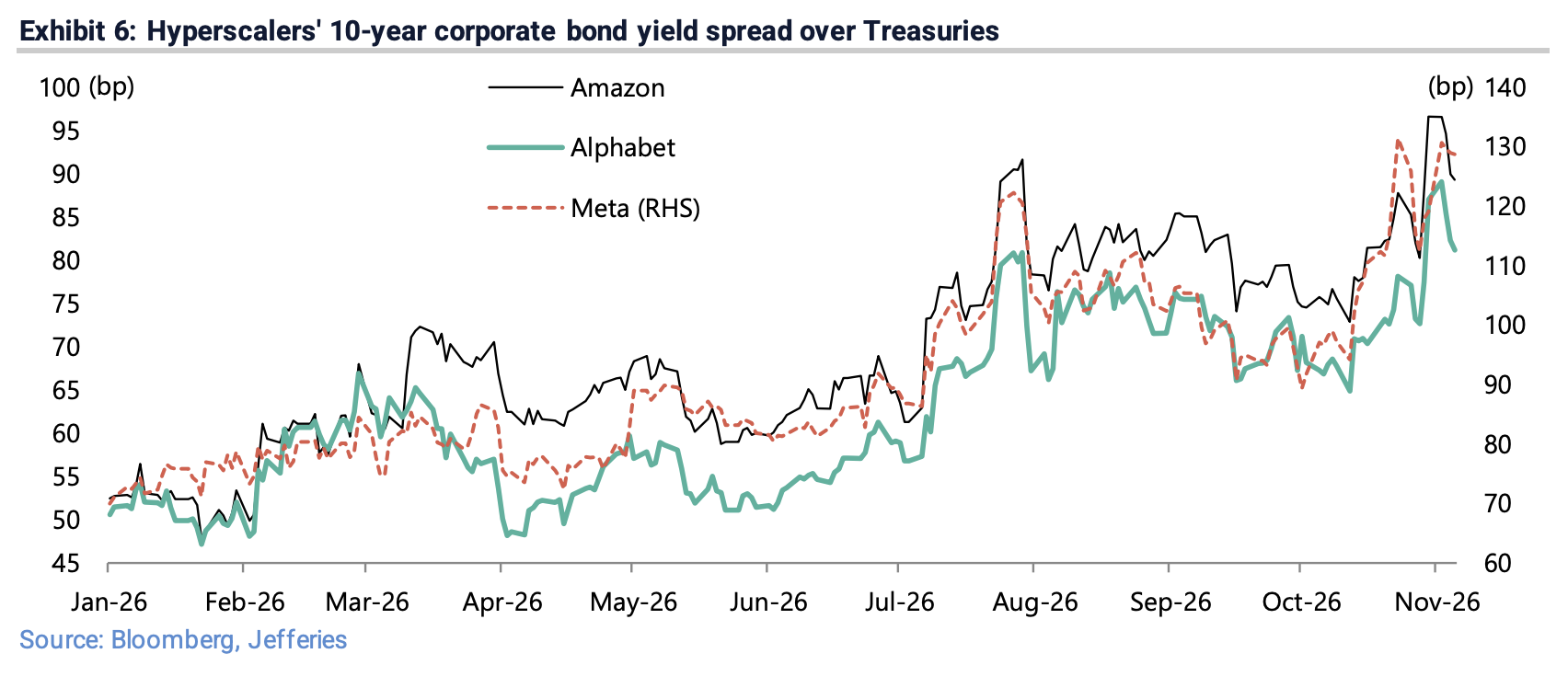
The market has already begun to react. Semiconductor stocks continue to be under pressure, and clear cracks have appeared in the credit market: the 10-year corporate bond spreads for Amazon, Alphabet, and Meta have widened 16, 16, and 35 basis points, respectively, from recent lows; Oracle and CoreWeave’s 5-year CDS spreads have soared from early June lows to 329 and 1163 basis points, respectively. Meanwhile, after the U.S. midterm elections, the Democratic Party’s regain of Congressional control has fueled market concerns that their stance on regulating data centers and AI models will further suppress expectations for AI spending.
Credit Markets Sound Alarm, Consensus AI Spending Forecasts Face Downward Revision Pressure
The turbulence in the credit market is the most direct market evidence supporting the view that the current AI capital expenditure cycle is peaking. The Jefferies report points out that the best way to assess the risks surrounding AI capital expenditures is to continuously track AI-related credit spreads—and the current spread movements have sent a clear tightening signal.
Specific data show that the 10-year corporate bond yield spreads for Amazon, Alphabet, and Meta have risen from recent October 12 lows of 73, 65, and 94 basis points to 89, 81, and 129 basis points, respectively. Oracle and CoreWeave’s 5Y CDS spreads have surged from early June lows of 153 and 452 basis points to 329 and 1163 basis points in late October. SoftBank’s 5Y CDS spread has also risen from a late June low of 278 basis points to 442 basis points.
The core implication of this signal is that the market is showing increasingly obvious declining willingness to finance AI-related investments. The Jefferies report believes that this means there is a substantial risk of downward revisions to the market's consensus forecast for the combined capital expenditures of the four hyperscale cloud service providers (Microsoft, Amazon, Alphabet, and Meta) in 2026—currently about $1.04 trillion.
Hyperscalers’ Free Cash Flow Under Pressure, AI Cannibalizing Traditional Business
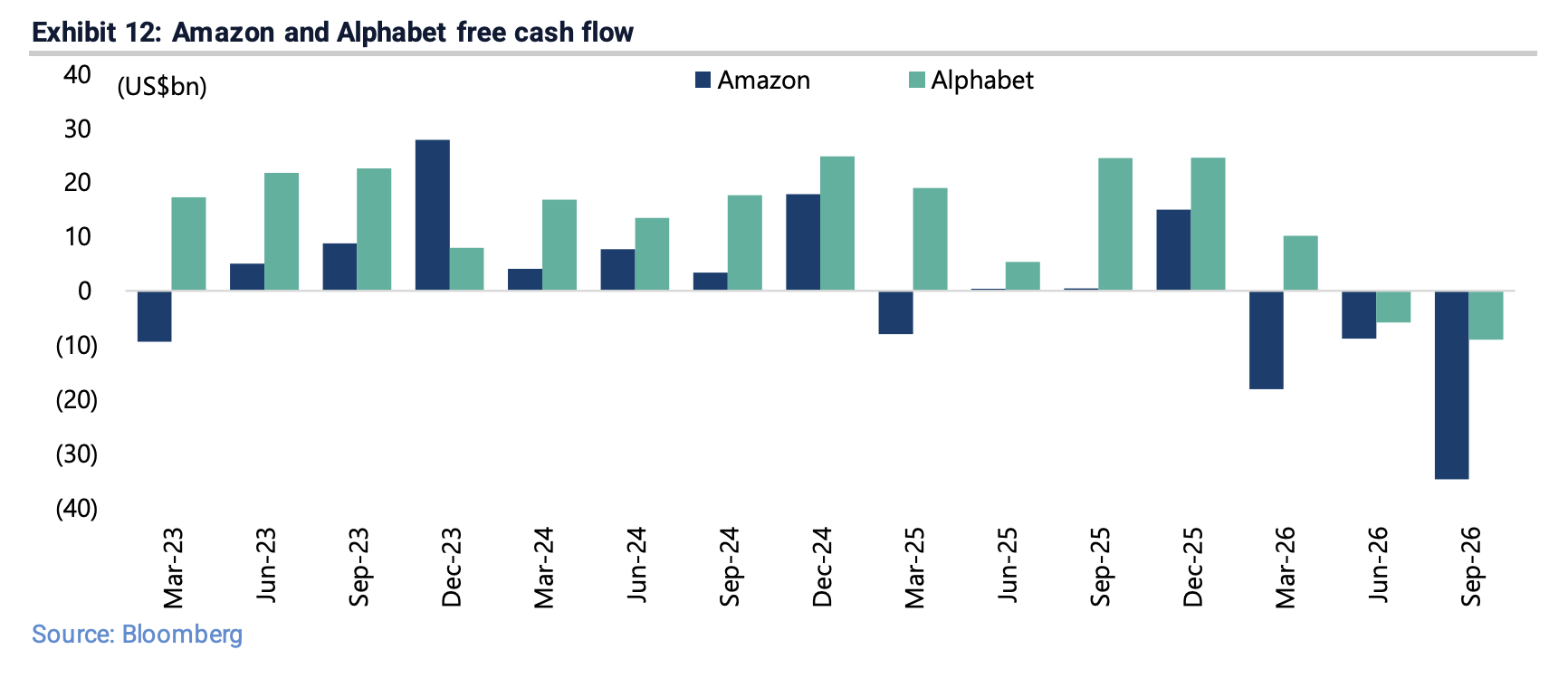
Recent quarterly earnings reports have further heightened market doubts over the sustainability of AI capital outlays. The four major hyperscale cloud providers’ combined capital expenditures doubled by 108% year-on-year in Q3, reaching $202 billion. However, Amazon and Alphabet's free cash flows have turned negative to -$35 billion and -$9 billion, respectively.
What’s more alarming to the market is that AI is beginning to cannibalize the traditional core businesses of hyperscalers. Alphabet’s Google search revenue growth slowed markedly from 19% year-on-year in Q1 2026 to 12% in Q3. For the first time, search revenue fell below 50% of Alphabet’s total revenue, dropping to 49.7%. At the same time, Google Cloud revenue skyrocketed 103% year-on-year to $30.7 billion, taking its share from 20.7% to 24.1%. Amazon’s online store revenue growth fell sharply from 15% year-on-year in Q2 to just 2% in Q3, while AWS revenue rose 39% year-on-year to $46 billion.
The Jefferies report posits that the hyperscalers’ heavy investment in AI is motivated by fear that AI will disrupt their traditional businesses—a defensive rather than an offensive spending logic, leading to a classic ‘prisoner’s dilemma’ where “doing nothing means certain decline, but spending heavily does not guarantee survival.”
Circular Financing System Expands, “Too Big To Fail” Risks Emerging
The Jefferies report specifically highlights a rapidly growing structural risk within the U.S. AI ecosystem: the circular financing system built around AI capital expenditures.
The four hyperscale cloud service providers (Microsoft, Amazon, Alphabet, and Oracle) have seen Remaining Performance Obligations (RPO)—i.e., backlogged contractual revenues—increase to $2.5 trillion as of the end of last quarter. Meanwhile, data center financing is increasingly being conducted off-balance-sheet, with hyperscalers partnering with private credit institutions to set up “special purpose” investment vehicles.
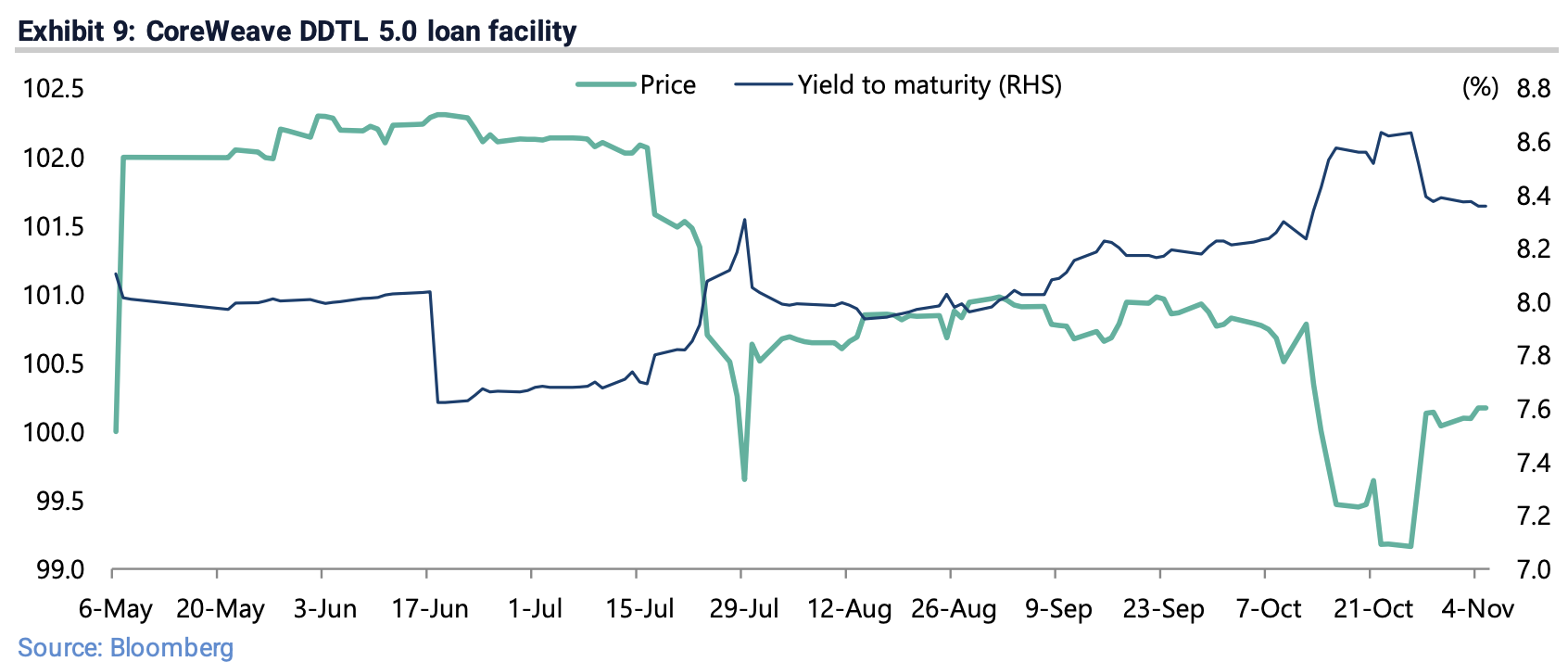
In May this year, CoreWeave completed $3.1 billion in Delayed Draw Term Loan (DDTL 5.0) financing, marking the first known GPU-collateralized financing syndicated publicly through a financing subsidiary. Its yield to maturity has risen from 7.62% to 8.36%. The estimated annual issuance of data center asset securitization reached $27 billion in 2025 and is expected to rise to $40 billion by 2026.
The Jefferies report bluntly states that this system is financially extremely risky, unless one assumes that certain parts of the U.S. AI ecosystem are now considered "too big to fail."
Microsoft Layoffs and Chinese AI Cost Reduction Signal Industry Paradigm Shift
The potential inflection point in the AI capital expenditure cycle has already left traces at the corporate behavior level. Microsoft announced a voluntary separation program for about 60,000 eligible employees—more than a quarter of its global workforce. The Jefferies report believes that this move is directly motivated by the need to cut costs under the pressure of ballooning capital spending bills—even though Microsoft’s Q3 free cash flow remains positive at $18.6 billion.
Meanwhile, Jefferies Global Head of Quantitative Strategy Desh Peramunetilleke noted in a mid-October report that the consensus market earnings growth forecast for global AI stocks is expected to slow sharply from around 100% in 2026 to 30% in 2027 and 22% in 2028, recommending that investors begin to diversify allocations beyond AI.
In China, the rationale of cost reduction has run through the AI boom from the very beginning. According to Jefferies Head of China Technology and Telecom Research, Edison Lee, Chinese AI labs have always focused on computing power efficiency, driven both by the scarcity of computing resources and a commercial application-oriented approach—rather than the Silicon Valley pursuit of AGI as the ultimate goal. This pragmatic path may become the direction the U.S. AI industry is forced to emulate under tighter financing conditions.
If AI Expenditures Suddenly Brake, U.S. Treasuries Face Difficulty as "Safe Haven"
The Jefferies report issues a clear warning about the macro consequences of a sharp contraction in AI capital expenditures: it would deliver a direct negative shock to U.S. economic growth and trigger a rapid shift in Federal Reserve policy expectations from tightening to easing.
However, the report also points out that in such a scenario, U.S. Treasuries will not be able to play their traditional role as “safe haven” assets. The reason is the “fiscal dominance” effect—U.S. fiscal deficits now stand at 6.2% of GDP, and history shows that recessions typically expand the deficit by about 6 percentage points. Once the economy downturns, the market’s attention will quickly turn towards the prospect of rapidly worsening fiscal revenue, at which point the performance of U.S. Treasuries will resemble that of a troubled emerging market asset rather than a traditional safe asset.
The report also cites Amara’s Law to remind investors: the short-term impact of new technology is often overestimated while the long-term impact is underestimated. Current market dynamics suggest that the global frenzy for AI may have already peaked in the short term. For investors, as uncertainty in the AI capital expenditure cycle intensifies, assets with low correlation to AI capex—such as gold and biotechnology—may be worth more attention.
Disclaimer: The content of this article solely reflects the author's opinion and does not represent the platform in any capacity. This article is not intended to serve as a reference for making investment decisions.
You may also like
Tesla Cybertruck: From Cracked Windows to Production Halt, a Three-and-a-Half Year Journey Ends
Since its launch in 2019, Cybertruck has been mired in controversy—ranging from a failed window demonstration on release day, a four-year delay in mass production, and its price rising from $39,900 to more than $100,000, along with a total of 11 recalls. The day before the halt of production was announced, Tesla raised the price once again, bringing a dramatic and intriguing end to the saga of this vehicle.

Democrats to destroy the data center boom? Goldman Sachs bucks the trend with an upgrade forecast!
Goldman Sachs has raised its forecast for US data center construction spending against the trend, increasing the 2026 projection from $67 billion to $80 billion and, for the first time, projecting $125 billion for 2028. Despite the market panic caused by Texas's moratorium, Goldman Sachs believes this is essentially a delay rather than a termination, and the overall construction cycle remains resilient. However, highly leveraged developers face substantial risks from rising financing costs and contract cancellations.
Chip Stocks Rebound Sharply: Time to Buy the Dip or Run for Safety?
Crypto prices
More


