
News
Stay up to date on the latest crypto trends with our expert, in-depth coverage.
1Bitget UEX Daily | Trump Raises Tariffs on South Korea; Precious Metals Pull Back After Hitting Record Highs; Nvidia Increases AI Investment (Jan 27, 2026)2Cardano whales bag 454M ADA while small wallets exit3Bitcoin Risk-Off Asset: CryptoQuant CEO Reveals Critical Market Misunderstanding in 2025 Analysis
How tariffs hit GM's 2025 margins
101 finance·2026/01/27 13:51
Boeing's fourth-quarter sales surge by almost 60%, driven by a significant increase in aircraft deliveries
101 finance·2026/01/27 13:42
PACCAR (NASDAQ:PCAR) Announces Q4 CY2025 Earnings With Revenue Falling Short of Analyst Expectations
101 finance·2026/01/27 13:39
XRP Price Forms Triple Bottom Structure as XRP Ledger Hits $1B Tokenization
Coinspeaker·2026/01/27 13:33
Brompton Bicycle delays £100m factory plans, citing sluggish economic conditions according to executives
101 finance·2026/01/27 13:27
Tether Secures Its Place with New Federal Compliance Stablecoin
Cointurk·2026/01/27 13:18
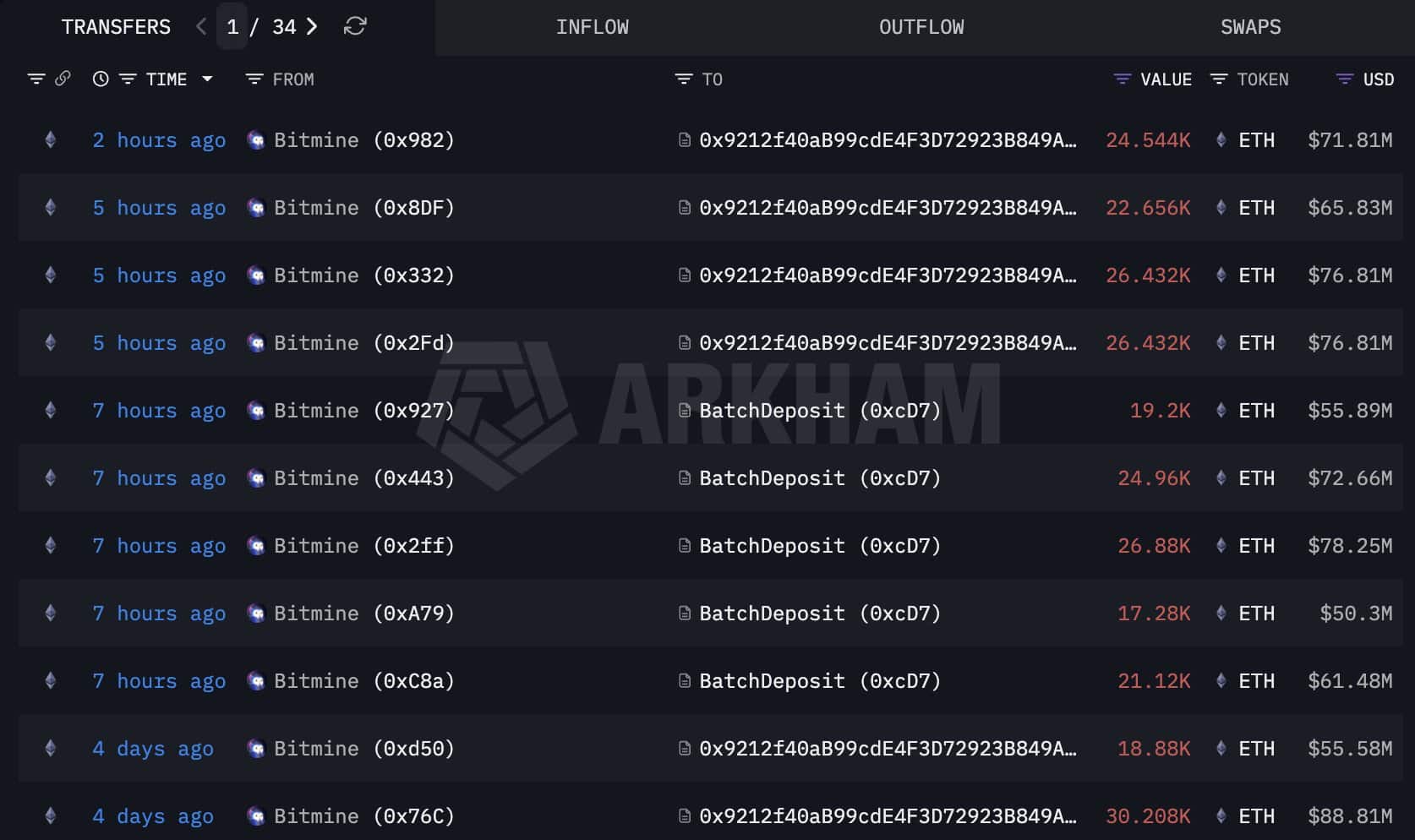
Bitmine’s Tom Lee: Crypto may surge once gold and silver cool off
AMBCrypto·2026/01/27 13:18
RIVER Fell By 4% After a Record High, Hinting Supply Concentration
CoinEdition·2026/01/27 13:15


Analysts Reveal the 4 Best Presale Coins Today With Massive Upside Potential: BlockDAG, NexChain, & More!
BlockchainReporter·2026/01/27 13:00
Flash
13:58
How Hedera Hashgraph Enables Fast, Low-Energy Authentication for IoT EducationThe Hedera-based IoT e-learning authentication stack hit 4,310 TPS, although performance lagged slightly to 3,425 TPS when combined with knowledge graphs.
Real-device tests showed 41–47 ms authentication on Raspberry Pi and 55–68 ms on ESP32; BAN+ProVerif runs found no authentication leaks.
Hedera Hashgraph is being cited in new research as a practical base layer for fast and low-energy authentication in IoT-based education systems. The research topic is a typical issue in the e-learning context, utilizing interconnected devices, wherein login and identity verifications might slow down access and increase failure probability when serviced by a single central facility. The proposed model uses Hedera as a trust and ordering layer while keeping sensitive identity data offchain.
According to researcher Marco Slazmann, the research combines Hedera Hashgraph, knowledge graphs, and GAN-assisted dynamic symmetric keys. Hedera Consensus Service is used to create ordered and timestamped events, so authentication actions can be validated and tracked without publishing private payloads. The solution is aimed at deployments where schools and training platforms can be based on low-power devices and high session volumes.
🧵 Hedera + Knowledge Graphs + GAN Keys: A High-TPS, Low-Energy Auth Framework for IoT E-Learning
IoT in e-learning is awesome… until login + identity becomes the bottleneck. Centralized auth = single point of failure, poor scalability, and IoT devices are resource-constrained.… https://t.co/QUqj1e1WyM pic.twitter.com/qP2vKHWjzc
— Marco Ħ 🇩🇪🇻🇪 (@MarcoSalzmann80) January 26, 2026
Meanwhile, Knowledge Graphs are utilized by the semantic component to model identities, attributes, and permissions in a relationship. This aids policy checks on the institution and assists in the control of access policies that cannot be easily controlled in the field of the username. However, the cryptographic aspect introduces a GAN module, which produces dynamic symmetric keys. According to the research, the GAN is not intended to substitute the traditional cryptographic generation of random numbers but to supplement them.
Hedera: Benchmarks Hit 4,310 TPS With Real IoT Hardware
In benchmark testing, the full stack reached 4,310 transactions per second. The study has also measured improvements versus baseline systems, including higher throughput, lower processing time, and lower execution time on larger datasets. Per the study, the energy use measured 6% to 15% lower, and the authentication delay fell by about 23% under heavy network load.
At the same time, the ablation results showed trade-offs between meaning and speed. Hedera with standard cryptography reached about 3,710 TPS. Adding Knowledge Graphs reduced throughput to about 3,425 TPS, reflecting semantic overhead. A blockchain plus Knowledge Graph baseline measured around 3,000 TPS. When the stack combined Hedera, Knowledge Graphs, and GAN-based key dynamics, throughput rose to 4,310 TPS, the best result in the study.
The study also measured the cost of semantic checks in the Knowledge Graph layer. Identity lookups took about 1.9–3.1 ms, while multi-hop reasoning took around 5.8–7.4 ms. Access-control queries came in at roughly 7.2–9.8 ms, showing the added time needed for policy-based validation.
The authors then tested whether low-power devices could keep pace with that overhead. Using Raspberry Pi 4, ESP32, and Arduino Nano 33 IoT, they executed lightweight cryptography, including AES-128 and SHA-256. For a 256-byte input, SHA-256 took 0.42 ms on Pi, 1.21 ms on ESP32, and 4.73 ms on Arduino, while AES-128 decryption took 0.18 ms, 0.83 ms, and 3.95 ms, respectively.
In addition, security validation combined BAN logic and ProVerif across 500 symbolic tests, and the study recorded no confidentiality or authentication failures in those runs. The implementation also used constant-time comparisons and masking steps to reduce timing variance and limit leakage in the authors’ side-channel setup. Meanwhile, outside the research setting, Hedera has also expanded visibility through a multi-year partnership with McLaren Racing, which plans free-to-claim weekend digital collectibles.
Amid these developments, the HBAR token has recovered after a
9%
decline in the last 30 days. At press time, the HBAR traded at
$0.1057
, a
1%
decline.
13:57
Scotiabank lowers Datadog target price to $180Glonghui, January 27|Scotiabank has lowered its price target for cloud security company Datadog from $217 to $180 to reflect the company’s revenue risks related to OpenAI, while maintaining an “Outperform” rating. (Glonghui)
13:54
Richtech Robotics and Microsoft announce partnership to advance agent-based AI in real-world robotics applicationsGlonghui, January 27th|American robotics company Richtech Robotics announced a deep partnership with Microsoft to jointly develop and deploy intelligent agent AI capabilities for real-world robotic systems. This collaboration focuses on applying visual, speech, and autonomous reasoning abilities to physical environments, enabling robots not only to perform tasks but also to support more context-aware, conversational, and operationally conscious interactions.
News