
GBP/USD edges down to around 1.3430 as Trump softens his stance on Greenland

GBP/USD Slides After US President's Comments in Davos
The GBP/USD currency pair dipped into negative territory following remarks made by US President Donald Trump at the Davos summit, where he stated he would not resort to aggressive measures regarding Greenland. At the latest check, the pair was trading at 1.3433, reflecting a 0.03% decline.
Sterling Softens as Market Optimism Balances UK Inflation Data
Investor confidence improved in response to President Trump's statements in Davos. Although he maintained his stance on negotiations with Denmark, he avoided mentioning tariffs—a term he had used recently when imposing 10% duties on eight countries, including Denmark.
Geopolitical developments have overshadowed economic indicators, especially as tensions eased after Trump’s address. On the data front, US Pending Home Sales for December dropped sharply by 9.3%, missing expectations of a 0.3% decrease and falling from November’s 3.3% gain.
Meanwhile, UK inflation for December came in at 3.4% year-on-year, slightly above the anticipated 3.3%, driven by higher air travel and tobacco costs. However, this figure remained just below the Bank of England’s 3.5% forecast.
Despite the uptick in inflation, financial markets are still factoring in 47 basis points of rate cuts from the Bank of England by year-end.
Recently, the Office for National Statistics (ONS) reported a weakening UK labor market in November, which could prompt the BoE to consider lowering interest rates to bolster economic growth.
Looking ahead, the UK’s economic calendar is relatively quiet for the remainder of the week. In contrast, the US will release key figures including third-quarter 2025 Gross Domestic Product (GDP), Initial Jobless Claims, and the Personal Consumption Expenditures (PCE) Price Index.
Technical Analysis: GBP/USD Outlook
On Thursday, the British pound struggled to maintain its upward momentum, consolidating between the 200-day simple moving average (SMA) at 1.3403 and the 20-day SMA at 1.3455, as the US dollar recovered some earlier losses. Although buyers still have the upper hand, the Relative Strength Index (RSI) has leveled off, suggesting a period of sideways trading.
Should GBP/USD break above the 20-day SMA at 1.3455, the next significant resistance lies at the January 20 high of 1.3491, followed by the 1.3500 mark. Surpassing this level could open the path to the January 6 peak at 1.3567. On the downside, a drop below the 200-day SMA would bring the January 19 low of 1.3338 into focus as the next support.
Disclaimer: The content of this article solely reflects the author's opinion and does not represent the platform in any capacity. This article is not intended to serve as a reference for making investment decisions.
You may also like
Research Report|In-Depth Analysis and Market Cap of Moonbirds (BIRB)

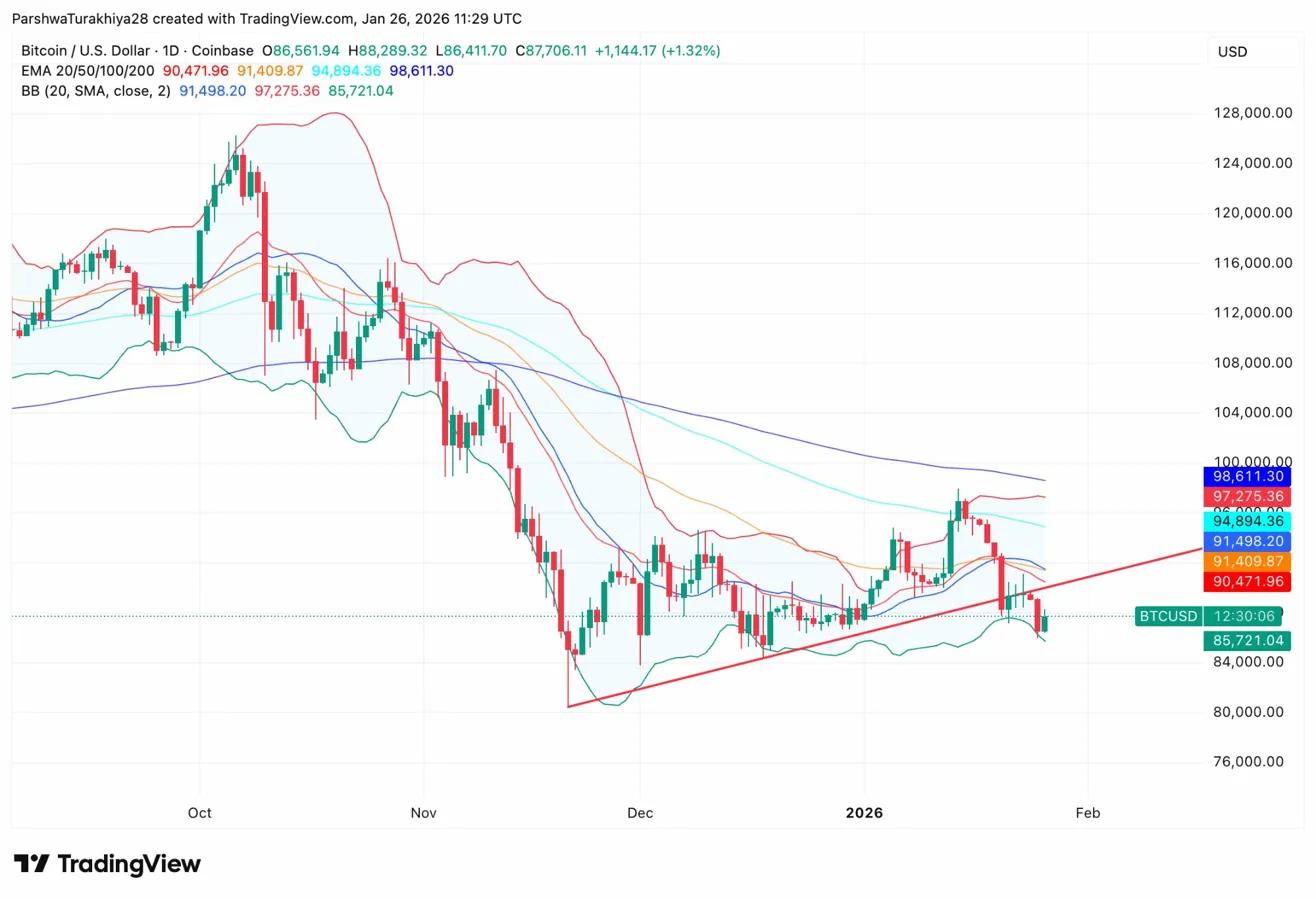
Bitcoin Price Prediction: $191M Accumulation Wave Tests Bollinger Band Support
Axie Infinity’s AXS Takes Center Stage as New Market Dynamics Emerge
Bitcoin and ether price fluctuations become more accessible to trade with Polymarket’s latest contracts
Trending news
MoreCrypto prices
More





