
California set aside $165 million for Tesla to help transition its trucking sector to electric vehicles. However, this move could potentially hinder advancements in EV technology.

Tesla Semi and California’s Clean Truck Incentives: A Controversial Boost
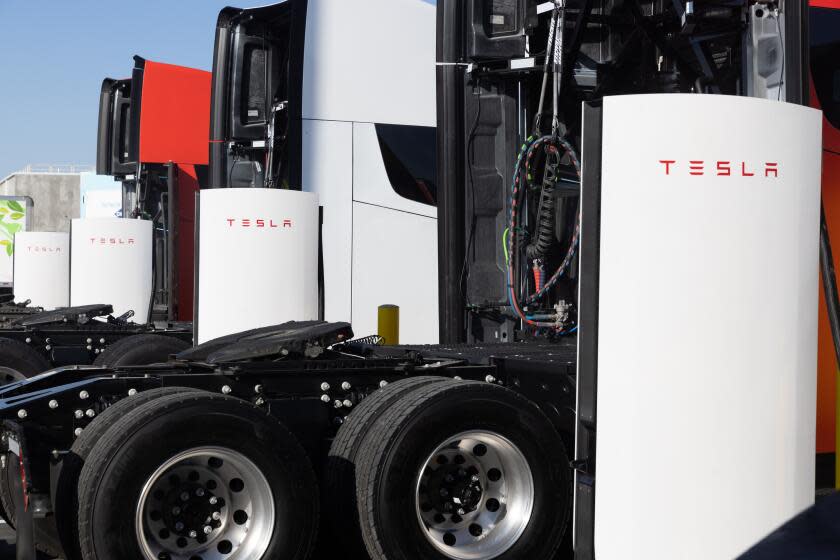
In 2023, Tesla’s electric Semi trucks were seen charging at Supercharger stations at Frito-Lay’s Modesto plant, where the company is transitioning from diesel vehicles to zero-emission trucks, solar panels, and energy storage systems.
(Benjamin Fanjoy / Bloomberg via Getty Images)
California’s Clean-Air Program Faces Scrutiny
A state initiative aimed at accelerating the adoption of electric trucks and buses in California has come under fire for allocating its largest-ever round of funding to support Tesla’s all-electric Semi—a vehicle that remains largely unavailable and whose production schedule is uncertain.
Over the past year, the California Air Resources Board (CARB) and nonprofit partner CALSTART have reserved close to 1,000 vouchers, totaling at least $165 million, to help commercial fleets purchase the long-awaited Tesla Semi. Marketed as a breakthrough in freight transport, the battery-powered truck is said to offer up to 500 miles of range per charge.
This decision has sparked backlash within the trucking sector, with critics accusing the state of favoring Tesla—a company already at the top of the automotive world—with incentives for a product that is not yet widely available.
Nearly eight years after Elon Musk first introduced the Tesla Semi concept, the vehicle remains scarce, hampered by repeated production setbacks and lacking a public retail price.
Some industry observers argue that Tesla’s Semi should not have qualified for state funding at all, noting that when Tesla applied for vouchers, the truck did not appear to have the required certifications to be sold or operated on California roads.
Nonetheless, the nearly 1,000 state-issued incentives have positioned the Tesla Semi as the leading contender in the electric heavy-duty truck market.
"Calling it market distortion or manipulation wouldn’t be an exaggeration," said Alexander Voets, general manager at RIZON Truck USA. "CARB has effectively made Tesla the leader in electric heavy-duty trucks, even though almost none are in customers’ hands."
Record Funding, Unclear Oversight
The funding was provisionally awarded through the Hybrid and Zero-Emission Truck and Bus Voucher Incentive Project (HVIP), which aims to cut pollution and greenhouse gases in freight and public transit. Since 2009, HVIP has allocated over $1.6 billion—combining state and local port funds—to help fleets acquire electric, hydrogen, and other low-emission vehicles.
The Program’s Impact and Criticism
Heavy-duty trucks make up just 10% of vehicles on U.S. roads but are responsible for 45% of nitrogen oxide emissions and 58% of particulate matter that affects respiratory health.
Experts have raised concerns about the program’s lack of rigorous oversight, which they say has allowed a handful of manufacturers to take advantage of its generous funding.
After media scrutiny, public data on HVIP funding was revised, showing lower amounts for Tesla and other automakers. Previously, the state had reserved the maximum eligible funding for Tesla—well above the truck’s retail price. In January, officials updated the public records to exclude local port funding, making it appear that Tesla received tens of millions less.
CARB also clarified that incentives from local utilities, separate from the state voucher program, further subsidized Tesla Semi purchases and reduced the state’s grant outlay.
Earlier data suggested Tesla could have received up to $202 million, about a third of all funding for 2025 and 2026. Individual vouchers ranged from $120,000 to $430,000 but now are listed between $84,000 and $351,000.
Even after these adjustments, Tesla is set to receive around $165 million—far more than any other manufacturer. For comparison, Canadian bus maker New Flyer secured about $68 million, less than half of Tesla’s total.
While Tesla has not publicly disclosed the Semi’s price, state documents indicate the standard 300-mile model sells for about $260,000, and the 500-mile version for $300,000. By contrast, the average price for a zero-emission big rig was $435,000 in 2024, according to CARB.
Private fleet operators can receive up to a 90% discount on the sticker price through the voucher program.
Questions About Tesla’s Eligibility
To receive a voucher, manufacturers must secure zero-emission powertrain certification and written approval from CARB for each model year, and the vehicle must be listed in the HVIP catalog.
The 2024 Tesla Semi was included as eligible by CARB, even though its powertrain certification was not posted on CARB’s website. No later model years were listed as eligible before Tesla applied for incentives.
"I haven’t seen any evidence that Tesla met the requirements," said a senior executive at another EV manufacturer, who wished to remain anonymous. "These are rules we all have to follow. How did Tesla bypass them, and why hasn’t CARB addressed this?"
Tesla did not respond to repeated requests for comment, and CARB did not directly explain how Tesla qualified for funding.
In a statement, a CARB spokesperson said, "The certification process involves confidential business information, so the status of any truck’s certification is not public."
CARB maintains that Tesla will not receive any state funding until all requirements are met and vehicles are delivered to customers.
A Tesla Semi operated by WattEv Transport Inc. is parked beside BYD electric trucks at a charging station in the Port of Long Beach, April.
(Patrick T Fallon / AFP via Getty Images)
This offers little reassurance to other manufacturers. Even if Tesla fails to deliver and forfeits the incentives, the reserved funds prevent other companies with available vehicles from accessing the support they need—potentially threatening smaller EV makers.
"That puts the rest of us at a disadvantage," said Peter Tawil, sales director at RIZON. "Our trucks are ready for delivery now. If this isn’t fixed, it could devastate the industry."
Policy Changes and Market Impact
Tesla’s surge in funding followed a quiet policy change two years ago, when California removed the cap on the number of vouchers a single manufacturer could receive at once. This rule had previously prevented large automakers from monopolizing clean-transportation incentives and ensured smaller companies had a fair shot.
Normally, dealerships obtain purchase orders from fleet operators and then request vouchers—typically up to 20 vehicles at a time. Vouchers are distributed on a first-come, first-served basis, making competition fierce. For example, in a recent funding round, $335.6 million was available, and 68% was claimed within two days.
This system has allowed some manufacturers to quickly secure large numbers of vouchers—even over 1,000—without having enough vehicles ready to deliver, leaving competitors unable to offer similar discounts.
Previously, a manufacturer could only hold 100 vouchers at a time until fulfilling those orders, a safeguard to prevent hoarding and to support smaller producers.
CARB explained that the cap was removed because it unintentionally restricted customers from accessing popular zero-emission vehicles. Waivers were often granted for in-demand brands.
"The original cap was meant to stop manufacturers from holding vouchers too long," a CARB spokesperson said. "But it ended up limiting fleet choices."
Without these limits, major players like Tesla have been able to dominate the program, intensifying competition at a time when the EV market faces significant uncertainty.
Federal support for EVs has also waned, with the Trump administration ending tax credits and rolling back California’s zero-emission targets, making it harder for the state to reduce pollution from its shipping sector.
The medium- and heavy-duty vehicle market has already consolidated, as automakers struggle to electrify and profit from delivery vans, buses, and big rigs in the U.S.
California’s voucher program has been a crucial support for electric truck and bus makers. However, Tesla’s entry into the heavy-duty segment has sparked debate and calls for changes in how incentives are distributed.
Is Tesla Semi a Game-Changer or a Work in Progress?
Ironically, Elon Musk, Tesla’s CEO, has previously argued against government subsidies for electric vehicles, claiming that Tesla would thrive without them. Yet, the company has actively pursued millions in state and local funding for the Semi, even as many in the trucking industry question whether the vehicle’s development justifies such large public investment.
Musk first revealed the Tesla Semi prototype in November 2017, promising a revolutionary electric truck that would help eliminate diesel models and reduce emissions from freight transport. He claimed it would offer a 500-mile range, accelerate from 0 to 60 mph in 20 seconds, and recharge in 30 minutes using solar-powered "Megachargers."
Production was slated to begin in 2019 at Tesla’s Nevada Gigafactory. However, early customers like PepsiCo have faced years of delays in receiving their orders.
The exact number of Tesla Semis sold remains unclear. State records show that only five units have been delivered and paid for through CARB’s voucher program, all to Nevoya Transportation LLC in July of last year.
Officials expect that most Tesla orders will be fulfilled in late 2026, based on discussions with the company.
Yet, doubts about the Semi’s readiness persist. During testing at the Port of Long Beach, a significant design issue emerged: the truck’s panoramic windshield, while offering excellent visibility, prevented drivers from rolling down the window to hand over paperwork at security gates.
For skeptics, this was further evidence that the Semi is not yet ready for widespread use.
Disclaimer: The content of this article solely reflects the author's opinion and does not represent the platform in any capacity. This article is not intended to serve as a reference for making investment decisions.
You may also like
Here's how market makers likely accelerated bitcoin's brutal crash to $60,000
Cango Inc. Releases 2025 Letter to Shareholders
The Mystery of Bitcoin’s Creator Satoshi Nakamoto Continues
Trending news
MoreCrypto prices
More





