Vitalik Buterin continues to highlight the need for enhancing Ethereum’s mainnet to future-proof the blockchain. Recently, Buterin remarked that some of the initial promises of layer-2 solutions no longer generate the same level of excitement as before. Ethereum is steadily becoming faster and more cost-effective—and these gains are just the beginning. The newly introduced Strawmap roadmap is poised to accelerate this momentum even further.
Strawmap Sets Five Ambitious Goals for Ethereum’s Core
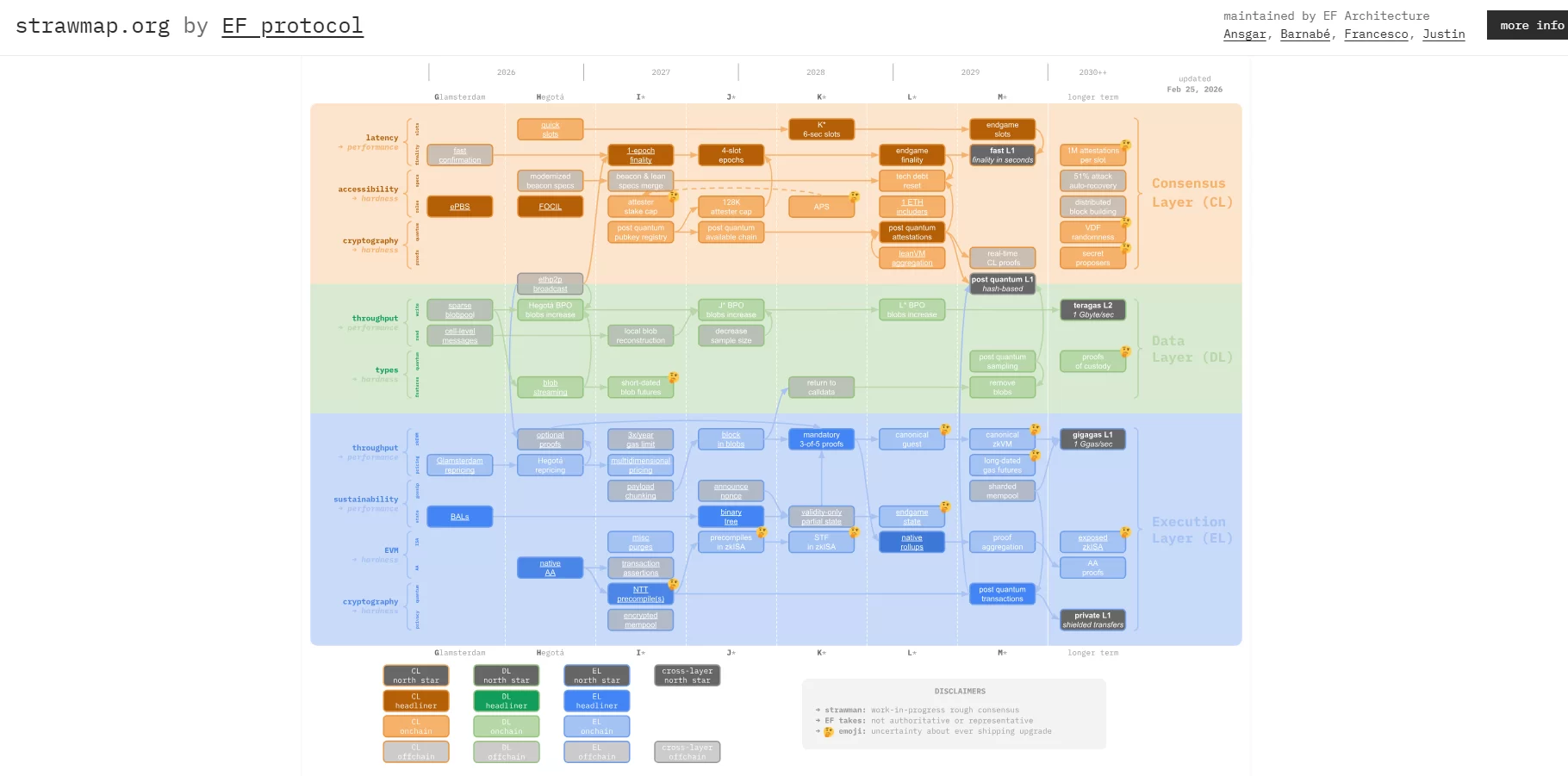
A comprehensive document released by the Ethereum Foundation on February 18, 2026, provides an in-depth visualization and explanation of the updated protocol roadmap, known as “Strawmap”. At the heart of this roadmap lie five key targets, all aimed at shaping Ethereum into a “scalable, secure, and private world computer.” These objectives focus on critical upgrades and enhancements that will define Ethereum’s next era.
Faster Mainnet Finality and Gigagas Ambitions
The roadmap’s first pillar—Fast L1—focuses sharply on drastically reducing transaction finality. By implementing Single Slot Finality (SSF) and trimming slot durations from 12 seconds to potentially 8 seconds or less, the mainnet aims to eliminate latency and ensure near-instant confirmations. This development is set to make using layer-1 directly much more seamless and efficient for users and applications alike.
Another major target, Gigagas L1, sets an ambitious goal for Ethereum to process one billion gas per second—referred to as 1 Gigagas/sec. The integration of enshrined zkEVMs—zero-knowledge provers embedded within the protocol itself—will pave the way for the mainnet to approach speeds of around 10,000 transactions per second (TPS), all without demanding additional hardware from participants.
Layer-2 Scaling, Quantum Security, and Enhanced Privacy
Looking beyond the mainnet, the Strawmap also introduces Teragas L2, which calls for an ecosystem-wide capacity of one teragas per second—that is, 10 million TPS—on layer 2s. Introducing technologies like PeerDAS (Peer-to-Peer Data Availability Sampling), Ethereum’s data layer is set to expand so vastly that layer-2 networks will be able to access the mainnet as a nearly zero-cost data platform. This leap in capacity promises to open new horizons for scalable, affordable decentralized applications.
Another priority highlighted by the roadmap is robust quantum security, branded as Post Quantum L1. As artificial intelligence advances, so too does the risk of quantum computers undermining traditional cryptographic systems. Recognizing this, Ethereum plans a shift from ECDSA signatures to quantum-resistant schemes based on hash functions or lattice cryptography. This transition is intended to shield the network from potential quantum-enabled attacks—a concern drawn into sharper focus by recent security debates in the broader crypto world.
Privacy also features prominently in the Strawmap vision, with Private L1 initiatives aiming to make confidentiality an embedded protocol feature rather than an optional add-on. Through technologies like shielded ETH transfers, Ethereum intends to enable users to conceal their balances and transaction histories without undermining the network’s decentralization.
In unveiling the Strawmap, the Ethereum Foundation has also reorganized the platform’s development stages—formerly known by names like “The Surge,” “The Scourge,” and “The Verge”—into three core workstreams: Scale (scaling improvements), Improve UX (user experience enhancements), and Harden L1 (mainnet security upgrades). Within this new structure, Ethereum is gearing up for two crucial technical milestones in 2026: the Glamsterdam update in the first half of the year, followed by the Hegotá upgrade in the second half.
While ETH has yet to reclaim the critical $2,100 level, it continues to post strong double-digit daily gains.