
Render Token, a Crypto Investment Tied to AI Computing, Poised for Growth

The race for artificial intelligence dominance has an overlooked battlefield: raw computing power. While investors focus on model developers and chip manufacturers, a quieter infrastructure layer has been expanding on blockchain rails. Render Network (RNDR-USD) operates a decentralized marketplace that connects GPU owners with users who need compute power for rendering and artificial intelligence workloads. In a crypto market crowded with speculative narratives, Render stands out for linking token economics directly to real demand for processing capacity.
Claim 50% Off TipRanks Premium
- Unlock hedge fund-level data and powerful investing tools for smarter, sharper decisions
- Stay ahead of the market with the latest news and analysis and maximize your portfolio's potential
For investors seeking indirect exposure to the AI buildout, RENDER offers a differentiated way to participate in the trend.
A Marketplace Built for the Compute Crunch
Studios producing visual effects, developers training machine learning models, and companies running inference workloads all face the same constraint: access to high performance GPUs remains expensive and uneven through traditional cloud providers. Platforms such as Amazon Web Services (AMZN) and Google Cloud (GOOGL) still dominate the market, but price volatility and capacity limits during peak demand periods have become recurring challenges. The surge in GPU demand from AI workloads has only deepened that strain.
Render addresses this gap by aggregating unused GPU capacity from a global network of node operators and matching it with buyers through a decentralized system. Instead of relying on centralized data centers, the protocol creates a marketplace where underutilized hardware can be activated on demand. Industry research suggests a meaningful share of installed GPU capacity worldwide sits idle for long periods, creating an opening for networks that can mobilize that excess supply efficiently.
The timing favors this model. The global artificial intelligence market was valued in the hundreds of billions of dollars in 2025 and is projected to approach the trillion dollar range before the end of the decade, according to Statista. Render has already processed workloads for visual effects studios, gaming firms, and machine learning teams. That blend of creative and technical users supports the case that the network is serving production grade use cases rather than experimental traffic.
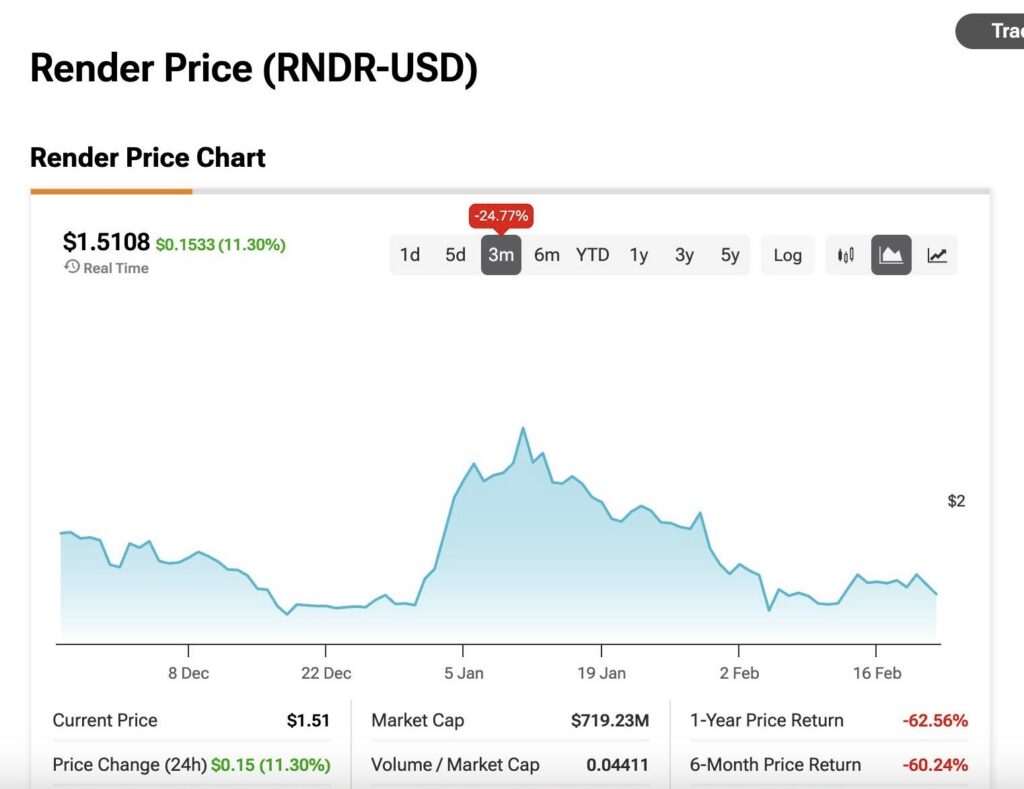
However, in line with other crypto prices in recent months, RNDR-USD has dropped 25% in the past three months.
Scaling Through Network Design
Render’s current growth profile reflects architectural changes that enabled higher throughput and lower transaction costs. Since moving its settlement layer to Solana (SOL-USD), the network has been able to handle a larger volume of compute jobs with minimal fee friction. This shift improved cost predictability for users and allowed job volume to scale without congestion bottlenecks.
On-chain data shows steady increases in completed workloads and node participation into 2026. Research firm Messari reports that cumulative token burns tied to network usage continued rising through 2025 and into early 2026, reflecting sustained demand for compute services rather than one time bursts of speculative activity.
Strategic relationships have also expanded alongside technical improvements. Render maintains integrations with firms involved in generative media and AI model development, including Stability AI and creative technology platforms used in content production. These relationships position the network as a hybrid infrastructure layer serving both digital media and artificial intelligence pipelines.
Tokenomics Linked to Real Activity
Render’s token structure is built around a usage based model. Through its Burn Mint Equilibrium system, the protocol destroys RENDER tokens equivalent to the dollar value of compute jobs completed on the network. New tokens are minted to compensate node operators who supply GPU power, but the burn mechanism offsets issuance as activity rises.
This design links supply dynamics to operational demand rather than purely speculative cycles. As more compute jobs are processed, more tokens are removed from circulation. Token holders also participate in governance through network proposals that determine upgrades and policy changes, reinforcing the connection between ownership and protocol direction.
Valuation and Growth Path
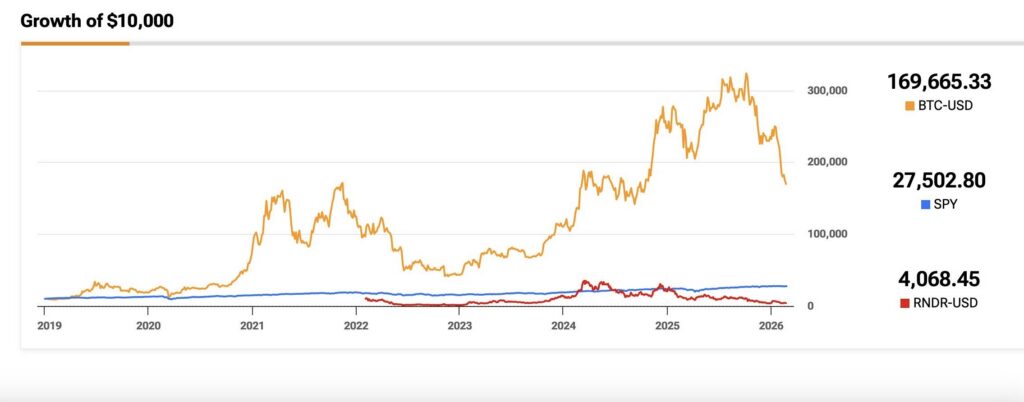
RENDER previously peaked during the early phase of the AI play in crypto and has since retraced along with the broader market. As of early 2026, the token trades well below its cycle high, with a fully diluted valuation under one billion dollars based on pricing data.
Development efforts now focus on expanding beyond traditional rendering into generalized compute services for AI inference and training workloads. Planned upgrades aim to support a wider range of job types with higher performance requirements. The network already supports tools used in generative video, image synthesis, and machine learning workflows alongside established rendering engines such as OctaneRender, Redshift, and Blender Cycles.
If this expansion continues, Render’s addressable market could widen from content creation into broader AI infrastructure demand.
Risks to the Thesis
RENDER remains highly sensitive to overall crypto market conditions, which can overwhelm project specific fundamentals. Regulatory uncertainty surrounding decentralized physical infrastructure networks may limit enterprise adoption in some regions. At the same time, centralized cloud providers are actively adjusting pricing and capacity strategies in response to competition.
Operational risk also remains. Maintaining consistent performance across a distributed network of independent GPU providers is technically demanding. Any prolonged reliability issues could weaken confidence among users who depend on stable compute delivery.
The Broader Investment Case
Render represents a bet on the continued expansion of AI and crypto infrastructure demand accessed through a token rather than a publicly traded stock. The network has established recurring usage, built partnerships tied to real workflows, and implemented token mechanics designed to benefit from growth in activity.
That combination does not remove volatility or risk, but it places RENDER among a smaller group of crypto assets with identifiable business drivers. For investors seeking exposure to the infrastructure layer of artificial intelligence without relying solely on chip manufacturers, Render offers a differentiated way to express that view.
Copyright © 2026, TipRanks. All rights reserved.
Disclaimer: The content of this article solely reflects the author's opinion and does not represent the platform in any capacity. This article is not intended to serve as a reference for making investment decisions.
You may also like
The US dollar heads for its worst week in three months: Fed credibility questioned as Japan makes massive intervention
The US dollar is heading for its worst week in three months.

Strategy Ends Its ‘Buy Every Dip’ Bitcoin Strategy, Here’s What’s Replacing It

Canada Goose (GOOS.US): Q1 Greater China Revenue Surges 44.2%, All-Weather Strategy Anchors Long-Term Growth
In the first quarter of the 2027 fiscal year, Canada Goose's global total revenue increased by 10.3% year-on-year to 118.9 million Canadian dollars.

After 439% gains, Situational Awareness faces a forced AI investment withdrawal
Crypto prices
More


