
Geoeconomic divisions push commodity markets into a lasting state of elevated risk—Capitalize on the emerging standard premium

A New Era of Global Risk: Uncertainty as the Norm
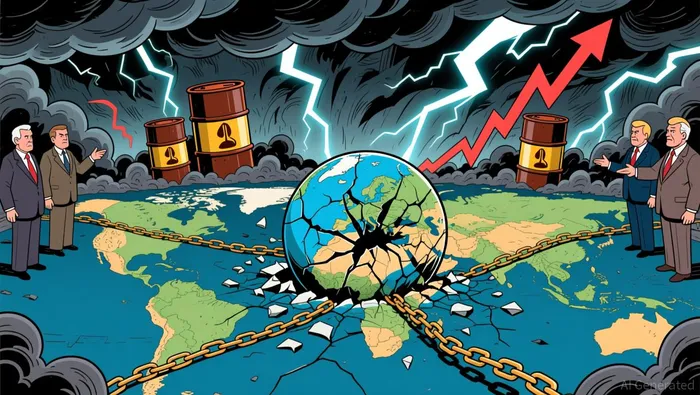
The global risk environment has undergone a profound transformation. Rather than facing sporadic, isolated disruptions, the world is now characterized by ongoing uncertainty as the standard backdrop. According to the most recent Global Risks Report, half of surveyed experts foresee a turbulent or stormy environment in the coming two years—a notable 14% increase from the previous year. Looking further ahead, 57% expect instability to persist over the next decade. This widespread anxiety reflects a world where rivalry is replacing cooperation, making market stability increasingly elusive.
Geoeconomic Rivalry: The Central Challenge
Geoeconomic tensions now stand as the most significant global risk for 2026, with 18% of respondents identifying it as the leading threat capable of sparking a major crisis. This risk has surged in prominence, climbing eight spots in the two-year outlook, indicating a shift toward enduring strategic competition. When economic leverage is used as a tool of conflict and supply chains are intentionally disrupted, commodity markets experience more frequent and severe shocks. This results in a persistently elevated risk environment, where markets must continually account for the possibility of deliberate state intervention.
This new reality goes beyond typical economic cycles. The decline of international cooperation, eroding trust, and rising protectionism have created a climate where collaboration is no longer the default. In this competitive era, stability is under constant threat. For commodity markets, this means the old model of predictable supply and demand is now overlaid with a permanent premium for geopolitical risk. Rather than occasional volatility, uncertainty now shapes the entire investment landscape, fundamentally altering how investors assess risk and return.
Commodity Markets in a Fragmented World
Market reactions to shocks reveal how adaptation is unfolding. Oil remains the key conduit for geopolitical risk—when supply is threatened, prices surge rapidly. However, history shows these spikes often subside within weeks if disruptions are not lasting. For example, recent U.S. and Israeli actions against Iran led to a swift jump in oil prices, but analysts expect prices to fall back once a clear path to de-escalation appears. The market’s attention is firmly on the flow of resources: if conflict is resolved or contained, risk premiums quickly diminish.
Gold, on the other hand, acts as a safe haven during crises. It typically experiences a sharp uptick at the onset of conflict as investors seek security. Following the Iran strikes, analysts anticipated a rapid surge in gold and other commodities. Yet, these gains often fade as the market shifts focus from the initial shock to the conflict’s duration and broader economic impact. As one trader observed, gold could rise by about $200 per ounce initially, only to drift lower as the day progresses. This highlights gold’s primary role: capturing the immediate fear premium, rather than sustaining long-term rallies.
Historical analysis supports this pattern. Reviewing nine major geopolitical shocks since 1990, prices often spike in the early days but normalize within weeks. A notable example is the 12-day conflict between Israel and Iran last June, where oil and gold surged initially but ended the month lower. Data shows that since 2006, most shocks have resulted in losses that faded within a month, except when supply disruptions are prolonged, as seen in the Russia-Ukraine war.
Ultimately, while the baseline risk remains elevated, market responses to individual shocks are often brief. However, repeated disruptions can fundamentally alter supply chains, capital flows, and strategic dependencies. As highlighted in one report, persistent instability can reshape global trade and investment patterns, embedding higher costs and new vulnerabilities into the long-term cycle.
Understanding the Commodity Cycle: Macro Forces and Ongoing Tensions
Short-term market reactions to shocks are typically temporary, but the broader trajectory of commodity prices is shaped by deeper, more persistent factors. In today’s environment, real interest rates, the strength of the U.S. dollar, and global economic growth are the main drivers. These macroeconomic forces can either dampen or amplify the effects of geopolitical events. For example, an oil price spike due to conflict may have limited impact if the global economy is weak, or it may be exacerbated if inflation is already a concern and central banks are tightening policy. As a result, investors must look beyond headlines to underlying trends.
Advances in energy independence and efficiency have lessened the impact of oil price shocks on developed economies. Modern supply disruptions are less likely to trigger the stagflation seen in the 1970s. However, this does not mean commodities are less sensitive to risk—rather, vulnerabilities have diversified. As one analysis points out, risks now extend to semiconductors, rare earth elements, and critical production networks. The ongoing friction of a contested world makes supply chain vulnerabilities a constant concern, affecting all commodities, not just energy.
For investors, the key is to distinguish between temporary price spikes and lasting structural changes. A short-lived surge, such as that caused by a contained conflict, may present opportunities in energy stocks or commodity-linked assets as markets revert. Historical evidence shows that markets can recover and progress when fundamentals are strong. The goal is not to avoid risk assets due to short-term volatility, but to avoid confusing noise with genuine trends. Persistent geopolitical friction can increase risk premiums and change how assets diversify portfolios—this is the real structural shift.
In summary, the commodity cycle now operates within a landscape of heightened uncertainty. Traditional supply and demand models must be adjusted to account for ongoing risk. Long-term price ranges will be shaped by real rates, growth, and currency movements, but with greater volatility. Investors who focus on core fundamentals while adapting to this new risk environment will be best equipped for success.
Key Signals and Strategies for the Future
The market’s resilience in the face of shocks depends on clear signals that indicate whether a conflict will be contained or escalate into a prolonged disruption. Currently, the most important trigger is a clear path to de-escalation. Analysts suggest that oil prices should decline once a diplomatic solution is in sight. Investors are watching for diplomatic breakthroughs or announcements of completed military objectives, which would allow markets to refocus on fundamentals. Without such developments, risk premiums remain high and volatility persists.
The Federal Reserve’s policy stance is another crucial factor. Geopolitical risks can delay expected interest rate cuts, keeping real rates elevated for longer. This dynamic is central to market stability. If inflationary pressures from supply disruptions cause the Fed to maintain higher rates, it could limit the economic fallout from price spikes. Conversely, if the Fed lowers rates in response to a broader slowdown caused by conflict, it could fuel rallies in risk assets. The direction of monetary policy will significantly influence the commodity cycle’s path.
Beyond oil, the real test of adaptation lies in the robustness of global supply chains. Ongoing friction is making vulnerabilities in semiconductors, rare earths, and other essential networks a permanent concern. Markets must now factor in the costs of building redundancy and diversification. As noted in one report, persistent disruptions are reshaping supply chains, capital flows, and resource dependencies. The key metric is not just price, but how quickly companies can adapt. Those that establish resilient, diversified networks will better manage risk, though this transition will raise costs across the global economy.
In conclusion, successfully navigating this new era requires a multi-layered approach. Immediate attention should be on conflict de-escalation, while the Federal Reserve’s policy response serves as an intermediate signal. Over the long term, the structural transformation of global trade and investment will be decisive. Investors must monitor all these factors, recognizing that a short-term shock can evolve into a lasting change if these signals do not align. The objective is not to anticipate every headline, but to identify the indicators that distinguish between temporary volatility and a genuine shift in the global landscape.
Disclaimer: The content of this article solely reflects the author's opinion and does not represent the platform in any capacity. This article is not intended to serve as a reference for making investment decisions.
You may also like
DeFi Hits $100B Milestone: Examining Governance and Liquidity Dynamics

Pakistan’s Ongoing Energy Challenges: Negotiation Efforts, Rising Fuel Costs, and the Next Phase of CPEC
Outlook: Do You Have a Gut Feeling Something’s Up?
Top Trader Says XRP Was Never Designed to be “Cheap.” Here’s the Designated Price
Trending news
MoreCrypto prices
More





