
Stock trading surges 70%, investment banking fees soar 50%: Bank of America’s Q2 revenue beats expectations, but cost challenges are just beginning

Bank of America delivered a better-than-expected Q2 earnings report driven by both its trading and investment banking engines.
Net profit reached $9.1 billion and total revenue stood at $31.6 billion, both far exceeding market expectations. However, behind these impressive numbers, non-interest expenses rose 8% year-on-year to $18.6 billion. On the same day, JPMorgan Chase raised its full-year cost guidance to around $107.5 billion, making the "cost ledger" of Wall Street banks an unavoidable secondary topic amid this earnings feast.
Sales and trading division revenue soared 34% year-on-year to $7.1 billion, a new all-time high, and far above CEO Brian Moynihan's earlier estimate of just 15% growth.
Within this, equity trading revenue surged 70% year-on-year to $3.6 billion, marking the best quarterly performance in Bank of America’s history; fixed income, currencies, and commodities (FICC) trading income grew nearly 9% to $3.5 billion, also surpassing analysts’ general expectations. The sales and trading segment recorded record income during the first half of 2026.
Investment banking also saw a strong recovery. Fee-related revenue grew 50% year-on-year to $2.1 billion; M&A advisory fees surged nearly 68% to $558 million; equity capital markets revenue stood at $535 million, and debt underwriting revenue at $1.1 billion; all significantly above analysts’ forecasts.
Driven by an AI-powered capex supercycle, the number of mega M&A transactions worldwide exceeding $10 billion in deal value surged to record levels in the first half of 2026.
Bank of America was deeply involved in several landmark deals—as joint bookrunner for SpaceX’s record-breaking $2 trillion IPO and as financial advisor on NextEra Energy’s $66.8 billion acquisition of Dominion Energy.
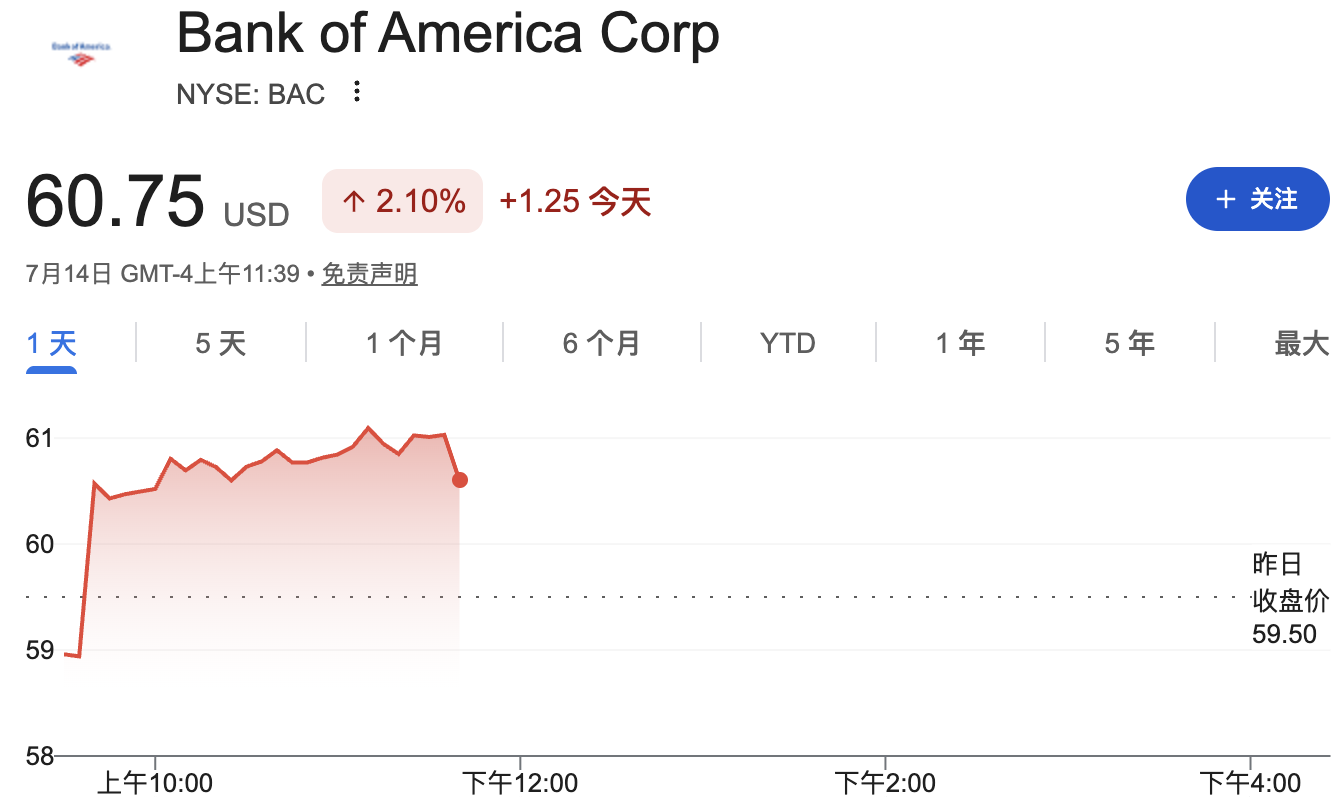
Following the earnings release, Bank of America’s shares rose 2% intraday on Tuesday. Year-to-date, the stock is up about 9%, outperforming rivals like JPMorgan Chase and Wells Fargo; over the past twelve months, shares have surged 28%, far above the S&P 500 Financials Index’s 7.4% gain during the same period.
The “Volatility Dividend” in Trading: Q2 Acceleration Built on Q1 Momentum
The surge in Bank of America’s trading business was not an isolated incident, but rather a trend strengthened ever since the outbreak of Middle East geopolitical tensions.
In Q1, the bank’s equity trading revenue had already jumped 30% to $2.8 billion, setting a then-record. The Q2’s 70% growth means trading desks not only held their ground but amplified profitability further in a persistently high-volatility environment.
Rising oil prices driven by U.S.-Iran tensions and oil supply concerns heightened uncertainty over rates and inflation, prompting investors to frequently rebalance portfolios.
This high-volatility environment translated directly into higher trading desk revenues for large banks. JPMorgan’s earnings released the same day showed equity trading revenue skyrocketed 86% to $6 billion, and Wells Fargo’s investment banking fees grew 35%. Across Wall Street, trading and IB divisions posted their best results in recent years this quarter.
AI Capex Supercycle: Investment Banking Pipelines Keep Expanding
According to Stephen Biggar, Director of Financial Services Research at Argus Research, the AI-driven capital expenditure supercycle is greatly benefiting equity issuance, M&A activity, and debt financing.
The total value of announced M&A deals worldwide reached $2.5 trillion in the first half of the year. As these transactions close over the next 6–9 months, banks will recognize income sequentially.
Bank of America CEO Brian Moynihan stated in the earnings release that, amid a healthy economic backdrop, resilient consumers and businesses are turning to the bank for spending, borrowing, and investing. The business pipeline remains strong in the near term, and commercial lending has also rebounded.
CFO Alastair Borthwick emphasized in a media call, "Our strategy is paying off. We are investing with discipline, achieving organic growth, expanding market share, and driving higher levels of growth and profitability."
Cost Increases: The Common Denominator Across Wall Street
Despite revenue coming in well above expectations, cost pressures have become the defining theme of this earnings season. Non-interest expenses at Bank of America climbed 8% year-on-year to $18.6 billion, slightly higher than analysts’ forecast of $18.35 billion.
On the same day, JPMorgan raised its full-year expense guidance further to around $107.5 billion, surpassing CEO Jamie Dimon’s earlier suggested increase.
In terms of net interest income, Bank of America grew 9% year-on-year in Q2 to nearly $16 billion, beating the market expectation of 8.5% growth. Average loan and lease balances edged up 1% year-on-year to $321 billion, as resilient consumer spending provided stable support to interest income.
For investors, the pressing question is: as the volatility dividend diminishes at the margin while cost bases rise, can the record growth in trading and investment banking be sustained through the second half?
Disclaimer: The content of this article solely reflects the author's opinion and does not represent the platform in any capacity. This article is not intended to serve as a reference for making investment decisions.
You may also like
The Bank of Canada shows its work while the Canadian Dollar reads Washington
Ethereum pivots to settlement role as perps thrive on Arbitrum, Solana
Ethereum hits all-time high of 18.7M weekly transactions while fees crater to $0.008
British Pound Sterling collects a refund on the Fed hike that never came
Crypto prices
More


