

Coin-related
Price calculator
Price history
Price prediction
Technical analysis
Coin buying guide
Crypto category
Profit calculator

What is CROSS (CROSS)?
CROSS basic info
The cryptocurrency market now operates across many independent blockchain networks. Ethereum, Solana, Bitcoin, Base, Cosmos, XRP Ledger, and other ecosystems each have their own tokens, wallets, applications, and liquidity sources. This diversity has encouraged innovation, but it has also fragmented the crypto market. Users often need to rely on several platforms to move assets between chains, exchange tokens, switch wallet networks, and obtain the correct gas token.
Cross-chain platforms aim to reduce these technical barriers. Squid is a cross-chain infrastructure platform that supports token swaps, asset bridging, liquidity routing, and cross-chain contract calls. It connects blockchain networks, decentralized exchanges, liquidity providers, wallets, and applications through a unified system. Its native ecosystem token, QUID, is designed to support staking, governance, and other developing functions. In this article, we will learn what Squid is, who created it, how its cross-chain technology works, and how the QUID token fits into its ecosystem.
What Is Squid (QUID)?
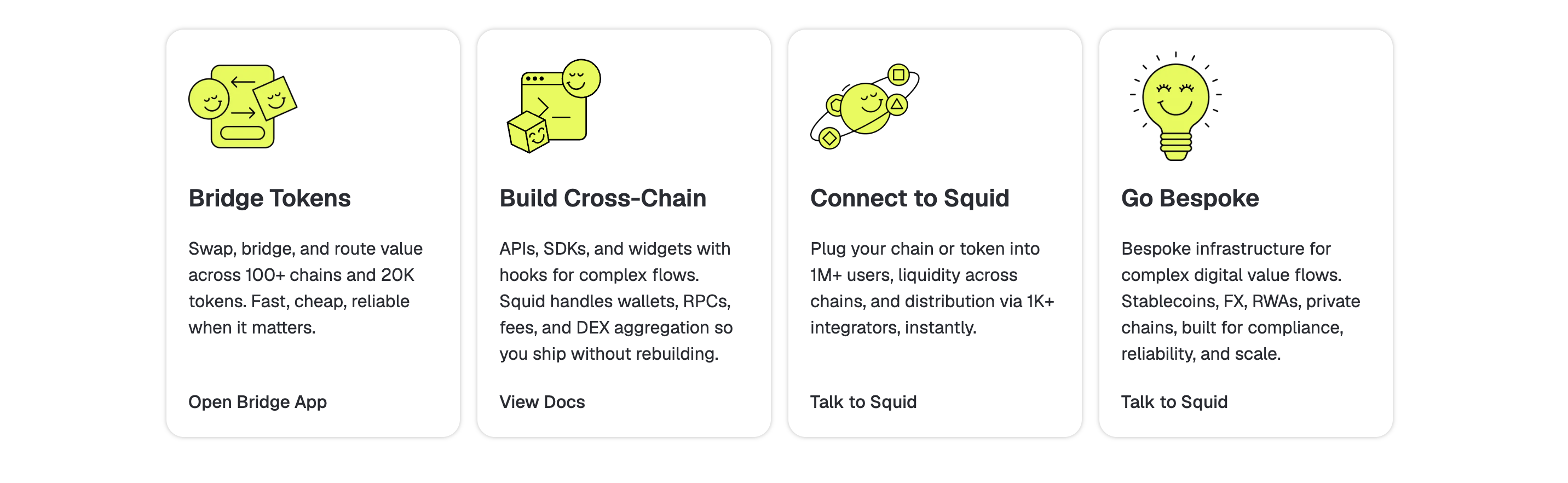
Squid, also known as Squid Router, is a cross-chain platform that connects blockchain networks, decentralized exchanges, tokens, liquidity providers, wallets, and applications. It allows users to swap, bridge, and transfer digital assets across supported networks through a single transaction. Instead of requiring users to operate several bridges and exchanges manually, Squid calculates a suitable route and coordinates the required steps through one interface. The project reports support for more than 100 blockchains, 20,000 tokens, and 130 decentralized exchanges, as well as over $6 billion in routed volume, more than one million users, and over 1,000 integrations.
Squid supports both EVM and non-EVM networks, including Ethereum, Base, Solana, Bitcoin, Cosmos, XRP Ledger, Stellar, Hedera, and Celo. Unlike a basic crypto bridge, which usually transfers an asset between two chains, Squid can also exchange the asset during the transfer. For example, a user may swap ETH on Ethereum for USDC on Base without completing each bridge and exchange step separately. QUID is the native token of the Squid ecosystem and operates as an ERC-20 token on Base. It is designed for staking, governance, and other ecosystem functions, although users do not need to hold QUID for every cross-chain transaction.
Who Created Squid (QUID)?
Squid was founded in 2022 by Fig, Xtina, and Koda to solve the problem of fragmented blockchain networks. Fig leads business development and product strategy, drawing on experience in medicine, venture capital, traditional finance, and algorithmic crypto trading. Xtina oversees growth and operations and has a background in business, philosophy, public policy, and technology leadership. Koda serves as the project’s engineering lead, where he manages Squid’s backend routing infrastructure and technical strategy after previously working on big-data and machine-learning systems for banks and mining companies. Squid also reports backing from nearly 100 investors and has disclosed $13.5 million in funding across rounds led by North Island Ventures and Polychain Capital.
How Squid (QUID) Works
Squid uses a routing and execution system to connect a user’s source asset with the asset and blockchain they want to receive. The platform searches available decentralized exchanges, bridges, messaging protocols, market makers, and liquidity sources to identify a suitable route. The user selects the source token, destination token, and networks, reviews the quote, and confirms the transaction. Squid then coordinates the required swaps and cross-chain transfers through one interface.
Squid also uses an intent-based system called Squid Intents. Instead of requiring users to choose every technical step, they specify the result they want. Solvers, which are professional market makers or liquidity providers, compete to fulfil the transaction. The selected solver sends the requested asset to the destination address, while Squid verifies the completed transfer before releasing the source funds. This structure allows Squid to support both EVM and non-EVM networks and may reduce execution time and routing complexity.
Key features of Squid include:
-
Cross-chain swaps: Users can exchange one cryptocurrency for another across different blockchain networks.
-
Token bridging: Squid transfers supported digital assets from one chain to another.
-
Single-chain swaps: The platform can also route token exchanges within the same blockchain.
-
Liquidity aggregation: Squid searches decentralized exchanges, bridges, solvers, and off-chain inventory for available liquidity.
-
Squid Intents: Solvers compete to complete eligible transactions according to the user’s requested outcome.
-
APIs and SDKs: Developers can add Squid’s cross-chain functions to wallets, decentralized applications, and other platforms.
-
Embeddable widgets: Projects can integrate a ready-made Squid interface without building a cross-chain system from the beginning.
-
Cross-chain hooks: Developers can attach custom contract actions to more complex blockchain and DeFi transactions.
-
Chain and token connections: Blockchain teams and token issuers can apply to add their networks or assets to Squid.
-
Institutional infrastructure: Squid offers tailored systems for payments, stablecoins, foreign exchange, real-world assets, private chains, and compliance-focused transactions.
Squid aims to simplify cross-chain activity by combining routing, liquidity access, and settlement within a single system. Its infrastructure serves individual users, developers, blockchain projects, and institutions that need to move digital assets across multiple networks.
Squid (QUID) Tokenomics
QUID is the native utility and governance token of the Squid ecosystem. It is designed to support staking, governance, ecosystem incentives, and possible future token-related mechanisms. QUID is issued as an ERC-20 token on Base, while Squid’s cross-chain platform connects both EVM and non-EVM blockchain networks.
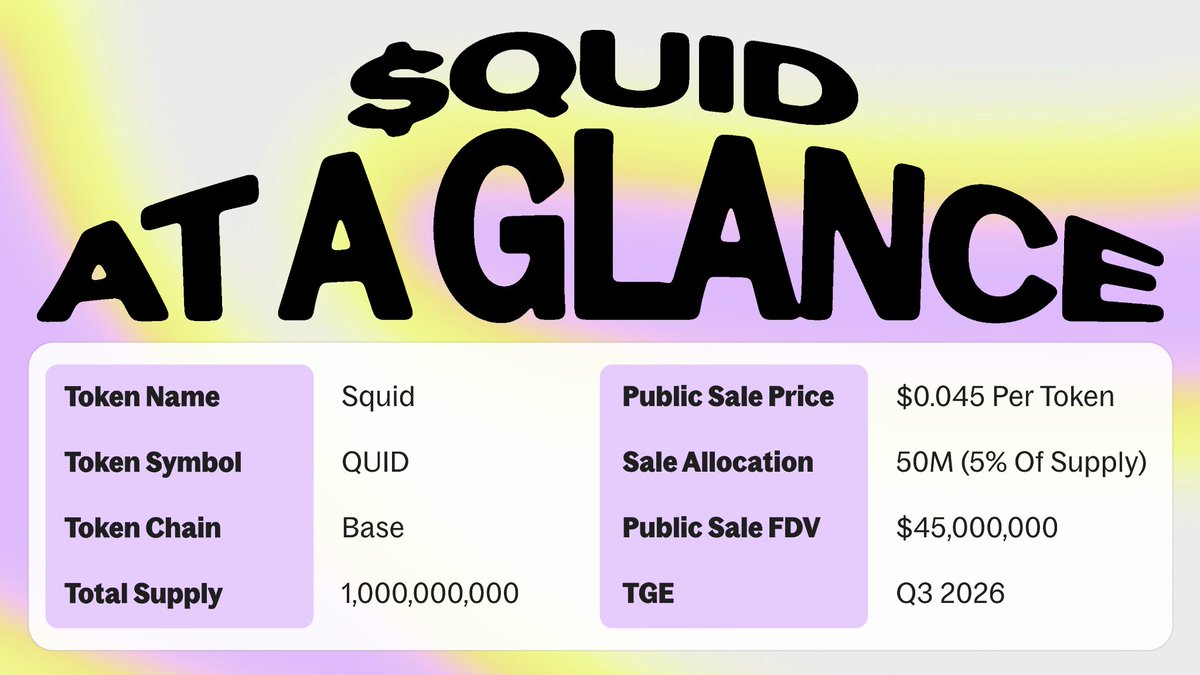
Token Details
- Token Ticker: QUID
- Blockchain: Base
- Token Standard: ERC-20
- Total and Maximum Supply: 1,000,000,000 QUID
- Public Sale Allocation: 50,000,000 QUID, or 5% of the total supply
- Public Sale Price: $0.045 per QUID
- Public Sale Valuation: $45 million fully diluted valuation
- Core Role: Staking, governance, ecosystem participation, incentives, and possible future token buybacks
The full QUID supply was created at the token generation event, and no additional tokens can be minted. Staking rewards and ecosystem incentives therefore come from existing allocations rather than inflationary token issuance.
Token Allocation
- Investors: 30.39%, or 303,946,126 QUID
- Team and Advisers: 23.95%, or 239,481,903 QUID
- Strategic Partners: 10%, or 100,000,000 QUID
- Public Sale: 5%, or 50,000,000 QUID
- Ecosystem Growth: 7.5%, or 75,000,000 QUID
- Foundation Treasury: 23.16%, or 231,571,971 QUID
Investors, team members, advisers, and strategic partners collectively hold 64.34% of the maximum supply. Their tokens are subject to lock-up and vesting conditions intended to limit immediate circulation.
Vesting and Unlock Schedule
Public-sale tokens were fully unlocked at the token generation event. Investor, team, adviser, and strategic-partner allocations had no initial unlock and are subject to a 12-month cliff.
After the cliff, 25% of each allocation unlocks. The remaining investor tokens vest linearly until month 24, while the remaining team, adviser, and strategic-partner tokens vest until month 36.
The foundation treasury receives a 10% initial unlock, followed by linear vesting of the remaining 90% over 36 months. The ecosystem-growth allocation includes 70 million QUID available at launch and five million QUID released during the first year for staking rewards.
Token Utilities
- Staking: Holders may stake QUID and receive rewards from a predefined ecosystem allocation. The first-year staking pool contains five million QUID, equal to 0.5% of the maximum supply.
- Governance: Staked QUID may provide voting rights on selected matters, including treasury decisions, staking parameters, protocol settings, and ecosystem initiatives.
- Ecosystem Participation: QUID may support incentives, access features, and other functions introduced as the Squid ecosystem develops.
- Token Buybacks: Governance may decide to use treasury resources to purchase QUID from the open market. However, buybacks were not active at launch, and their timing, size, and treatment are not guaranteed.
The effective staking return depends on the amount of QUID participating in the program because the reward pool has a fixed size. QUID does not represent equity in Squid, and the official documentation does not guarantee holders a share of protocol revenue or transaction fees.
Squid (QUID) Goes Live on Bitget
We are thrilled to announce that Squid (QUID) will be listed in the DeFi zone. Check out the details below:
-
Deposit: Open
-
Trading: Opens on August 4, 2026, 13:00 (UTC)
-
Withdrawal: Opens on August 5, 2026, 13:00 (UTC)
-
Spot Trading Link: QUID/USDT
-
Convert: Opens within 10 minutes after trading begins. You can exchange tokens for BTC, ETH, and other tokens supported by Bitget Convert, with no transaction fees.
-
Simple Earn: Opens on August 4, 2026, 14:00 (UTC). You can subscribe to Simple Earn to earn rewards on your assets.
Conclusion
Squid is a cross-chain infrastructure platform that connects blockchain networks, decentralized exchanges, liquidity providers, wallets, and applications. Through its routing system and Squid Intents, the platform aims to make token swaps, bridging, and cross-chain transactions faster and easier across both EVM and non-EVM networks.
QUID supports the ecosystem through staking, governance, incentives, and possible future token-related mechanisms. With broad network coverage, growing integrations, and a focus on simplifying multichain activity, Squid may benefit from continued demand for cross-chain infrastructure, although investors should still evaluate token distribution, vesting schedules, competition, and the long-term utility of QUID.
Disclaimer: The opinions expressed in this article are for informational purposes only. This article does not constitute an endorsement of any of the products and services discussed or investment, financial, or trading advice. Qualified professionals should be consulted prior to making financial decisions.
CROSS resources
CROSS supply and tokenomics
Links
What is the development prospect and future value of CROSS?
The market value of CROSS currently stands at --, and its market ranking is #999999. The value of CROSS is not widely recognized by the market. When the bull market comes, the market value of CROSS may have great growth potential.
As a new type of currency with innovative technology and unique use cases, CROSS has broad market potential and significant room for development. The distinctiveness and appeal of CROSS may attract the interest of specific groups, thereby driving up its market value.
Is CROSS worth investing or holding? How to buy CROSS from a crypto exchange?
How to get CROSS through other methods?
What is CROSS used for and how to use CROSS?
Want to get cryptocurrency instantly?
Buy cryptocurrencies instantly with a credit cardTrade popular cryptocurrencies nowHow to buy popular cryptocurrenciesSign up now!Want to view similar cryptocurrencies?
What are the prices of popular cryptocurrencies today?What would have happened if you had bought popular cryptos?What are the price predictions for popular cryptocurrencies from 2025 to 2050?You can trade CROSS on Bitget
Learn about other cryptos




