
CoreWeave's $66.8 Billion Pipeline Drives Major Expansion in AI Infrastructure

The Shift in Investment: From Tech Giants to AI Infrastructure
The investment environment is undergoing a significant transformation. The well-established technology leaders, often referred to as the "Magnificent Seven," have reached maturity, with their rapid growth phases largely behind them. Their current expansion is driven mainly by incremental AI enhancements to existing offerings, rather than the disruptive innovations that once propelled their rise. As a result, the most dynamic growth opportunities are now emerging in the foundational infrastructure supporting the AI boom.
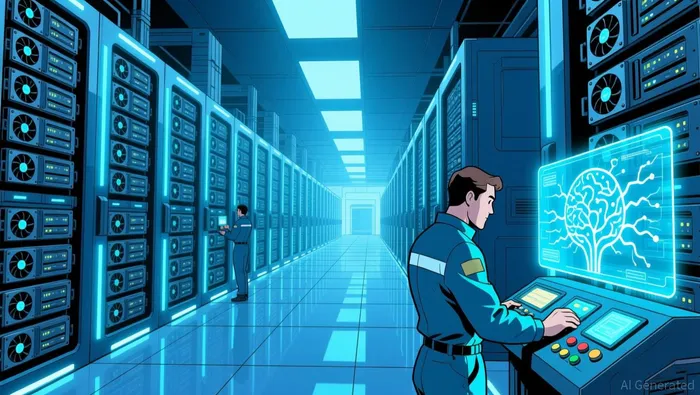
This emerging sector is known as the neocloud. Unlike conventional cloud providers that rely on general-purpose CPUs, neocloud companies such as CoreWeave are purpose-built for AI workloads. These platforms blend the scalability of public clouds with specialized, high-powered GPU resources, forming the backbone for the AI development pipeline. This approach addresses a critical need: AI training and inference require immense computing power, which often faces bottlenecks in traditional hyperscale environments due to shared resources and resulting inefficiencies.
Market data points to a surge in adoption. Global investment in AI infrastructure is expected to surpass $200 billion by 2028, signaling the start of a rapid growth phase. CoreWeave is well-positioned to benefit, operating a network of data centers equipped with Nvidia’s latest GPUs. Their business model is straightforward: providing dedicated GPU capacity for lease. The company’s recent growth to 590 megawatts of active data center capacity demonstrates its aggressive scaling to meet soaring demand.
The landscape is clear: while established hyperscalers focus on optimizing their current infrastructure, neocloud providers are laying the groundwork for the next wave of technological advancement. For investors, the key question is which part of the technology stack will experience the most dramatic growth. The infrastructure layer, where CoreWeave operates, is uniquely positioned to benefit as AI transitions from experimental projects to widespread, production-level deployment.
Strategy Spotlight: ATR Volatility Breakout (Long-only)
- Entry Criteria: Enter a long position when the 5-day ATR(14) surpasses its 60-day average and the closing price exceeds the 20-day high.
- Exit Criteria: Exit if the closing price drops below the 20-day low, after holding for 15 days, achieving a 20% gain, or incurring a 10% loss.
- Backtest Period: Last 2 years
- Instrument: NBIS
Risk Management
- Take-Profit: 20%
- Stop-Loss: 10%
- Maximum Holding Period: 15 days
Backtest Performance
- Total Return: -29.78%
- Annualized Return: -4.92%
- Maximum Drawdown: 59.96%
- Profit-Loss Ratio: 1.17
Trade Statistics
- Total Trades: 11
- Winning Trades: 4
- Losing Trades: 7
- Win Rate: 36.36%
- Average Holding Days: 8.36
- Max Consecutive Losses: 4
- Average Gain per Win: 21.38%
- Average Loss per Loss: 14.49%
- Largest Single Gain: 26.8%
- Largest Single Loss: 29.3%
Financial Dynamics: Balancing Rapid Growth and Profitability
CoreWeave’s financial profile exemplifies the classic infrastructure investment playbook. The company is prioritizing rapid expansion over immediate profits, a common strategy when establishing the core infrastructure for a new technological era. Recent financials highlight this trajectory: in the fourth quarter, revenue soared 110% year-over-year to $1.57 billion, and the company’s contracted backlog swelled to $66.8 billion, providing a clear indicator of sustained demand and future revenue streams.
However, the company’s valuation reflects a strong focus on future potential. With a trailing P/E ratio of 980, investors are clearly betting on long-term growth rather than current earnings. CoreWeave remains unprofitable for now, with recent losses per share falling short of expectations. This is by design: CEO Mike Intrator has emphasized that current margin pressures are the result of heavy investment to secure future revenues. Planned capital expenditures for 2026 are set between $30 billion and $35 billion—more than double the previous year—directly tied to signed contracts that will convert into future income.
The strategic alliance with Nvidia further reinforces this growth narrative. Nvidia’s $2 billion investment and acquisition of 24 million shares signal strong confidence in the underlying demand for compute power. This partnership not only provides capital but also secures a vital supply chain in a market where GPU availability is a significant constraint.
Recent volatility following Q1 guidance illustrates the inherent risks. The company’s projected revenue range fell short of analyst expectations, and management identified Q1 as the period of lowest margins. Such fluctuations are typical for businesses in rapid expansion mode, as costs are incurred before revenue fully materializes. For investors, the focus should be on the company’s long-term growth path, with profitability anticipated to rebound to low double digits by year-end. The elevated forward P/E ratio reflects the market’s belief that the company’s true value lies ahead.
NBIS Stock Snapshot
- Ticker: NBIS
- Company: Nebius Group
- Price: 117.620
- Change: -3.900 (-3.21%)
- Exchange: NASDAQ
- Status: Closed
Valuation and Growth Drivers: The Premium for Infrastructure
CoreWeave’s lofty valuation is a direct reflection of the premium placed on foundational AI infrastructure. With a forward P/E of 980, the market is pricing in extraordinary growth, not current profitability. This is supported by projected revenue growth of 83% in 2026, far outpacing the mature tech giants. The market recognizes that the underlying infrastructure enabling AI is more valuable at this stage than the applications built on top of it.
The main catalyst for this valuation is the ongoing surge in AI adoption. The company’s $66.8 billion contracted backlog is a strong indicator of sustained demand, representing years of future revenue. Should AI move from limited enterprise trials to widespread deployment, this backlog will translate into significant cash flow, justifying the current investment levels. The partnership with Nvidia further reduces risk by ensuring a reliable supply of critical hardware.
Nevertheless, the sector faces notable risks. Concerns about a potential slowdown or an AI investment bubble have contributed to stock volatility—CoreWeave’s shares surged over 300% by June 2025 before retreating, reflecting uncertainty about the sustainability of massive AI spending. This creates a delicate balance: the same forces driving rapid adoption also fuel skepticism about valuations. For now, the company’s ability to execute on its backlog remains the key driver.
Structural challenges also persist. The neocloud model is under pressure from shrinking margins and declining GPU rental rates, as highlighted in industry reports. Achieving profitability by year-end will depend on expanding margins from the existing backlog and differentiating the business beyond just providing raw compute power—potentially by offering integrated software solutions.
In summary, CoreWeave is in a high-stakes race. Its premium valuation leaves little margin for error. The company must successfully convert its backlog into revenue, improve margins, and demonstrate that demand for AI infrastructure is sustainable. The risk is that investor patience may run out if profitability does not materialize quickly enough.
Disclaimer: The content of this article solely reflects the author's opinion and does not represent the platform in any capacity. This article is not intended to serve as a reference for making investment decisions.
You may also like
India's Naval Move: Securing LPG Supply or Raising Strategic Stakes?

Keir Starmer Faces Leadership Threat Amid Labour Unrest and Energy Turmoil

Musk’s Automated Tweets: A $9 Billion Market Shift That Misfired

Trending news
MoreCrypto prices
More





